And the winner is ….

30 08 2011

Rachel! With her guess of Aug. 22!

Baby has an “official” birthday of Aug. 21.

Thank you to readers/guessers Zacharias and Maria, who were very close!

(Thank you also to my long-suffering co-worker Katie C-C for pulling the name out of the basket – again!)

If I’d been more organized, I’d have set up a photo to use with this post – but I have numerous pix of this girl to post later … and many future visits.

Rachel, can’t wait to hear what you come up with as a name for Kootenai’s gorgeous baby girl! No pressure! 🙂 And your calendar will come to you toward the end of the year!

Update: I decided that I couldn’t let Zacharias walk away empty-handed after his also-excellent guess, so I offered him a calendar, too. And yes, I’m definitely planning to hold another vote about calendar images this year – hopefully earlier so I can get them done and out earlier! Really, I’m thrilled with their guesses (especially because I originally thought “no way she’ll foal that early!”) – and with Maria’s Aug. 24 guess, too. I’ll have to figure out something for Maria – maybe a print of Kootenai’s filly. September-guessers – I would have been with you! Until I saw Kootenai on Aug. 19, I thought for sure she was going to head right into September before she shared her baby!

Here are a couple other photos to round out this post:

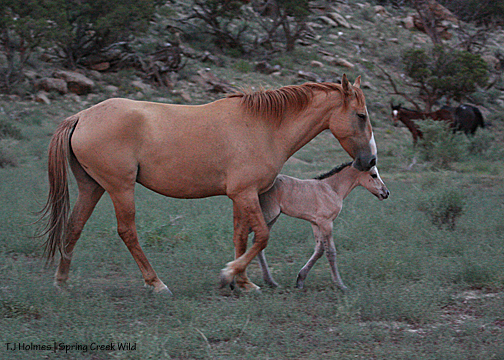
Baby girl and mama. Such a teeny thing, and mama looks fabulous! You can see big brother Apollo and his mama, Raven, in the background – Kreacher was just to the right of them. It was cloudy enough (and we’d already had several waves of light rain) that it was “dark” before it was dark. My camera was having a hard time “seeing,” but I was having a hard time putting it down! This was just after the sun had actually set … we got a teeny bit of light when the sun dropped out of the clouds … before it slipped back into clouds and around the curve of the world …

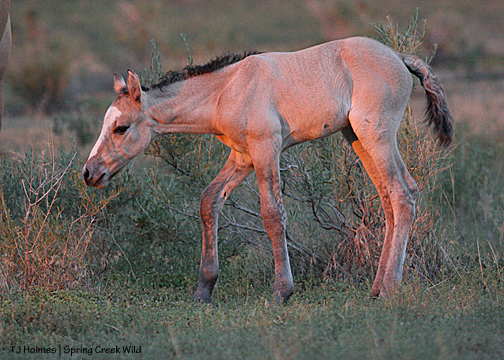
Baby girl in that soft little red glow that lasted just minutes. … And yes, I think she’ll stay dun. I don’t think this girl is destined to go grey. Notice Kootenai’s legs – she has the stripes, with that lovely “webby” sort of pattern, but they’re darker “orange” than the rest of her body coat, not dark or black, like Hollywood’s are.

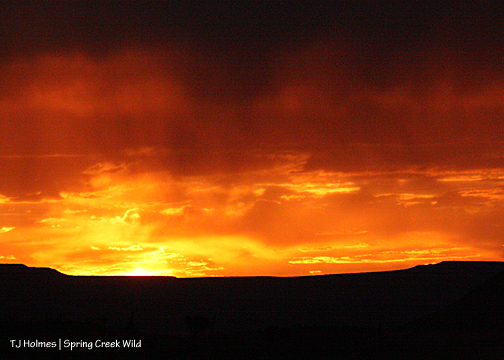
Can’t forget daddy Kreacher! Little bit of that glow on him, too, and lighting up the eastern “wall” of the basin … caused by …

Wow, right?!

Beautiful day to find a beautiful girl. 🙂


The roundup

25 08 2011

With the Spring Creek Basin roundup just about three weeks away, the time has come to address with more in-depth explanations what’s coming with regard to the Spring Creek Basin roundup. Along the same lines, I’d sure like to start discussions about what YOU are most interested in knowing. What are your concerns, fears, apprehensions regarding this roundup? I will answer as fully and candidly as possible – based on my knowledge. I can yak about things I *think* you’re interested in … but if you have something specific, please do ask. If I get enough questions, I may do a specific post, addressing each question, rather than leaving them in the comments sections.

My email – if you would rather not leave a public comment – is mtbgrrl (at) fone (dot) net.

A couple of disclaimers to start:

* I feel the need to explain this again: Because of the size of Spring Creek Basin (slightly less than 22,000 acres of high desert), it cannot support a population that is considered by many to be genetically viable on its own. Please don’t get carried away with some “certain” number that would make the Spring Creek Basin herd viable. The finite nature of the herd management area – and its water and forage resources – makes a population other than what the basin can physically support a moot point. To achieve that balance and maintain both herd and range health, this roundup and the removal of some horses is necessary.

* Because I will be working with BLM does not mean I am in full agreement with all its policies and/or procedures. In fact, quite a bit of the status quo that CAN be changed is what I am working very hard TO change. But we must work within the bounds of reality, and with that in mind, we have accomplished quite a bit here.

Follow this link to get to a PDF map of Spring Creek Basin Herd Management Area. Warning: It takes an obnoxiously long time to download – and I’m on a high-speed connection. Then, when it was “done,” it was black. I clicked the + button at the top to bring it into view. The blue line denotes the boundary of Spring Creek Basin, and the G at the western edge denotes the location of the trapsite.

So let’s talk about the roundup.

As a representative member of Disappointment Wild Bunch Partners and president of the Colorado chapter of the National Mustang Association, I will be involved with BLM during the roundup. As documenter of the herd, with specific knowledge of the horses, I will be intimately involved. This is not precedent-setting; it happens with at least three other herds I know of. It’s one of the things that most impressed me before I started documenting the Spring Creek Basin herd – and why I realized I had to make it happen here.

What it means is that I will be at the pens the entire time, attached at the hip, so to speak, to Jim Dollerschell, manager of the Little Book Cliffs herd, who will be at our roundup in the capacity of “contracting officer.” What that means in practical terms is that Jim has lots of experience, and Spring Creek Basin does not have a herd manager at present (though it is hoped one will be hired by the time of the roundup). Because of Jim’s specific experience as manager of the Little Book Cliffs herd – using native PZP successfully (their roundup this fall was canceled, remember) and working with an active and dedicated advocacy group (Friends of the Mustangs) – I am extremely grateful to be working with him, in particular.

My main duty will be to advise BLM about the identities of each horse captured, as well as advising BLM – and, in turn, the helicopter pilot, with whom Jim will be in contact via radio – of the identities of horses on the range, especially as it comes to bands that should NOT be targeted for roundup. Specifically, two of those bands will be Kreacher’s and Seven’s, which include Raven and Kootenai (in Kreacher’s band), and Mona (in Seven’s). The reasons here are two-fold: 1) Raven, Kootenai and Mona were introduced in 2008 for their genetics, needed in Spring Creek Basin to keep our own genetics strong. 2) Kootenai just had her foal, and Mona is due to foal Sept. 15, the day the roundup is scheduled to start. Beyond even what BLM says, it would, indeed, be a “PR nightmare” for very young foals to be killed during the roundup – especially when they’re *known.* The third band will be Ty’s, which includes yearling Puzzle and her dam, Chipeta, who is due to foal Sept. 1.

Bringing in by band

We have talked with BLM about bringing horses in by band – as opposed to large groups of unrelated horses. BLM has not made any promises whatsoever in this regard – I don’t believe it *can* make such promises. But the biggest problem, as I see it, is that no matter in what “organization” the horses come to the trapsite, they are immediately “processed” and sorted into gender-specific pens – in other words, separated from their families and put in with unfamiliar horses, which causes fighting among stallions as well as mares protecting foals. This has no bearing on the current roundup, but it’s worth saying: Keeping families together – until the point of actually selectively removing a particular horse or horses – is just one benefit of bait trapping. However, because of the very nature of the helicopter-driven roundups and related “efficiency,” I really don’t see how it could be done other than the way it will be done. (That it NEEDS to be done differently is one thing we’re working on!)

Dates/timing of release and number(s) of horses to be released

Some specifics here via what we learned at our meeting yesterday (Aug. 24): The horses to be released (including mares, who will get the PZP primer) will most likely be set free as soon as it is determined the roundup is over and no more horses will be captured. The roundup is scheduled to start Thursday, Sept. 15. Expectations are that it will last no more than a couple of days, but, of course, this is subject to on-the-ground realities such as weather conditions. Horses not going to adoption may be loaded onto trailers bound for Canon City by Saturday (Sept. 17), and the horses bound for adoption will be hauled to the fairgrounds Sunday (Sept. 18). I understand that’s because that is the soonest date the Montezuma County Fairgrounds will be available for them. The training demonstration by Ems Rapp and her Spring Creek Basin mustang, Rock On, will be held from 5 to 7 p.m. Friday, Sept. 23, with the adoption scheduled Sept. 24. The adoption details will be outlined in a separate post.

The contractor – Cattoor, same as in 2007 – is expected to arrive in Spring Creek Basin on Wednesday, Sept. 14, to set up, and the roundup is expected to start Thursday, Sept. 15. It is scheduled through Sept. 18, but it may or may not last that long, as noted above. BLM says about 10 horses likely will be released, but that number will depend entirely on the number of horses rounded up and the number left in the basin (not rounded up). We also have not specifically addressed how many horses will be left in the basin post-roundup. The low end of the AML is 35, but 43 were left in 2007 (unknown to BLM; the manager at the time thought 37 horses were left). We hope to use this precedent – as well as logic such as the use of PZP (with documented efficacy of at least 90 percent), no planned introductions of horses and the gender skewing – to leave at least this many horses after this roundup.

Mares to be released will be given the PZP primer (by Jim, hopefully with me being allowed to help) in the chute immediately before release. They will NOT be branded because of acknowledgment of my documentation – which will, of course, continue. (Of interest here is that BLM recently announced that it will pay for the PZP to be administered to Spring Creek Basin mares; NMA/CO had offered to pay for PZP for a period of five years (the expected length of the fertility control EA).)

In addition to saying it’s likely 10 horses will be released, BLM also says (in the Decision Record, at least) that the released horses will likely be six stallions and four mares. In a perfect world, that would represent a 60%/40% stallion-t0-mare ratio. In the real world, BLM cannot know (none of us can) what the make-up of the herd will be when BLM ends the roundup and prepares to release horses. In 2007, still espousing the gender-skewing goal, BLM released five mares, the weanling filly of one of those mares and four stallions (with Traveler released nearly a month later). As it turned out, there was still quite a significant split between mares and stallions. BLM had no idea then of the post-roundup stallion-to-mare ratio before it released those horses. This time, we’ll know – exactly – and the numbers/genders to be released can accurately reflect that. (To be clear, gender skewing is not something NMA/CO (at least) supports, but it was a battle we chose not to fight at this time.)

Contractor behavior

We also have repeatedly asked that the contractors give the horses time to settle in the first pen at the trapsite instead of being choused by the contractor’s cowboys using plastic bags on the ends of whips/sticks after the horses have just been run for miles and captured in pens and are then sent immediately into the chute for “processing.” Again, no promises have been made here – other than they will bring it up to the contractor. However, I believe this is behavior that should not be tolerated unless it is specifically warranted in a specific situation. Wild horses – like other wild animals – move away from pressure, a human being a great pressure. Example: At the last Little Book Cliffs roundup (also in 2007, just a few weeks after ours), only once did the volunteers need to use a plastic bag. Two very small bands came in together – as I recall, a stallion with one mare and a stallion with two mares (with a foal or yearling?). In the close confines of the alley leading to the pens, the bag was used to separate the stallions – then immediately put away.

Yelling and screaming and waving those things in the faces of wild horses that have just been on a terrifying run ahead of a helicopter and then penned with no way out is NOT the time to use it. We reiterated this plea at our meeting yesterday and will continue to do so.

Selection process

Now, about the “selection process,” the thought that prompted this post in the first place (much of this is pre-typed (though, I admit, oft-edited); I was waiting for information from yesterday’s meeting to post it). I want to emphasize here that this is MY philosophy, and based on MY knowledge of the Spring Creek Basin mustangs. This is necessarily tempered by the reality of what I think BLM is most likely to accept.

Part of my selection process is genetics, and the other real part of it is “adoptability.”

I’m going to address specific language in the Decision Record (and in the EA). (If you wonder why I use “roundup” instead of “gather” in my writing, it’s because this is, in fact, rounding up horses – capturing them against their will – sorting them and removing “excess.” “Gather” assumes some gentleness – some emotion. I can be emotional (and will be) as the day is long about these horses – my horses – but logic has gotten me this far, and it has earned me a reputation with local BLM that, in turn, earned me a place at the table (or at the pens). I defend the need for this roundup, but I absolutely will not call it a “gather.”)

According to the Decision Record: “Animals captured within the HMA would be removed using a selective removal strategy. Any horse gathered from outside the HMA would be removed and not relocated in the HMA. Selective removal criteria for the HMA include: (1) First Priority: Age Class – Four Years and Younger; (2) Second Priority: Age Class – Eleven to Nineteen Years Old; (3) Third Priority: Age Class Five to ten years old. Up to 10 of the captured wild horses would be released; of these, about 4 would be mares and about 6 would be studs.”

First, there are currently NO horses outside Spring Creek Basin, so I think this is formal language “just in case.” In 2007, several horses were outside the herd management area. One was moved into the herd area from private property and remains – David. One currently serves with the U.S. Border Patrol on the U.S.-Canada border from Washington state – Justice. (If you’ll allow me some pride … Justice also was one of the 10 Border Patrol mustangs that marched in President Obama’s inauguration parade – just 18 months after he was captured. (An FYI – he was aged at 10 by the contractors – and ripe for removal, no questions asked – but at Canon City, he was determined to be no older than 5.)) And about four horses were captured outside the southwest end of the basin.

Second, my strategy for “selective removal” is genetics-first – because I KNOW quite a bit of the genetics, especially of the adoptable-age horses. BLM goes with age because that’s what it knows (based on the contractor’s expertise in aging by teeth … which wasn’t all that great in 2007, as it turned out (even according to BLM)).

Third … which is related to second … is that I’ll be looking at a combination of genetics AND ages – especially as it relates to “adoptability” – or the fact that horses between the ages of 1 and 4 are most likely to be *offered* for adoption – especially locally, immediately after the roundup.

I will NOT make public the horses on the lists that I have given BLM, but these are the categories: STAY (I will say that Traveler and the introduced horses, at least, are on this list), should stay, can go, can go or can stay. This idea of having multiple lists came from Matt Dillon of the Pryor Mountain herd, to allow flexibility, and I think it’s excellent, so I adopted it (Matt has been a great inspiration over the years in many ways). Necessarily, maybe, the “can go or can stay” category has the most names.

*** Please (I really beg you), don’t appeal to me for your favorite horse(s). As important as I believe this duty to be, and as absolutely grateful as I am to our local BLM folks who have afforded me this opportunity, it’s going to just about kill me to make these decisions. I am trying to make decisions that I can defend logically, that BLM will accept and that will benefit the herd as a whole. Please, please do not make it any harder.

BLM says about half the horses rounded up will be offered for adoption and about half will be sent to Canon City. (Horses CAN be adopted from Canon City, and people can request halter (and saddle) training by inmates at the Canon City facility, to then be transported to the adopter’s home.) Realistically, this will depend on the number and make-up of the horses actually captured and removed.

BLM’s rationale for the half-half deal is that in 2007, only about 13 of the 32 available horses were adopted. As BLM says, it’s a bad economy, the horse market in general is in the tank, and the mustang-adoption market itself is down considerably from happier times.

But here’s “the rest of the (hi)story”: In 2006, BLM held a mustang adoption in Pagosa Springs, in southern Colorado, about 100 miles from the site of the 2007 adoption (it will be here again: Montezuma County Fairgrounds, on U.S. Highway 160 a few miles east of Cortez, Colo.). In 2005, a post-roundup adoption of Spring Creek Basin mustangs was held. So three adoptions in three years? That would tend to “saturate” even a bad market, yes? At the previous adoption – in 2000 – almost all the horses were adopted, according to NMA/CO memory. One of my goals for future sustainable management of this herd is to *create* a market for our Spring Creek Basin mustangs by making offerings somewhat “rare” – infrequent with few(er) horses.

BLM roundup information hot line

A BLM hot line will be available with information about the roundup: Tom Rice, associate manager of the Dolores Public Lands Office and deputy district ranger for the Dolores District of San Juan Public Lands, will update a message by about 10 p.m. each night about that day’s roundup activities. People can call that hot line at this number: (970) 882-6843 (his office number). The time will depend on the day’s activities and how soon he can get away to locate cell service. (Cell service within the basin – within the entire Disappointment Valley area – is bad at best.

I have thought about trying to figure out a way to post updates to the blog through my cell phone, and if I have a strong enough signal, I will surely do so. I am almost positive I won’t be able to post any photos until I return to civilization, which likely won’t be until at least Monday (Sept. 19). I plan to be at the roundup every single day, until the last horse is gone, the last panel is loaded and the second-to-last human being (me being the last) has left his dust on the road. I’ll apologize in advance for being publicly incommunicado during that time, but honestly, I won’t be thinking about the blog a whole lot.

Public observation

I want to talk about observation for a minute. This is a little up in the air with regard to FAA rules about safety of people (and horses) with proximity to the helicopter. In 2007, observers were situated on the rim of Spring Creek Canyon, above the creekbed through which the horses run on the way to the pens, and on a hill “behind” the pens – the route of the horses brought them to the pens almost directly in front of this hill. Until BLM talks with the contractor and pilot, we won’t know for sure where observers can be, but BLM told us that as of now, they plan to allow observation from the hill as before but probably not from the top of the canyon. Local BLM has told us they are committed to transparency, and close observation such as this has been a great thing about roundups here in the past.

Also, we have been told that in this age of “social media,” every/anyone can be considered a “journalist.” What that means in terms of the roundup is that media and public will be treated no differently. If the media can be in a spot, the public can be in that spot and vice versa.

BLM public information specialists are working on a flier/brochure about roundup/visiting etiquette that will be given to observers upon entrance to the basin. This is important: THE BASIN WILL NOT BE CLOSED DURING THE ROUNDUP – unless there is a safety issue. First flights each morning will likely begin around 7 a.m.

Safety

Another word (or more) about safety: An APHIS (Animal and Plant Health Inspection Service) veterinarian will be onsite, a veterinarian with a clinic in San Miguel County (most of the basin is in San Miguel County) will draw blood for Coggins testing, and a local Montezuma County veterinarian (Dr. Sue Grabbe, who has been present at the last two or so roundups) will be onsite again at the request of NMA/CO to observe the roundup for safety of the horses.

Transparency

Finally, I promise to be candid about the event. I won’t defend BLM and/or the contractor if something “untoward” happens – and/or I’ll explain the event/why it happened (such as the mare that was mistakenly put in with the stallions in 2007) – but neither will I allow attacks via this blog on any of them for doing their jobs. We – BLM and our own advocates – have made every effort to ensure this roundup runs as smoothly and as safely – for horses and for humans – as possible.

**********

This is going to be a difficult thing … but it’s something our groups have spent the last four years (specifically) working on to ensure that safety – and other management considerations such as fertility control implementation. Literally, we started almost immediately after the 2007 roundup. Nothing happens with government overnight, and it has taken every one of those years to get where we are now. We’re not done. We’re not going away.

It will always remain the priority of the Disappointment Wild Bunch Partners (and each of our individual groups) to maintain the highest level of welfare for our Spring Creek Basin mustangs.


Spring Creek Basin roundup EA

2 08 2011

Spring Creek Basin Wild Horse Herd 2011 Gather Plan Environmental Assessment   

The Bureau of Land Management issued the final environmental assessment and decision record for its gather plan for the wild horse population in the Spring Creek Basin Herd Management Area southwest of Norwood, Colo.

Beginning about Thursday, September 15, BLM will gather approximately 60 wild horses in the Herd Management Area, which is a 21,932 acre area managed for a healthy wild horse herd that is in balance with other resources and uses. The current estimated population of wild horses in the HMA is about 90. This number is based on ground survey completed in May 2011 by volunteers with the Four Corners Backcountry Horsemen and includes the 2011 foal crop.

The appropriate management level identified for the population in this HMA is between 35 to 65 wild horses. Up to 10 of the captured adult horses will be released to maintain herd population within the established appropriate management level. The application of the contraceptive porcine zona pellucida will be administered to the mares upon release.

Wild horse numbers have increased an average of 23 percent per year since the HMA was gathered in 2007, thereby reducing the frequency of gathers.

25 of the wild horses gathered will be available for adoption through BLM’s wild horse and burro program.  The adoption will be held at the Montezuma County Fairgrounds, east of Cortez, CO on Saturday, September 24th beginning at 9AM. Individuals interested in adopting a horse must meet corral and shelter requirements. These standards can be found by visiting the following website: https://www.blm.gov/adoptahorse/requirements.php

The wild horses not adopted will be placed in long-term pastures.

Link to the above information can be found at this website.

Link to the EA in PDF version can be found here: http://www.blm.gov/pgdata/etc/medialib/blm/co/field_offices/san_juan_public_lands/pdf.Par.10445.File.dat/DOI-BLM-CO-S010-2011-0062EA_7252011.pdf


Moving on …

2 08 2011

Editor’s note (warning): This is a fairly long post – all words, no pix. It combines some realities with some hopes, and hopefully, the overall message is, in fact, one of optimism. It’s a little “news” and a little “response” to “just leave them alone.” Again, I am no particular expert. I hold no degree in the areas of wild horse or range management (though I was briefly a range mgmt major). And I certainly have no expertise whatsoever about herd management areas other than Spring Creek Basin. For Spring Creek Basin, however, I will defend my extensive knowledge of both the range and the horses, based on near-weekly visits for almost the last four years. Sometimes you preach to the choir … and sometimes you have visitors. I do hope this doesn’t come across as preaching but rather my continuing dedication to education. Perhaps in wanting to avoid “preaching,” I’ve slacked on education, as I’ve heard that some don’t understand what we’re trying to do here. That does seem to make me appear an “expert” – in my own mind, at least – but other than my own common sense and observations, I really can’t claim that moniker.

The Jeep, my chariot of freedom, had a two-day stint at the mechanic’s last week, but I don’t think I’d have gone to the basin if I could have. Some emotions still too raw, the nature of Twister’s injury too … just *too much,* maybe. How could I go back and enjoy the others, knowing he wasn’t part of the whole, that which I enjoy so fiercely?

For part of my part in the coming roundup, I’m working on an ID book for BLM, with photos of each horse and basic info. Having as many photos as I do of everybody, it seems like it would be an easy task, but although I started my documentation project (how formal a description that seems now) with the goal of getting full photos of each horse showing markings and mane orientations, my photos in more recent years have left that goal far behind – and become somewhat unnecessary as I know each horse on sight and can specify most even from a considerable distance. I’ve been saving particular photos as I go along in a particular file, but I’m not THAT organized, so the labor in this ID book is to go back through photos – mostly using my blog-photo files to jog my memory and then finding the original photo from the date taken.

The days I wasn’t in the basin, before I got back the almost-fixed Jeep (it IS 11 years old, and it does have 280K miles on it, and I can’t bear the thought of parting with it) and drove into the mountains out my back door (which I’ve done only once this year?), I worked on the “book,” and I went through photos, and I think that process – those reminiscences of not only the horses themselves but the times spent with the horses – was a bigger healing help than I could have anticipated. Pictures are worth so ever much more than simply 1,000 words.

Time marches on … The roundup is less than two months away. I thought I was preparing myself for that particular loss … and then unexpected Twister … We take what comes, we find the good, the positive, and we move on. The horses would understand that, if we can’t.

I want people to know – again – that the roundup and removal of some Spring Creek Basin mustangs is necessary: Because of past management, because of current conditions, because we hope to institute better – sustainable – management with this event that eases the future and provides more for the well-being of the horses than for the convenience of humans. Because a roundup now, while the horses are in good condition, is better for them than going to the point where they are NOT in good condition (such as was the case last time). It’s also better for the finite range that sustains them – that will continue to sustain them.

The day of the evening I found Twister was a big day in Spring Creek Basin. Twelve people toured the basin with me, all but four of us BLM or Forest Service (management of San Juan Public Lands is “Service First,” which includes both Forest Service and BLM). This cannot be other than public information, so I’m “announcing” it here (it’s in the preliminary EA): Jim Dollerschell, manager of the Little Book Cliffs herd – the roundup of which was CANCELED this year because of the successful annual PZP darting program there – will be in charge of our roundup, the “contracting officer,” I think, is the particular title. I can’t tell you how relieved I am about this. Also, Wayne Werkmeister, much-vaunted former Spring Creek Basin herd manager from about 1990 to about 2000, will be involved closely with the roundup. Wayne is currently the Grand Junction Field Office’s associate field manager, so knows and works closely with Jim. The acting manager/district ranger of the Dolores Public Lands Office/Dolores District is Connie Clementson – also coming from the Grand Junction Field Office. Her insights about the ponds in Spring Creek Basin mirrored my own uneducated thoughts, and I’m also glad to have her involved with the office and this roundup. And of course, Tom Rice, associate manager/deputy district ranger of the Dolores Public Lands Office/Dolores District, will be in charge of the overall roundup/adoption activities. We haven’t known him long, but he has proved caring and capable, and we are thankful to be working with him.

Those folks and more attended the basin tour almost two weeks ago, along with two of our NMA/CO board members (plus me, la presidente) and two other members of Disappointment Wild Bunch Partners. Another thing that I particularly want people to be aware of is that our group(s) is working specifically and directly with BLM – as they are welcoming our knowledge – to make this roundup as smooth-running and safe as possible. Following the precedent(s) set by Friends of the Mustangs (Little Book Cliffs), Pryor Mountain Wild Mustang Center (Pryor Mountain) and Friends Of A Legacy (McCullough Peaks) – at least – so is Disappointment Wild Bunch Partners (National Mustang Association/Colorado, Four Corners Back Country Horsemen, Mesa Verde Back Country Horsemen and San Juan Mountains Association) working with BLM to ensure the long-term protection of the Spring Creek Basin herd of wild horses.

Our biggest accomplishment to date is the coming implementation of an annual PZP darting program in Spring Creek Basin – along the lines of the programs in place in the above-mentioned herds.

Warning: Here’s where I might start to get a little preachy: If you think wild horses – particularly those on particularly small, fenced, finite parcels of dry, dusty, wind-blown geography with poor vegetation and even poorer water quality and quantity – should be “left alone,” please think about it again – and rationally. Not just one elderly, poor-condition horse starves from lack of forage and/or water – they all do. Not just one part of an originally-poor range suffers the effects of overgrazing and erosion – it all does. The horses are in great condition, with no need to remove some? Would you instead wish the roundup on horses in poor condition – as was the case in 2007, with nearly 120 horses on the range – some of which were apparently so desperate for water and/or forage that they pushed through/over fences in search of those things necessary to their survival? Would you instead wish an “emergency roundup” on even more horses, say, 130 – as was the case in the 1990s, when the horses were so stressed by lack of forage that the added stress of a roundup killed many of them? Wayne is haunted by that. I am haunted by his telling.

Our groups have worked – intensely and often with massive frustration – since early 2008 to effect change for the Spring Creek Basin herd (and NMA/CO and 4CBCH have been working much longer than that). Sustainable management is not unattainable. It does take work – and preparation. We couldn’t accomplish all we set out to do (mineral bait trapping was high on our list) … but now that IS high on the list – BLM’s list. Roundups are costly, high-profile affairs that don’t often produce “good” news. With our help, the Dolores Public Lands Office is saying it wants sustainable management for the Spring Creek Basin herd – and it’s willing to accept the help we offer to get there.

That, my friends, is progress.

And with every start and stop along the loop, horses here, horses there, we proved it – and BLM, by their very presence and invitation to us a reaching out, proved it back.

I will relate one particular incident that I believe captured BLM’s attention. Early in the morning, before anyone else arrived, a helicopter flew low over the basin. I was visiting with Grey/Traveler’s band, who were napping under trees near the road in the north hills. When the sound of the helicopter reached us, the horses bolted. That’s something I can tell people … but until they see it for themselves …

Early in the tour, an hour and a half or so later, we were standing above Spring Creek Canyon and the trapsite when the helicopter flew back over the basin. Low enough to see, comment on.

About midway through the tour, we paused in the east pocket to look out at Bounce’s band … and Grey’s. While our caravan was stopped. Grey’s took off running again. “Do you think they’re running because of us?” No, no, it must be the proximity of Bounce’s band. Bounce’s band was much closer to Grey than we were – both bands at a considerable distance from us on the road.

Other horses were on the old (and now illegal) WSA road past Sorrel Flats – Iya and Cougar with Poco and Roach. When we drove on, Grey’s appeared around the back side of the “tree island.” Hmm. Because of us? Because of the line of vehicles (four, including my Jeep)? Surely not. I’ve never seen him do such a thing (though I must say I’m almost never in the company of other vehicles, let alone three others). We got stopped at an arroyo; Grey’s kept running south.

Down past the double ponds, up onto the S saddle that returns the view of the rest of the basin … and there they were again – still running. And I finally had to admit it was us – and the helicopter. On they went toward Round Top. Not a comfortable view of the basin’s most famous stallion and his family. (The next day, I finally saw his band as I was leaving – they were all the way over on the west side of Flat Top. I know these descriptions won’t mean much to most of you, but the point is that his band traveled an enormous distance, and though they didn’t run at the sight of me, they were still moving …)

Does that change my mind about the coming roundup? No. In fact, it hardens me to the necessity of it. Because without a roundup this year, when the horses are in good condition, we’d have one next year, when they’d probably NOT be in such good condition (and back in the 120-130 population range) – and what good would that be for THEM or for the range? And without starting a program to limit reproduction among the basin’s mares, we’d see this scenario play out again in just another few years – like it has all the previous times. And THAT is what I am trying to prevent: helicopters chasing horses and families being torn apart with frequent regularity.

Little Book Cliffs STOPPED its roundup because of its program to limit reproduction. Spring Creek Basin can – will – do the same. And in the future, mineral bait trapping is an effective way to selectively remove horses that, because of the lengthy period between roundups, will hopefully come to have a particular market.

The preliminary EA states: “Population modeling reflects that the implementation of fertility control and selective removal would result in slightly reduced growth rates of the wild horse population in the Spring Creek Basin HMA, when compared to selective removal alone. The model indicates that growth rates would not be so low as to cause risk to the population should fertility control be implemented. …” It goes on to compare native PZP and PZP-22 with no real understanding of the actual differences of the two outcomes – as demonstrated by studies of both native PZP and of PZP-22. It also seems to forget that native PZP has been in use far longer than BLM has been using it – and working to great efficacy … definitely greater than the “model” used for this EA.

Fertility control – in the form of native PZP (and, eventually, mineral bait trapping to selectively remove fewer horses) – can actually quite effectively reduce the growth rate of the wild horse population in Spring Creek Basin – compared or not with “selective removal,” which in this case isn’t particularly selective at all, requiring the helicopter-driven capture of most of the horses to make good choices about who to remove and who to leave to carry on the herd’s legacy. PZP darting and mineral bait trapping, therefore, can drive a sustainable management goal of less-frequent roundups as well as the removal of fewer horses – becoming the preferred management process for BLM’s Wild Horse & Burro Program, and we are optimistically involved in helping that dream become a reality.

Relationships between civilian advocates and BLM can be and are proving successful. On behalf of NMA/CO and the Wild Bunch, I am thankful to our local government officials who think so, too.


Shout out

11 07 2011

Thank you to all who commented on our preliminary EA for this fall’s roundup in Spring Creek Basin. Your support of our mustangs is very much appreciated!

Juniper & Winona


Down to the wire

10 07 2011

Comments on our preliminary EA for this fall’s roundup are due tomorrow – Monday, July 11. Comments from this preliminary document will form the basis of the final EA. If nothing else, and if you haven’t already, please send comments in support of “Alternative 1 – proposed action: Helicopter drive trap and capture up to 60 wild horses in order to remove 50 excess animals. Apply the contraceptive porcine zona pellucida (PZP) with annual boosters over the next five years, and establish a 60% male sex ratio.”

Cinch

Details: Mail to Tom Rice, BLM Associate Field Office Manager, 27501 Highway 184, Dolores, CO 81323, or email to trice@blm.gov. For more information, call Tom Rice at (970) 882-6843. Comments are most helpful if they are specific to Spring Creek Basin Herd Management Area and to the proposed gather activities described in the Alternatives section of the EA. Comments received in response to this solicitation, including names and addresses, will be part of the public record.

Hacho & Maiku

We have worked hard – almost four years, since the last roundup in 2007 – to get to this point. Is there more work to do? Of course there is – management has goals, but good management has no end point – it evolves. Right now, this is the next step on the path to sustainable management for the mustangs of Spring Creek Basin. Do we wish bait trapping was being used over the helicopter? Of course we do. We worked on that, and for a variety of reasons, that plan did not come to fruition for this roundup. We’re also working on the gender skewing issue. Sixty percent stallions is actually better than it was after 2007 – and now we know the exact makeup of the herd to ensure it’s no more than that.

Whisper & Aurora

But annual PZP darting is a huge, integral part of the new management plan – and that IS being implemented at this roundup. This is a giant step, and it represents numerous steps in a process that at times has been massively frustrating, and it heralds a valuable new partnership between our advocacy groups (National Mustang Association/Colorado, Four Corners Back Country Horsemen, Mesa Verde Back Country Horsemen – as individual groups and collectively as Disappointment Wild Bunch Partners (which also includes San Juan Mountains Association)) and the Dolores Public Lands Office, managing agency for Spring Creek Basin Herd Management Area. Representative volunteers from these groups will be actively involved at both the roundup and adoption.

To clarify some concerns I’ve heard from people: We are NOT using PZP-22 here again; we are using native PZP, delivered annually via dart. No stallions will be returned to the basin as geldings. Cattle grazing in the basin is NOT part of the current EA – which pertains to the roundup only.

Sustainable management means managing wild horses in the wild. Doing that means reducing population growth. The means to do that is within reach. Please support Alternative 1.

Varoujan


Preliminary roundup EA – comments due Monday

8 07 2011

A reminder that comments for the preliminary EA for the scheduled roundup this fall of Spring Creek Basin are due Monday, July 11.

Here’s a link to my previously posted thoughts about this preliminary EA and a request for folks to get their comments in. Again, this roundup and the removal of some horses IS necessary this year. Visitors can attest to how dry it is in the basin, and we’re nearing capacity for what this range can sustain in numbers of horses. Please support “Alternative 1 – Proposed Action: Helicopter drive trap and capture up to 60 wild horses in order to remove 50 excess animals. Apply the contraceptive porcine zona pellucida (PZP) with annual boosters over the next five years, and establish a 60% male sex ratio.”

https://springcreekwild.wordpress.com/2011/06/28/thoughts-on-the-preliminary-ea-for-scb-roundup/


Happy Independence Day!

3 07 2011

What cost, freedom? What value? What would we do to preserve it?

That others fought and fell – fight and fall – so we may live independent of tyranny and oppression, we must never forget.


Thoughts on the preliminary EA for SCB roundup

28 06 2011

With less than two weeks before comments are due for the preliminary EA for the Spring Creek Basin roundup this fall, some thoughts.

First, here’s the link to the preliminary EA.

And here is information about where to send your comments.

I’ve been reading over the preliminary EA for our roundup this fall, and our groups (National Mustang Association/Colorado, Four Corners Back Country Horsemen and Mesa Verde Back Country Horsemen – singularly, and collectively as Disappointment Wild Bunch Partners) propose to support “Alternative 1 – Proposed Action: Helicopter drive trap and capture up to 60 wild horses in order to remove 50 excess animals. Apply the contraceptive porcine zona pellucida (PZP) with annual boosters over the next five years, and establish a 60% male sex ratio.”

A roundup IS necessary in Spring Creek Basin with the attendant removal of some horses for the benefit of the herd as a whole and for the finite, fenced environment on which they depend.

Notice that this preliminary EA is for the roundup, not specifically and/or separately for fertility control. I/we thought that was coming in a combined EA, but that’s apparently not the case. The fertility control EA will have to be much more complete – along the lines of the Pryor Mountain Wild Horse Range Fertility Control Environmental Assessment, but there are some things that need to be addressed in the roundup preliminary EA as presented.

Some of my concerns about our preliminary EA:

* Application of PZP: All the mares will need to be treated with primer this fall (primer, not “primary”), not just the mares captured and released. Hopefully, that’s just an oversight in this prelim EA because I’ve been talking about that all along. Also, I wonder when the number of mares to be “treated” fell from 10 to five? This has never been discussed with us by BLM. Note, it’s still “10” on the roundup schedule, even though the number of horses to be captured/removed varies between this preliminary EA (round up 60/remove 50) and the roundup schedule (round up 65/remove 45) – and has changed from the original roundup schedule (round up 90/remove 60). I was never sure where the number 10 came from originally (in fact, this was the first glimmer we had that BLM was planning fertility control here), and I’m making the possibly erroneous assumption that that’s the number of mares BLM thinks to give the booster (as opposed to the primer … but given the information about PZP, the EA writer is unfamiliar with PZP at all) … The point is, that number from BLM is premature; no one knows the post-roundup makeup of the herd or number of total mares, and there is no herd manager or approved fertility control plan in place to dictate for certain one way or another. As it says about gender skewing in this preliminary EA: “It is impossible to determine the sex ratio of captured horses until the gather takes place.” (Page 12, third full paragraph) It also is impossible to determine the number of mares to be boostered (or even given the primer) until the roundup is complete and the number of horses and makeup of the herd is known. But to implement the program, it is necessary to treat all the mares with the primer. They get it just once in their lifetimes, but they have to get it before the booster can be given the first time. The primer needs to be given even if the mare will not be boostered next spring. In the future, we will have a seasonal application plan of boostering selected mares in the late winter/early spring and giving primer doses in the fall to maturing fillies. NMA/CO will pay for the PZP (primer and booster doses) for the first five years. This should not be a problem, and it should not have been overlooked in this preliminary EA.

* Low range of AML: This preliminary EA continually mentions taking the population back to the bottom range of the AML – 35 (AML is 35 to 65 adult horses). We also have repeatedly argued against that, especially with the implementation of an annual PZP darting program. Based on the precedent in Spring Creek Basin of leaving 43 horses after the last roundup and the PMWHR statement that their “Decision Record” states “The population will not be taken to the low range of AML when fertility control is utilized” (top of Page 3), I’d like to see that acknowledged here, especially with the continuation of gender skewing. Even with gender skewing (apparently even less than this prelim EA proposes – gender skewing was said to be 55% stallions/45% mares post-2007 roundup and is planned to be 60% stallions/40% mares this fall), and the PZP-22 that was administered to the released mares in 2007 not working (it worked on one mare; two of the original five have since died), and the introduction of three mares (from Sand Wash Basin, for their genetics) between the last roundup and currently (and three foals produced by two of the mares), we still went four years before a roundup. There’s no rational reason to remove more horses than necessary given BLM’s troubled Wild Horse & Burro Program and all the horses in holding. In fact, rational reason dictates managing horses in the wild as much as possible and appropriate – as is the case here. So our suggestion is for BLM to leave 40-45 horses after this roundup, in conjunction with the annual PZP darting and their 60/40 gender skew. We do not plan to contest the gender skewing – partly because I think it will fall on deaf ears and so it’s not a battle worth fighting at this time, and partly because, if we are given enough time and not hampered in our ability to prove the efficacy of PZP here, it should naturally skew back to normal (and I’m curious enough to see that happen).

* Modeled population growth: Also, I’m disappointed that BLM’s “Win Equus” model of population growth and this preliminary EA seem to present a token use of PZP rather than making full use of it in a plan of sustainable management that will actually save BLM money and labor and us horses. This preliminary EA suggests status quo (even with the use of PZP and gender skewing): the continuation of roundups every few years – three per 10 years (2011, 2016 and, presumably, 2021) – as was done in 2001, 2005 and 2007. Why? Just five years between this roundup and the next? Why? My proposal shows that it’s possible to reduce roundups here from three per decade to one – with all the attendant cost savings, in roundups (lack thereof; this would amount to at least $150,000 in savings per decade in roundups NOT held), and horses going to holding (lack thereof; this is by far the biggest savings over time, at least $2 million saved in horses NOT removed and sent to holding during the decade). So BLM is already anticipating that PZP won’t work? Or that it won’t use the PZP well enough to be as beneficial as it could be? With a roundup in 2011, the next anticipated roundup (by BLM) – indicated by this preliminary EA – will be in 2016 (Page 31) and, presumably, one to follow in 2021, that’s three per decade – exactly what we’re trying to prevent.

Again, reviewing some precedents to the above issues: In 2007, BLM left 43 horses (remember, low end of the AML is 35). Pryor Mountain, in its fertility control EA (which, again, we do NOT yet have here …), says that when PZP is used, the herd population does NOT need to be reduced to the low end of the AML. Mention is made in our EA (Page 12) that it is “impossible to determine the sex ratio of captured horses until the gather takes place.” By all logic, it also is impossible to know how many mares to treat post-roundup with PZP – other than with primer, and this number should be “all.” 😉

A concern raised specifically by our Colorado chapter of the National Mustang Association is the lack of mention of our group’s longtime role in advocating for these particular mustangs – about 15 years’ worth.

On page 41, the preliminary EA states: “The Four Corners Back Country Horsemen has helped obtain horse counts in the Spring Creek Basin HMA for several consecutive years (I believe this is at least 12 years). They also have been consulted regarding the proposed gather and subsequent local adoption. Some members have expressed an interest in observing the gather but none have expressed any specific concerns relative to the gather or the adoption.”

I guess I can’t speak for 4CBCH, but NMA/CO and MVBCH have expressed concerns – members of both our groups made comments at the public hearing. Not mentioned? Why? Also, although 4CBCH has, indeed, conducted counts all these years, BLM has not very often taken their counts into account. Case in point: In February 2007, a flyover was conducted during which two BLM personnel (the then-current herd area manager and the previous herd area manager) counted horses. They each (separately, we were told) observed “97 horses.” In May that year, during their annual count, 4CBCH counted about 120 horses. Based on my knowledge of the 2007 roundup and subsequent documents and my own documentation, there were between 110 and 120 horses in the herd. Based on the numbers in this preliminary EA we’re now discussing, there were at least 118 horses present in the herd pre-roundup 2007. 4CBCH just about nailed it – but was discounted.

In the paragraph above the aforementioned, it states: “A local wild horse advocacy group the Disappointment Wild Bunch [Partners] (affiliated with the Colorado Chapter of the National Mustang Association (NMA)), has worked closely with BLM on several projects and have been consulted regarding both the proposed gather and the adoption planned immediately afterward at the Montezuma County Fairgrounds. In ” (One wonders what got cut out …)

Correctly, NMA/CO is one of the represented groups that make up Disappointment Wild Bunch Partners. Each group holds equal representation as a stakeholder in the welfare and well-being of the Spring Creek Basin wild horse herd. NMA/CO was formed at the request of a former BLM herd area manager (surprise?) and is the longest-serving advocate of the Spring Creek Basin herd.

Also, no mention is made of the specific, extensive documentation project conducted (by yours truly) that enables – finally – a sustainable management plan for this herd – and would allow for NOT BRANDING PZP-treated mares. This hasn’t been mentioned, but it’s a lingering concern. NMA/CO, 4CBCH and MVBCH have been the foundation and support of the documentation work I’ve been able to do to reach this point. Nationwide, BLM hasn’t been able to figure out a sustainable management plan in 40 years (euthanization, sterilization, tens of thousands of horses in holding, more being rounded up, HMAs and HAs zeroed out/reduced in size … need I say more?!) – though some individual herds have and are on that path (Little Book Cliffs, Pryor Mountain, McCullough Peaks). Now we have been able to, in less than three years, hand BLM a sustainable management plan on a silver platter. We had hoped bait trapping would be the method of this roundup … but that’s another story … and it’s likely coming in the future.

I’m extremely proud of the accomplishments we’ve made, and I’m cautiously optimistic for the future (I say that a lot; it has been a frustrating journey in many ways). We have a lot more work to do, but we’re here, we’re obviously not going away, and we will continue to advocate for the sustainable future of our Spring Creek Basin mustangs.
Again, with any questions, please contact me by leaving a comment or email me at mtbgrrl (at) fone (dot) net. If you’re a long-time reader of this blog and enjoyer of these mustangs, you are aware of most of the unique components of this herd and how/why we’ve arrived at this point. If not, I’ll be happy to explain some of the “back story” in more detail. Thank you with all appreciation for your support of our Spring Creek Basin mustangs.


Oppose sterilization

24 06 2011

Sterilizing wild horses is NOT management. BLM has apparently “reconsidered” spaying mares in two Wyoming herds (White Mountain and Little Colorado) but plans to continue with the gelding of stallions.

No, no and NO.

http://org2.democracyinaction.org/o/6931/t/0/blastContent.jsp?email_blast_KEY=1168526

Why BLM in general *won’t* come up with sustainable management plans is beyond me. It talks about that often enough. In fact, we’ve effected change here by showing local BLM just how workable sustainable management can be. In 40 years, things have gone from bad to worse with these hare-brained ideas apparently designed to allow BLM to do little to nothing about their responsibility to wild horses and burros AND the American public for whom mustangs and burros are managed. And yet, when I talk about fertility control in the form of REVERSIBLE PZP, people invariably ask: “Why don’t they just geld the stallions and return them?”

* Horribly invasive.

* Horses must be rounded up and captured to do it.

* Horses must (?!) be held in corrals while they heal.

* Complications?? One of the introduced Spring Creek Basin stallions (three were introduced in the late 1980s or so) was later removed to a sanctuary, where he was gelded … and bled out … How often does this happen insanitary conditions? In a temporary pen full of other horses in dusty range conditions …??

* If I wanted to see a pasture – no matter the size – of geldings, I’d take a drive up the road to see ranch horses. Talk about upsetting the natural dynamic of wild and free-roaming (as much as possible) horses.

In contrast, fertility control such as PZP is reversible. By its use, we’re not trying to stop population growth, just limit it to sustainable levels. Periodic removals will still occur but with less frequency and hopefully on a much smaller scale than currently. While I fully appreciate that annual darting is not feasible or even possible in many large areas, where it IS, it should be used.

As adamantly as I support limiting population growth, I am adamantly opposed to stopping it altogether.