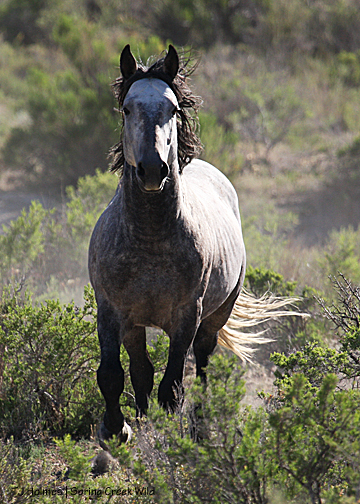
Oppose sterilization

24 06 2011

Sterilizing wild horses is NOT management. BLM has apparently “reconsidered” spaying mares in two Wyoming herds (White Mountain and Little Colorado) but plans to continue with the gelding of stallions.

No, no and NO.

http://org2.democracyinaction.org/o/6931/t/0/blastContent.jsp?email_blast_KEY=1168526

Why BLM in general *won’t* come up with sustainable management plans is beyond me. It talks about that often enough. In fact, we’ve effected change here by showing local BLM just how workable sustainable management can be. In 40 years, things have gone from bad to worse with these hare-brained ideas apparently designed to allow BLM to do little to nothing about their responsibility to wild horses and burros AND the American public for whom mustangs and burros are managed. And yet, when I talk about fertility control in the form of REVERSIBLE PZP, people invariably ask: “Why don’t they just geld the stallions and return them?”

* Horribly invasive.

* Horses must be rounded up and captured to do it.

* Horses must (?!) be held in corrals while they heal.

* Complications?? One of the introduced Spring Creek Basin stallions (three were introduced in the late 1980s or so) was later removed to a sanctuary, where he was gelded … and bled out … How often does this happen insanitary conditions? In a temporary pen full of other horses in dusty range conditions …??

* If I wanted to see a pasture – no matter the size – of geldings, I’d take a drive up the road to see ranch horses. Talk about upsetting the natural dynamic of wild and free-roaming (as much as possible) horses.

In contrast, fertility control such as PZP is reversible. By its use, we’re not trying to stop population growth, just limit it to sustainable levels. Periodic removals will still occur but with less frequency and hopefully on a much smaller scale than currently. While I fully appreciate that annual darting is not feasible or even possible in many large areas, where it IS, it should be used.

As adamantly as I support limiting population growth, I am adamantly opposed to stopping it altogether.


Insanity in Wyoming

17 06 2011

I saw this news just before I left for the basin this week … to visit with wild horses and their foals. BLM officials for two Wyoming wild horse herds – White Mountain and Little Colorado – plan to make the herds completely sterile, non-reproducing and totally unnatural.

Pam Nickoles has information on her blog with this post.

This sort of death knell to rational – sustainable – management cannot be allowed to be set as precedent. Slow population growth, don’t stop it.

As readers of this blog are aware, I am a huge proponent of native PZP, and we plan to implement such a plan of annual darting here this fall. I am absolutely against sterilization of wild horses (and burros).

Please visit Pam’s blog for all the pertinent contact information to urge AGAINST sterilization of these herds (of any herds).


EA out for roundup

10 06 2011

Preliminary Spring Creek Basin Wild Horse Herd Gather Environmental Assessment available for comment

The Bureau of Land Management is seeking public comments on a preliminary Environmental Assessment, which analyzes the environmental consequences of removing up to 50 excess wild horses from the Spring Creek Basin Herd Management Area on BLM lands located in San Miguel and Dolores counties, about 45 miles northeast of Dove Creek, Colo., and 33 miles southwest of Norwood, Colo., off San Miguel County Road 19Q. The document is tiered to the 1994 BLM Spring Creek Basin Herd Management Area Management Plan and the 1985 San Juan/San Miguel Resource Management Plan.

The Proposed Action would gather about 60 and remove approximately 50 excess wild horses from within and outside (if necessary) the Spring Creek Basin Herd Management Area in mid-September 2011 (the roundup is now scheduled from Sept. 15-18). Horses would be removed using a selective removal strategy.  In keeping with BLM guidance, fertility control options are also being evaluated.  

Comments must be received by close of business on Friday, July 11, 2011, and should be mailed to Tom Rice, BLM Associate Field Office Manager, 27501 Highway 184, Dolores, CO 81323 or emailed to trice@blm.gov. For more information, please contact Tom Rice at (970) 882-6843. Comments are most helpful if they are specific to the Spring Creek Basin Herd Management Area and to the proposed gather activities described in the Alternatives section of the EA. Comments received in response to this solicitation, including names and addresses, will be part of the public record. Link to PDF : Preliminary Spring Creek Basin Wild Horse 2011 Gather Plan EA

[NOTE: The EA link referred to above is not actually set as a hyperlink right now, but this is the link to the San Juan Public Lands website for the above information: http://www.blm.gov/co/st/en/fo/sjplc.html 

Please also note that the correct name of our herd area is Spring Creek Basin Herd Management Area, not “Spring Creek Wild Horse Herd Management Area.”

**I’ve changed it above to reflect the correct name.]

UPDATE: Here is the link to the actual preliminary EA for the 2011 Spring Creek Basin Herd Management Area Gather Plan.


Wild horses as natives!

7 06 2011

http://www.katu.com/news/national/123199993.html

Are wild horses native to the U.S.? BLM roundups challenged

RENO, Nev. (AP) – American history textbooks teach generation after generation that the wild horses roaming the Western plains originated as a result of the European explorers and settlers who first ventured across the ocean and into the frontier.

But that theory is being challenged more strongly than ever before at archaeological digs, university labs and federal courtrooms as horse protection advocates battle the U.S. government over roundups of thousands of mustangs they say have not only a legal right but a native claim to the rangeland.

The group In Defense of Animals and others are pressing a case in the 9th U.S. Circuit Court of Appeals that maintains wild horses roamed the West about 1.5 million years ago and didn’t disappear until as recently as 7,600 years ago. More importantly, they say, a growing stockpile of DNA evidence shows conclusively that today’s horses are genetically linked to those ancient ancestors.

The new way of thinking could carry significant ramifications across hundreds millions of acres in the West where the U.S. Bureau of Land Management divides up livestock grazing allotments based partly on the belief the horses are no more native to those lands than are the cattle brought to North America centuries ago.

Rachel Fazio, a lawyer for the plaintiffs, told a three-judge appellate panel in San Francisco earlier this year that the horses are “an integral part of the environment.”

“As much as the BLM would like to see them as not, they are actually a native species. They are tied to this land,” she said. “There would not be a horse but for North America. Every single evolutionary iteration of the horse is found here and only here.”

Judge Mary Schroeder, former chief of the circuit, asked: “Just like polar bears?”

“Yes,” Fazio answered, “they belong there.”

The lawsuit cites researchers who say the most recent science backs her up and that the concept is widely accepted by most of the scientific community, with the most notable exception being the BLM itself.

“It’s significant because BLM treats the wild horses like they are an invasive species that is not supposed to be out there,” Fazio said in a recent interview with The Associated Press.

A reversal of that long-held belief could have the effect of moving the native horses to the front of the line when divvying up the precious water and forage in the arid West.

BLM maintains the horse advocates are perpetuating a myth and many ranchers claim it’s part of a ploy to push livestock off public lands.

“There are plenty of horses out in the Nevada desert,” said Tom Collins, a Clark County commissioner who has a ranch outside of Las Vegas and has run cattle on U.S. lands in Arizona, Idaho and Utah.

“Most of these folks, maybe their father slapped them or their mother didn’t love them, so now they are in love with these wild horses that aren’t really wild,” he said

BLM devotes “Myth No. 11” on its Web site to the “false claim” that wild horses are native to the United States.

“American wild horses are descended from domestic horses, some of some of which were brought over by European explorers in the late 15th and 16th centuries, plus others that were imported from Europe and were released or escaped captivity in modern times,” it says.

“The disappearance of the horse from the Western Hemisphere for 10,000 years supports the position that today’s wild horses cannot be considered `native’ in any meaningful historical sense,” BLM explains. It acknowledges the horses have adapted successfully to the Western range, but biologically they did not evolve on the North American continent

Jay F. Kirkpatrick, a leader in horse reproduction research who directs ZooMontana’s Science and Conservation Center in Billings, Mont., is among those who say BLM’s view is outdated.

“On the face of the science, it is just absolutely incorrect,” said Kirkpatrick, who has studied reproductive physiology for decades since earning his degree at the College of Veterinary Medicine at Cornell University.

“It wasn’t the predominant horse on the continent but it was here. It is native to North America,” he told AP.

Kirkpatrick, who actually supports roundups as a necessary tool to control herd populations, said the key to determining if an animal is native is where it originated and whether or not it co-evolved with its habitat.

The mustangs “did both, here in North America,” he said, beginning about 1.4 million years ago. He said they eventually crossed the Siberian land bridge into Asia before going extinct locally as recently as 7,600 years ago.

“This isn’t about history, it’s about biology,’ Kirkpatrick said. “The Spanish were bringing them home.”

Ross MacPhee, curator of the Department of Mammalogy at the American Museum of Natural History in New York, agrees. He said the mustangs are classified as Equus caballus, which “evolved from more primitive forebears” in North America.

“There is therefore no question that it is `native’ within any reasonable meaning of that word – much more so than bison, for example, whose immediate ancestry is Asian,” MacPhee said. “Yes, it disappeared from our shores for a few thousand years, but that has no bearing scientifically on whether it is historically `native.”

BLM officials said they can’t comment on pending litigation, but referred AP to their Web site descriptions and a leading scientist who agrees the agency’s version is closer to the truth.

“Horses did evolve in North America but they went extinct 10,000 years ago,” said Michael Hutchins, executive director of the Wildlife Society, a nonprofit scientific and educational association in Bethesda, Md.

Today’s mustangs are “a domesticated, feral version that had gone through many, many generations of selective breeding to use as beasts of burden and were brought back to North America,” he told AP. “They are a mishmash of domestic horses. They are not native. They are not wild horses.”

If they are native, then so too are camels, cheetahs and lions that roamed the continent before extinction about the same time, Hutchins said. But they are not, he said, partly because the same ecological conditions no longer exist, the climate changed and most big predators gone.

Kirkpatrick said Europe’s domestication of the horse over about 6,000 years may have changed the nuclear makeup of some genes but “it remains the same species and retains the same social organization and social behaviors that evolved over 1.4 million years.”

“It matters not a Tinker’s Damn if the ecology has changed,” he said. “E. Caballus is the same species that disappeared.”

The case pending in the 9th Circuit could go a long way toward determining future management of the animals and has the potential to send BLM back to the scientific drawing board before it can resume seasonal roundups of thousands of mustangs it says are damaging the environment.

The case already has cleared an unprecedented legal hurdle in that the appellate court is entertaining arguments about the merits of the law at all.

In previous similar challenges, courts have denied requests for emergency injunctions to block pending roundups based on conclusions plaintiffs failed to prove significant harm was imminent and/or they were likely to ultimately succeed in proving the government broke the law.

Then in a sort of “Catch-22,” by the time a non-emergency hearing arrives, the BLM already has completed the roundup and persuades the judge the case is moot, any damage already done.

But that may be changing.

David Schildton, a Justice Department lawyer representing BLM, was following that script when he told the Ninth Circuit panel in January that “a live controversy” would have to exist for the court to act.

“And since the gather has already occurred and approximately seven horses were humanely destroyed because of pre-existing conditions, I don’t know that there is effective relief,” he said.

Not necessarily, said Judge Johnnie Rawlinson.

“The remainder of the horses could be returned,” she said. “The overall claim for relief is these horses were being taken from their native habitat. If the horses are being housed at a long-term or short-term facility, they could be reinstated to their native habitat.”

The 9th Circuit ruling is still pending. But the judge in Sacramento who denied the original bid in September to block a 1,700-horse roundup in the Twin Peaks area along the California-Nevada line adopted a similar position in April when he refused BLM’s request to dismiss the case.

U.S. District Judge Morrison England Jr. ruled it could go forward because “effective relief can still be granted” if plaintiffs prove BLM violated the National Environmental Policy Act or the Wild and Free-Roaming Horses and Burros Act of 1971.

“This court could conceivably provide relief in the form of an order returning all animals in … holding facilities to either Twin Peaks or the West until all requirements of NEPA are met,” he said.

BLM agrees Congress wants the horses treated as part of the environment, Schildton said, but the focus should be on protecting the land itself not affording the horses special treatment.

“They are not an endangered species,” Schildton said. “The effect on the horses themselves would be part of the environmental study… but the ultimate question is, `Does this proposal bring about a significant environmental impact?”‘

Fazio said BLM misinterprets the law.

“The whole purpose of this act is to protect the wild horses from capture, harassment, branding and death,” she said. “Multiple use if fine, but where lands are designated for horses – this icon of the West, this embodiment of freedom – you have to make a priority out of protecting them.”


Another virus update, per BLM

27 05 2011

I got this release from Tom Rice, our local BLM chief. Please pass it on as appropriate.

If you haven’t yet heard about this outbreak, click here for a Durango Herald article about it that ran about a week ago and here for a follow-up article.

From the first article: “The disease is highly contagious and can cause respiratory problems, neurologic disease and death. There is no cure, though symptoms may be treatable, officials said.”

Little Book Cliffs Wild Horse Range officials already had limited access to the range by domestic horses with a deadline of today. Not sure whether that’s being extended.

BLM Statement on Outbreak of Equine Herpes Virus (EHV-1)

The BLM is aware of the recent outbreak of neurologic disease caused by the equine herpes virus (EHV-1) in the western United States. The Bureau has been working with state and federal animal health officials to help protect the health and well-being of wild horses and burros on the range, along with those in BLM holding facilities.

No BLM-managed wild horses or burros on the range or at BLM facilities are known to have been exposed or affected by the neurologic EHV-1 outbreak at this time. However, the Bureau is consulting and coordinating with animal health officials regarding the movement of wild horses and burros, as well as the scheduling of events such as adoptions that may place horses and burros in contact with horses, burros, or their owners in the domestic horse community. Some lower-risk movements between BLM facilities or BLM facilities and adoption events will continue. Other movements may be canceled because of concerns regarding potential exposure to EHV-1.

At this time, decisions will be made on a local, case-by-case basis in consultation with the BLM’s attending veterinarians and the state veterinarians in the area. All BLM horses and burros that travel interstate do so with valid Certificates of Veterinary Inspection (health certificates) and in accordance with state and federal animal health regulations. The BLM asks the public to be aware of disease transmission risks and to contact local BLM offices to see if there are any restrictions in place before bringing domestic horses onto BLM-managed public lands.


Wild Horse Inmate Program’s 25th anniversary

22 05 2011

From the BLM website about the 25th anniversary of the wild horse inmate training program at Canon City, which is going on today (started yesterday): “This year marks the 25th anniversary of Colorado’s Wild Horse Inmate Program in Canon City. To celebrate, the BLM is hosting an event in Golden to draw attention to the program and highlight how the program has contributed to the community.

“In the last 25 years, the WHIP in Canon City has contributed enormously to the community. Those contributions include inmate rehabilitation and job training, national security along the border, and training opportunities for new riders.”

For more information, visit http://www.blm.gov/co/st/en/BLM_Programs/wild_horse_and_burro/whip_25_anniversary.html

I do hope it’s a successful event, with lots of horses adopted. One of our Spring Creek Basin mustangs, who went through the program at Canon City is currently serving at a Border Patrol station in Colville, Wash. In fact, he was one of 10 mustangs that participated in the inauguration parade for President Barack Obama less than 18 months after he was rounded up. We’re extremely proud of our Justice – and all the mustangs serving on our country’s borders (our Kootenai was named after a Sand Wash Basin cousin, also serving on the northern border).

Also, the Colorado chapter of the National Mustang Association has contributed to the program over the years with donations of magazines and boots for the inmates. I visited the facility in August 2007 after our roundup, when we were allowed to identify Grey/Traveler, who was not identified during the roundup and was mistakenly removed and taken to Canon City, and bring him home. That story has a happy outcome, and we’re forever grateful to Fran Ackley, Wild Horse & Burro Program lead for BLM in Colorado, for making that happen.

If any readers attend the events at Canon City, please leave a comment and let us know how it went.


Greetings, new!

15 05 2011

‘Twas a charmed visit, my friends! Three glorious days with my beloved mustangs … transcended to heaven, was I. Let me show you what I mean (prepare ye for extreme cuteness overload):

Meet Boreas, son of Two Boots and Chrome. I didn’t expect to meet him this week … in fact, of the mares due, Two Boots was pushing the edge of that. In another fact, she’s about a week early with this little mister – not that I’m complaining! I found them almost as soon as I drove into the basin. I’m sure the little was born earlier that morning. Boreas is the Greek god of the north wind, and there’s some interesting equine mythology associated with him.

No name yet for this little girl, the daughter of Mahogany and Sundance. As it turns out, Sundance finally lost Mahogany to Aspen between the time I took this pic and the next morning. He’s cut and bruised and sore, but he’ll be OK. She looks a lot like Briosa. A long-time theory I held was that Piedra was possibly Mahogany’s daughter … like daughter, like granddaughter? (I have to say, though, that neither Sage nor Tenaz look anything like any of Mahogany’s other offspring). As last year seemed to be the year for bay babies, so far we have two sorrels (that I think will stay sorrel), a silver buckskin and a few brownish to darkish foals that will turn grey, one black that I think is true black – oh yeah, and this next big boy! – our first bay of this year:

This strapping big boy is Raven’s and Kreacher’s son – his second-born (Shane (dam: Mona) is his firstborn), but it appears he’ll be the first Kreacher will raise in his band (Mona and Shane have been with Seven since Shane was born; Corona, who is not Kreacher’s daughter, was with Duke the first six months of her life). Raven is extremely protective of this big guy, but she allowed me to spend a wonderful evening with the family soaking in the gorgeous sunshine.

Meet Kestrel’s and Comanche’s daughter. Comanchero got a lot of practice with his adored stepdaughter, Winona, but this little angel-girl is his firstborn. Claude Steelman saw her Monday, the day of her birth, and let me know, so I was eagerly anticipating meeting her! I’ll tell you something, this baby is a genuine tree-hugging earth muffin! She apparently LOVES trees! Nearly every time I saw her, she was checking out some tree or other, whether it was green and alive or dead and fallen. In the pix to come, check out how often she’s surrounded by trees.

Are they fantastic?! Of course they are!!!!!!!!

They were all born between Monday and Thursday (which I know thanks to visits and reports by Claude and a group from Telluride that included four children on Mother’s Day!). Names and more photos are coming!

The Four Corners Back Country Horsemen held their annual wild horse count this weekend, and we were blessed with mostly gorgeous weather. Saturday saw the advance of slightly stormy skies, but it was really beautiful. The count is one way the 4CBCH helps managers of San Juan Public Lands with observances and projects to benefit the vast geography we call home here in Southwest Colorado. We were fortunate to welcome Tom Rice, associate manager of the Dolores Public Lands Office, and his wife, Kelly, to ride with the group of horsemen who set out Saturday in search of horses. We are most grateful for their involvement.


Scoping reminder

3 05 2011

This is what I need for myself – a reminder that we’re still in the scoping period ahead of the fall roundup for Spring Creek Basin.

To keep our current scoping process in front of people and continue to ask for your help to help us help the horses, I’m reposting links to the scoping request out now from the Dolores Public Lands Office ahead of our fall roundup. Send comments to Tom Rice, Associate Field Manager, Dolores Public Lands Office, 29211 Highway 184, Dolores, CO  81323. Comments, due May 12, may also be sent via email to trice@blm.gov

We want to make the roundup as gentle and safe for the horses as possible, and we also want to encourage BLM to implement an annual darting program with native PZP using volunteer darters. In the future, we want BLM to use bait trapping over helicopter-driven roundups. This is a win-win situation that will present a longer interval between roundups – and hopefully fewer horses at those times, hopefully create a little bit of a market for our Spring Creek Basin mustangs that are removed and ensure the herd’s sustainability long into the future – and present the most humane way possible to reduce numbers of horses to preserve the overall herd and the range the horses depend on for survival. It also encourages a necessary partnership between our advocate groups and BLM to share in the responsibilities of managing OUR herd.

To all of you who have sent your comments, thank you, thank you, thank you on behalf of our Spring Creek Basin mustangs.

This is the link to my post about points to make in your comments:

https://springcreekwild.wordpress.com/2011/04/10/scoping-comments-points-to-make/

This is the link to the scoping letter itself:

https://springcreekwild.wordpress.com/2011/04/08/scoping-is-out/


More scoping information

22 04 2011

To keep our current scoping process in front of people and continue to ask for your help to help us help the horses (!), I’m reposting links to the scoping request out now from the Dolores Public Lands Office ahead of our fall roundup. Also, a sample letter that might help you in crafting your own comment letter to send Tom Rice, Associate Field Manager, Dolores Public Lands Office, 29211 Highway 184, Dolores, CO  81323. Comments, due May 12, may also be sent via email to: trice@blm.gov

A reminder: A public hearing about the helicopter portion of the roundup will be held from 5:30 to 6:30 p.m. Monday, April 25, at the Dolores Public Lands Center, near the junction of Colorado highways 184 and 145 just west of Dolores. If you’re local and can attend, please do so to make your comments about our Spring Creek Basin mustangs known to BLM!

This is the link to my post about points to make in your comments:

https://springcreekwild.wordpress.com/2011/04/10/scoping-comments-points-to-make/

This is the link to the scoping letter itself:

https://springcreekwild.wordpress.com/2011/04/08/scoping-is-out/

*****************************************************

This is a cover (explanatory) letter and sample comment letter NMA/CO sent to NMA/CO members by longtime board member Pati Temple that I thought would be helpful to share here:

TO: Members of National Mustang Association and those who care about wild horses

DATE: April 21, 2011

RE: Bureau of Land Management scoping process for the September 2011 wild horse roundup

Hi Everyone –

National Mustang Association needs your help by sending a letter to BLM introducing important issues related to the upcoming gather (roundup) of the wild horses in Disappointment Valley – our Spring Creek Basin herd. Currently, BLM is soliciting information during their “scoping” process. After that, BLM will develop “alternatives” contained in a document called an “environmental assessment” (EA) that will be presented to the public for review. Last, BLM will review the comments and select  one of the “alternatives” that will guide the process of the gather. Now is the time to submit issues and concerns that you may have.   

As you know, NMA has been working for the benefit of this herd for more than 10 years and trying to persuade BLM to include immunocontraception (birth control) as a regular tool to address reproduction rates.  The preferred fertility control agent is native porcine zona pellucida (PZP), which has been used extensively with great results. A successful birth control program will result in fewer round-ups, fewer horses going to long term government pens, tremendous monetary savings, significantly less stress for the horses as family bands remain together, on the range and wild, and improved land health.   

About PZP:  PZP does not inhibit a mares’ cycles at all, so yes, she will continue to come into heat. PZP does not harm either the mare or the fetus she may be carrying at the time of application (of either primer or booster). PZP is a protein derived from pig eggs. It simply blocks fertilization of the mare’s egg by the stallion’s sperm. It does not cause a mare to develop masculine features. Mares in herds where PZP has been in long use are living longer, healthier lives – the result of not having babies year after year after year. PZP is administered by remote dart when biologically appropriate. The mares aren’t rounded up, they aren’t tranquilized, they aren’t touched except by the dart. PZP has at least a 90 percent efficacy (success) rate. We don’t want to stop reproduction; we want to slow it. No Spring Creek Basin adult horses died last year, which means it’s not very realistic to think that we’ll equal birth and death rates.

Be assured, NMA has researched this issue extensively and concluded it is safe, humane and cost-effective, with a long history of use. Our chapter president, TJ Holmes, has become certified to dart, and NMA has purchased the appropriate darting rifle.

We also have concerns about the gather process as listed below. Please join us in providing comment to BLM during this scoping process.  Comments should be in by May 12.

*****************************************************

Please send your letters or emails to:  (sample below)

Bureau of Land Management, Attn:  Tom Rice, Associate District Ranger/Field Office Manager, 29211 Highway 184, Dolores, Colorado 81323 and/or email:  trice@blm.gov  

Dear Mr. Rice:

Thank you for the opportunity to comment regarding the upcoming wild horse roundup of the Spring Creek Basin herd. Below are my comments and concerns:

 A roundup is necessary this year while the horses remain in good condition and to preserve the health of the range.

The use of native porcine zona pellucida (PZP) should be introduced at this roundup. Further, native PZP should become an integrated tool to address reproductive rates and part of the Spring Creek Basin Herd Management Area Management Plan.  

Native PZP is cost-effective. 

An effective birth control program will result in fewer roundups and fewer horses being removed from the range and ending up in expensive and unnatural government holding pens. It would amount to significantly less social disruption to the herd and fewer injuries to horses during the gather process. Roundups and removals completely remove genetics of horses that have never contributed to the gene pool. Reducing the frequency of roundups will allow more horses to contribute their genetics over a longer period of time – even though fewer horses are reproducing at any given time.  

Roundups are extremely stressful and socially devastating as family bands often become permanently separated. The social structure in the equine world is the single most important thing in their lives. To greatly reduce this practice and to progress toward selective and infrequent removal of horses is far more acceptable management.  

Use the expertise and ability of TJ Holmes in the administration of native PZP. TJ is familiar with each and every herd member, is properly certified to dart and the Colorado chapter of the National Mustang Association (NMA/CO) has ownership of the appropriate darting rifle.

It is unnecessary to brand treated mare because NMA maintains extensive documentation of 100% of the horses in Spring Creek Basin.   

We do not support excessive gender skewing where more stallions versus mares remain in the herd. This is socially incorrect.

It will not be necessary to reduce the herd down to the lower end of the “appropriate management level” of 35 because of the documented efficacy of native PZP and potential slowed growth of the Spring Creek Basin herd.

In the future, please institute mineral bait trapping and horse removal (with continued PZP treatment of wild mares) as a more humane alternative to helicopter-driven gathers.  

Regarding the use of helicopters during the gather process, please instruct the contractor and helicopter operator to bring the horses in band by band and corral them that way to avoid the injuries suffered by forcing unfamiliar horses together. Please do not drive them too fast, particularly those that are with foals, very old or somehow incapacitated.

At the trap site, it is imperative that BLM instruct the contractors and other handlers to be careful NOT TO OVERSTIMULATE the horses with their flagging, which often causes the horses to become very frightened, unduly stressed and often injured by jumping into panels. This is not contemporary or humane handling. Once the animal is going in the desired direction, stop stimulation. It will go a long way toward reducing injuries.

Please be certain the contractors provide salt and water at the trap site and only good-quality grass hay (not alfalfa).

Our wild horses are important to us. They touch our hearts in many ways. The remote Disappointment Valley’s Spring Creek Basin herd is truly wild, incredibly beautiful and significant. They provide an important nonconsumptive use of wildlife, an opportunity to view spirit, wildness and beauty all at the same time. They represent so much to so many for a variety of reasons.

BLM is the keeper of this resource. Please do the best job you can, hand-in-hand with willing volunteers.   

Sincerely,


Scoping comments – points to make

10 04 2011

The scoping process starts the chain of events of BLM looking for public input about the upcoming roundup in Spring Creek Basin. We also understand that it is a time when public comments advise BLM of “alternatives” the public would like to see – these then come out in the EA, which provides another opportunity to comment.

A roundup and removal of some horses needs to happen, and it needs to happen while the horses are in good condition – not when they’re in poor condition. An annual PZP darting program is necessary and appropriate to integrate into the management plan of Spring Creek Basin Herd Management Area.

When you make your comments in support of annual PZP darting by trained volunteer darters in Spring Creek Basin (and please do support us in exactly this, not more use of PZP-22), focus on these areas:

* Cost – This is perhaps the biggest in getting BLM’s attention. A complete dose of PZP (PZP + adjuvant + dart) costs less than $30 per mare. That’s no typo, and I’m not missing a zero. PZP-22 is about $200, and it currently requires the additional expense of a roundup to capture the mares and deliver. Native PZP does not require a roundup, does not require handling the mare in any way, so it’s also less stressful to the horses. And with fewer foals born, less potential for those grown-up horses to end up in holding, which is another massive expense for the Wild Horse & Burro Program. Labor provided by the Science and Conservation Center-certified volunteer darter(s) who knows and has complete documentation of the horses – FREE. Paperwork/record-keeping done by volunteer darter(s) – FREE. Cost to BLM to implement the annual PZP darting program – FREE. The Colorado chapter of the National Mustang Association has offered to pay for the first period (to be laid out in the EA as a five-year period, we hope) of PZP. This will be in our formal comments; we made the oral offer to BLM at our recent Disappointment Wild Bunch Partners meeting.

* Genetics – Roundups and removals completely remove genetics of horses that have never contributed – the youngsters. Reducing the frequency of roundups by use of PZP will allow more horses to contribute their genetics over a longer period of time – even though fewer horses are reproducing at any given time. Because of the small size of the Spring Creek Basin herd (AML = 35-65 adult horses), we foresee that periodic introductions of mustangs from similar herds will continue to be necessary.

* Social – PZP is far less disruptive to the horses than roundups and subsequent removals. PZP does not inhibit a mare’s cycles at all, so yes, she will continue to come into heat. The “disruption” of bands in the Spring Creek Basin herd has been minimal and, as far as I can tell, not related to the PZP-22 several of the mares have received. It worked on Alpha – she has been with the same band/stallion since she was released after the 2007 roundup. It worked on Mona – she was with the same stallion until she foaled in 2010; when she went off alone to have her foal, she was picked up by a different stallion. It worked on Raven – she came to us pregnant, and when she went off to have Corona, she ended up with a different stallion; after about six months, she ended up back with the original stallion; she did not foal last year; she looks on track for a spring foal. It worked on Kootenai – she has been with the same stallion with one brief exception (which seemed to be to go get Raven) since her arrival. She ought to have a foal this year, but so far, she does not look pregnant. The other surviving SCB mares have been with the same band since their release – with the exchange of a single band stallion for a dominant band stallion and three bachelors, one of which may be the mature son of one of the mares.

* Safe for the mares – PZP does not harm either the mare or the fetus she may be carrying at the time of application (of either primer or booster). PZP is a protein derived from pig eggs. It simply blocks fertilization of the mare’s egg by the stallion’s sperm. It does not cause a mare to develop masculine features – it is a protein. Mares in herds where PZP has been in long use (example: Assateague Island) are living longer, healthier lives – the result of not having babies year after year after year.

* Low stress/no handling – PZP is administered by remote dart when biologically appropriate. The mares aren’t rounded up, they aren’t tranquilized, they aren’t touched except by the dart. I won’t say there’s no stress to being darted, but compared with a roundup and separated from family members?? No comparison. Very low.

*Effective/successful at preventing pregnancy – PZP has at least a 90 percent efficacy (success) rate. On Assateague Island, as of last year, it’s 95 percent successful. We don’t want to stop reproduction; we want to slow it. No adult horses died last year, which means it’s not very realistic to think that we’ll equal birth and death rates.

* Branding of treated mares – Unnecessary because of extensive documentation of 100 percent of horses in the Spring Creek Basin herd.

*Excessive gender skewing – Unnecessary because of documented efficacy of native PZP.

* Removing horses to the low end of the AML – Unnecessary because of the documented efficacy of native PZP and potential slowed growth of the Spring Creek Basin herd.

* Ask also that bait trapping be used as a more humane alternative to driving horses with a helicopter. This requires more time and patience (when is that ever a bad thing with horses and/or wild animals?) and a temporary holding facility onsite or very near – which I have a lead on. We have pushed for this since 2007 … keep it on BLM’s radar! Dan Elkins, who does bait trapping, is just south of us in New Mexico, and he uses bait trapping very effectively on the Carson National Forest and Jicarilla Wild Horse Territory – also the first Forest Service-managed herd to use PZP.

Other comments to make about the roundup itself:

* During the heliocopter gather, bring the horses in band by band and corral them that way to avoid the injuries suffered by forcing unfamiliar horses together.

* Instruct the contractors and other handlers to be careful NOT TO OVERSTIMULATE the horses with their flagging, which often causes the horses to become very frightened, unduly stressed and often injured by jumping into panels.  This is not contemporary or humane handling.

* Be certain to use grass hay – not alfalfa.

* Provide water and salt immediately as many of the horses have been driven from the southern end of the herd management area. (The trapsite is at the upper western edge of the basin.)

Spring Creek Basin and its mustangs meet all the criteria: Check out again this FAQ card I created.

Talk about the horses. Call them “wild horses” or “mustangs” – beings that have touched your heart, that you admire, that you love. Make frequent use of their homeland’s name: “Spring Creek Basin.” This is not a random herd. This is not an unknown place. Yes, it’s remote. Yes, it’s small and out of the way. The horses are no less beloved for those facts. In fact, they ARE beloved – the “stats” on this blog tell me that – almost 70,000 hits in three years. YOU love these horses. Tell BLM – and back it up with these facts about why it should implement an annual PZP darting program in Spring Creek Basin using trained volunteer darters.

Do use these facts to make your case in your comments for the use of an annual PZP darting program here with trained volunteers. The way this works is that BLM needs you, the public, to make this information known – for this herd – ahead of this roundup. What can you do for our mustangs? … I hope I’ve just given you a way. On behalf of the mustangs of Spring Creek Basin – for their well-being and healthy future, I THANK YOU for helping us help them!