Skyline

8 01 2011

“I just look at the skyline …

“A million lights are lookin’ back at me…

“And when they shine …

“I see a place …

“I know I’ll find some peace …

“I just look at the skyline”

~”Skyline,” Court Yard Hounds (two-thirds (the sisters) of the former Dixie Chicks)

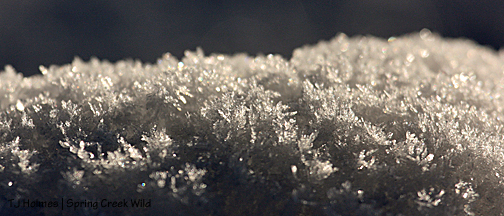
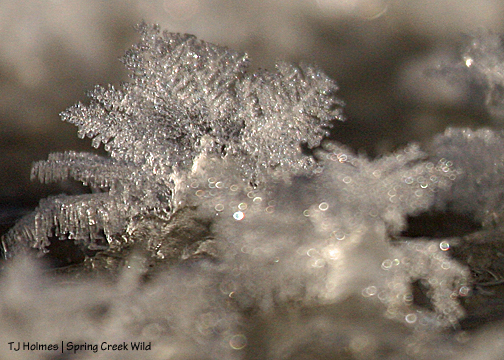
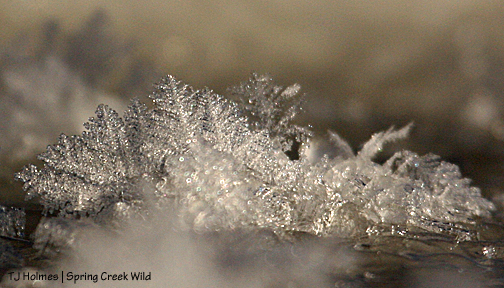
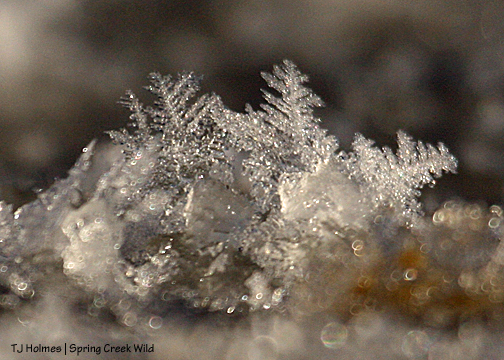
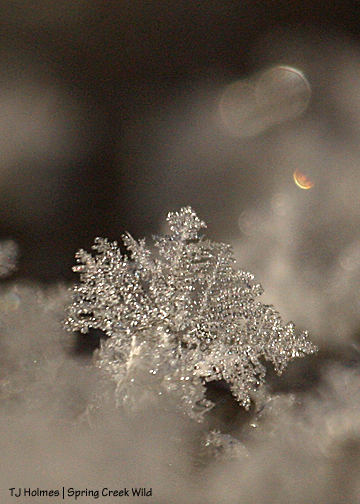
The first two photos are of snow covering a small boulder in the bottom of Spring Creek arroyo. The blue background is the bank, which was a few feet away. The other photos are of ice crystals – ice flakes?! – on ice and snow a few feet opposite the boulder right at a wild-pony super-highway crossing. Water trickling below the snow and ice (a thick slab of it). Do you see the rainbows reflecting? I had just my long lens, and all but the top two photos are major crops of the originals. They’re not as sharp as I wish they could be, but …

This song started running through my head when I saw the snowflake crystals on the boulder as a “hill” against the “blue-sky” background. The rest of the chorus seemed appropriate. I did find much peace there, on my belly in the snow in the bottom of the arroyo (and yes, it went up my shirt because I had to keep scooching back to get the lens to focus!), the horses grazing above me, deep in the heart of the basin, surrounded by winter’s mantle, warm as could be, under Colorado-blue skies, listening to the snow (you CAN hear it, you know) and the horses talking above, buoyed by magic and the wonder of life.

Impossibly beautiful. Yet there it was. Gloriously beautiful.


Brilliance

7 01 2011

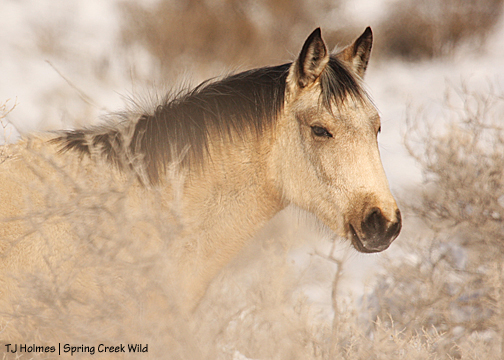
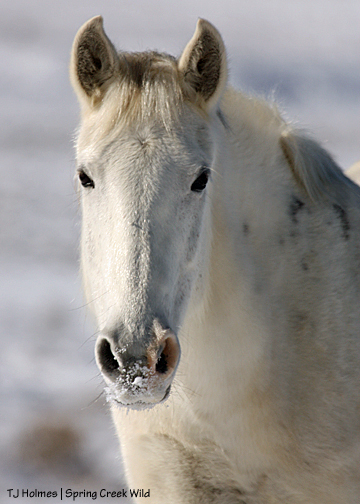
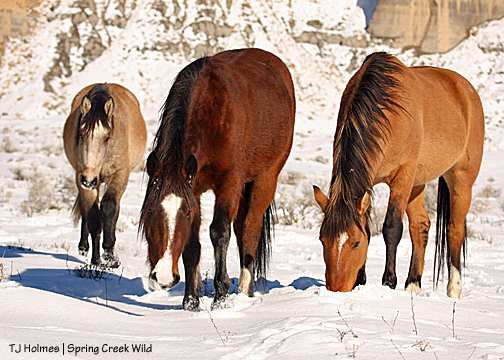
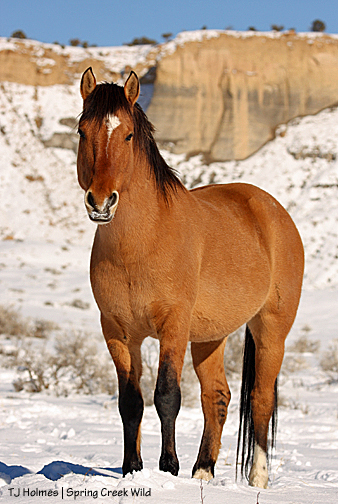
Really, I have no time and fewer words for the incredible beauty and magic that is the basin and its inhabitants right now.

“I am blessed” “I am blessed” “How blessed am I?”

Kept running through my head all day(s) long.

I’m working on more.

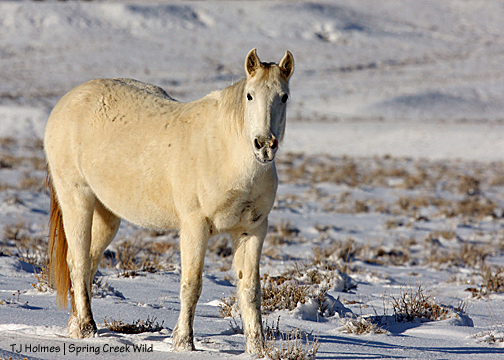
Winona

Alpha

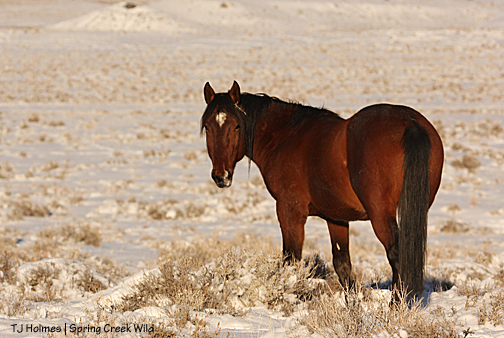
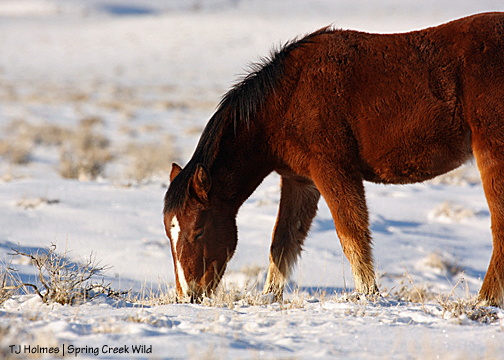
Baylee, Sage and Hollywood

Hollywood

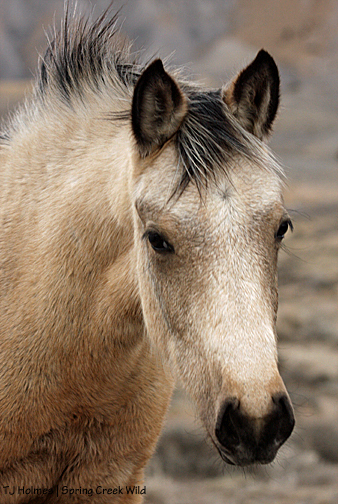
Winona (buckskin and blue and white)

Ice flake crystal


“Urgent for Coloradans”

7 01 2011

News item:

Here’s a little blurb we came across from Hilary Wood of Front Range Equine Rescue. While this pertains to Colorado, this may start cropping up in other states.

Urgent for Coloradans!

Your 2011 Colorado income tax form provides a check-off category for the “unwanted horse fund”. The organization receiving the donated funds is not a horse rescue, takes no stand against horse slaughter, and many of their Board members are pro slaughter (they support bringing horse slaughter plants back to the U.S.). We strongly encourage you to give your hard-earned tax donations directly to legitimate equine rescues instead. The tough economy has already hurt many rescues; giving your tax dollars to the “unwanted horse fund” means less for the rescues. If you are not in Colorado, we appreciate your relaying this information to your friends or relatives who live in Colorado.


What we want to know

6 01 2011

Today, I was so honored to spend some time with three smart, beautiful young ladies at a local elementary school, talking about horses – specifically, wild horses – more specifically, the wild horses of Spring Creek Basin. They wowed me from the start, with the list of things they knew about horses and then a list they had compiled that they wanted to know.

A, M and M, thank you for sharing part of your day with me! I hope I contributed to your excitement about wild horses, and I can’t wait to see you next week!

With permission from K at the school, these are their questions:

WHAT WE WANT TO KNOW:

1. Is there a first aid for horses?

2. Is there a cure for horses that break their leg?

3. Measuring horses by hands.

4. How fast does a wild horse run?

5. What are the symptoms of colic?

6. What is founder?  Do you wild horses get founder?

7. Since wild horses aren’t shoed, does that have an impact on them?

8. Why is it called “Disappointment Valley” where the wild horses live?

9. How do you find the wild horses?

10. How many wild horse herds are in Colorado?

11. What diseases do wild horses get?

12. Are the wild horses affected by car crashes?

13. How long is a horse pregnant?

14. How long before a colt stands?

15. How many breeds of horses are there?  What are they called?

16. How do you transport rescued horses?

17. How do you train a horse that’s been abused?

18. Can you feed a horse chocolate?

Can you believe those fabulous questions?! (I love the last one!) Also next week, the girls will meet a local couple that rescues abused and unwanted horses. They’re getting quite an education!

This is the list they had come up with of things they know:

1. Different horses have different tempers.

2. Horses have no nerves in their manes.

3. Some horses need you to click and say trot if you want them to trot.

4. In order to make a horse canter, you have to slap their rumps – hard.

5. You pull on the reins very softly to make horses slow down.

6. Horses have a muscle in their hooves called a frog that makes them able to trot and canter at amazing speeds.

7. If a horse has a broken leg, you have to kill it.

8. Horses like apples and carrots.

(Note that the second to last thing they “know” in this list becomes the second question they “want to know.”)

Check out how many of their questions have to do with the horses’ health and well-being. Are you as impressed as I am? A and M are in second grade; M is in fourth grade.

Beautiful, beautiful and beautiful.


Belated … but right on time

6 01 2011

http://www.youtube.com/watch?v=8vC8Hffm9BE

Beautiful. Look for the horses. You’ll see them twice!  🙂


Somebunny loves snowbunnies

6 01 2011

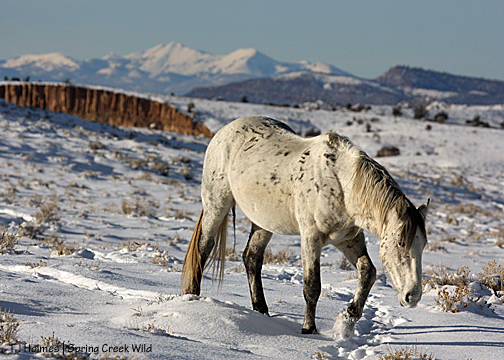
Snow-white Alpha at home in the snow.

What a super visit to kick off the new year! It was a visit of some firsts: first visit of the year, first visit ever to see wild horses … I had a special visitor today! We had tried a couple of times last year to get out to see the horses but were stymied by bad weather each time. Today proved worth waiting for with bright sunshine, pristine snow and freezing conditions perfect enough to drive right in!

She’ll be back for sure … C, I hope you enjoyed your first visit!

We saw lots of horses – very far away – and visited with just Steeldust’s and Kreacher’s bands. We helped a fellow in need, who was performing ice-breaking duty for the horses and for the cattle that are in through February. Always nice to have a set of eyes out there – and the ice-breaking is awesome! Thank you, B! All around, a wonderful day!

Aspen

Mahogany

Gideon, Steeldust, Alpha and Storm

Gideon

Storm and mama Alpha

Mahogany and her boys

Sundance

Steeldust

Very cold – in the mid-teens – but it didn’t feel that cold in the sunshine … until the sun was very low on the horizon. The snow is just amazing – pristine, glittering like infinite rainbows … and when the sun hit low and orange – WOW! Unbelievable gorgeousity!

Special thanks to another C, who gave the thumbs-up on driving in after her lovely visit on New Year’s Day!


A boy and a girl

4 01 2011

After spending time with Chrome’s band during my last visit, I headed back to the Jeep, and found Hollywood’s and Comanche’s bands just over the hill on the other side of the road, so I mosey out to see what they were up to. As it turned out, I visited during their visit. Oh, if they could talk in language we could understand (true in many ways, eh?)!

What caught my eye was Tenaz and Winona, the 2010 babies in each band, disregarding band boundaries, playing together while their respective bands grazed – respectfully – a short distance from each other. Babies are absolutely neutral ground, and I’ve seen this again and again.

Comanche and Kestrel – Winona’s dam and stepdaddy – were up the hill to my left; Hollywood (Tenaz’s daddy), Piedra (Tenaz’s mama), Baylee (aunt), Sage (big brother) and Iya (soon-to-be producer of Sage and Tenaz’s half-brother or -sister in the spring) were down to the right. The fence you see is part of an “exclosure,” designed to help BLM monitor forage. The horses (nor cattle) can get at the forage inside, so it gives a sample of what ungrazed vegetation looks like. I’m not sure how often (or if at all?) BLM monitors the exclosures (there are a few in the basin). I like this picture – stand by for anthropomorphization: Isn’t it just like a girl to be focused elsewhere (mama and stepdaddy), and isn’t it just like a boy to be focused on the girl? 🙂

I took a seat, and pretty soon, Tenaz came trotting past on his way to mama-security …

… and ‘Nona came by for a look after checking in with her own mama.

Eventually, Comanche came to “collect” his little girl, and she walked back toward mama (grazing up the hill) … Tenaz in tow.

Oh, little boy. Oh, stallion-to-be.

Either of these foals would be a candidate to stay in the basin … Winona definitely represents outside genetics: Her grandma Luna came from Sand Wash Basin in 2001. Tenaz might represent outside genetics; I think his sire, Hollywood, is a son of grulla mare Slate, who was brought with Luna and another mare (she died the winter after the roundup – unknown cause).

We got a major Arctic blast just as I traveled back from Texas – lots of snow and subzero temperatures. A visitor to the basin New Year’s Day reports lots and lots of snow – which represents summer water. I can’t wait to get out there. From her pictures, the scenery of the basin is vastly different than when I took these pictures three weeks ago!


Calendar notes

3 01 2011

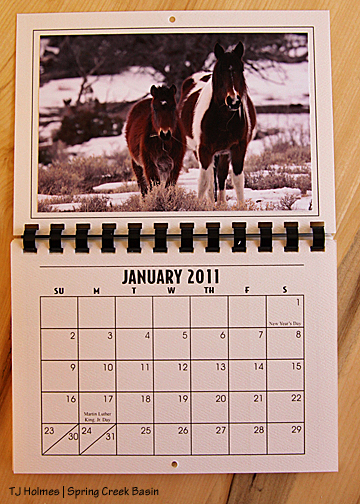
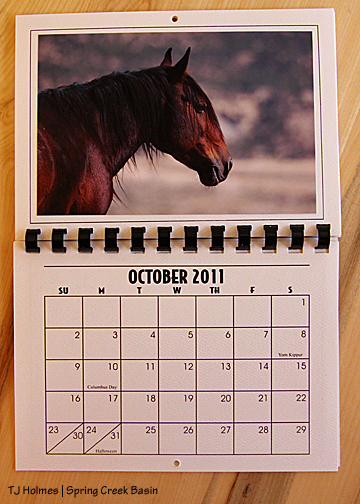
This is how it turned out!

Cover

January

October

Thank you so much to all who voted on photos for the calendar. It turned out beautifully.

The first batch of orders are ready to send out, and I’ll make more as there’s demand. They’re $15, and $5 of that goes to the Colorado chapter of the National Mustang Association as a donation. If you would like to order one, contact me at:

mtbgrrl (at) fone (dot) net

Again, thank you all! This was such a fun project this year … though I should have started it earlier!


What about the numbers?

3 01 2011

Please take the time to listen to this documentary by Amy Hadden Marsh about how BLM conducts census reports of wild horses and burros in the West: http://www.kdnk.org/article.cfm?mode=detail&id=1293643372755. Follow that link, then click the arrow under “Documentary; Wild horses caught in the crossfire” to the right to play. It’s not too long, and it’s very informative.

One of the best things I’ve done since starting my mustang advocacy was to grab onto the idea of documenting each horse in my herd, which I learned in short order after witnessing the first day of the Little Book Cliffs roundup in September 2007 (and later meeting documenters and darters for that herd, including Marty Felix and Billie Hutchings) and then meeting Matt Dillon, director of the Pryor Mountain Wild Mustang Center and writer and photographer of the Pryor Wild blog, later that same month. I knew a good thing when I saw it! In 22,000-acre Spring Creek Basin, it took me about 2.5-3 months of weekend visits to document the 43 horses left after the 2007 roundup and be sure I had seen them all.

Amy is a master’s degree candidate in wild horse management (where do I sign up??), and she has put together this oral documentary that touches on a lot of interesting points, including how BLM counts and estimates populations. The documentation of Spring Creek Basin’s and Little Book Cliffs’ herds are mentioned, as well as counting flights over Piceance Basin.

Follow Amy’s blog at From Western Colorado.


Gearing up for 2011

2 01 2011

With the holidays fast approaching and my Christmas trip to Texas, I never stood a chance of posting some more pix from my last visit to the horses last year. Although it was a cloudy, grey day, I spent quite a bit of time with Chrome’s, Hollywood’s and Comanche’s bands – heaven. So I’m going to try to get some more photos up of various horses before I hopefully head out again this week for my first visit of 2011!

Something I’m tremendously excited about is a two-part visit, starting this week and ending next week, to a local elementary school to talk to three students for a project they’re doing about horses! I’m talking about wild horses – of course! They’ll learn more about horses from other people involved in different aspects, including a local equine rescue group, throughout the month. I’ve been speculating about ways to get local kids involved with our mustangs for a couple of years now, so I hope this is the start of something we can continue annually. Later in the spring, I’ll take the students out to Spring Creek Basin for an up-close look at OUR mustangs in the wild. I can’t wait to learn about the students and find out what they’re most interested in regarding horses. I bet they have some super questions!

I’m also excited about being a tour leader for the third year (stymied last year because of rain) to the Spring Creek Basin mustangs during the Ute Mountain Mesa Verde Birding Festival. The link is to last year’s information, but they should be updating it soon. My tour will be Thursday, May 12. If you’re local, sign up! I think the cost is about $60, and it includes travel, some birding along the way to the basin and back, and lunch. Hopefully the weather will cooperate this year! About a dozen people on the tour meet in Cortez and drive out to the basin, where I meet them, and we drive in to look for horses, talking about all kinds of things related to the horses along the way. The Forest Service, a partner in the festival, always has a couple of people along to answer questions about San Juan Public Lands. The year before rain put a damper (sorry) on our plans, we saw almost all the horses.

Our NMA/CO group also plans to do some educational presentations around the region this year. I’ll have more information as we make those plans.

Chrome and Hayden

Now for some heavy stuff. This year, Spring Creek Basin will see another roundup. It’s on the BLM schedule for Sept. 17-21. It hasn’t taken that long in the past, but I plan to be there for every day of it this year, and my fervent hope is that BLM will give the go-ahead for a fertility control program using native (annual) PZP and volunteer darters. We (NMA/CO) have been encouraging fertility control since the last roundup, and we made a formal proposal last year to use PZP (not PZP-22) and volunteer darters. In light of that, with my growing feeling of responsibility to provide as much information as I can as I learn and observe, I will be writing some posts this year that I hope are, in fact, educational and informative. My opinion (and it is an opinion) varies a bit from some of the “mainstream advocacy groups.” I do HATE roundups, but I DO support fertility control, and I do NOT support “let nature take its course,” aka starvation, and even with fertility control, I foresee roundups (we hope for bait trapping over helicopters) in the future, hopefully lessened.

Chrome and Rio

The horses are in great shape. Five water holes have been dug out in the last two years. We got rain last summer (a lot of rain).

Do I want to stop the roundup? No.

Yes, we will say goodbye to many horses this fall. Will it break my heart? It has been breaking  a little every day for the last few years in anticipation.

Does this seem contradictory?

The basin is fenced. It is finite. It cannot support an infinite number of horses. I would rather see fewer horses removed WHILE THEY ARE HEALTHY than many, many horses removed in the very lean condition they were in during the 2007 roundup and before the basin’s grazing and water resources are so taxed. And I want to see fertility control started as soon as possible … so that the next roundup may be years and years and years away. And it is also my hope that by saving such an incredible amount of money by reducing the frequency of roundups, as well as fewer Spring Creek Basin horses going to interminably long-term holding, we might set BLM’s sights on bait trapping – rather than helicopter-driven roundups – in the future.

Could we stop roundups altogether? I’m sure we could. Assateague Island did it. But I’m not sure we’re ready to go there just yet. That is a very intensive program – of necessity.
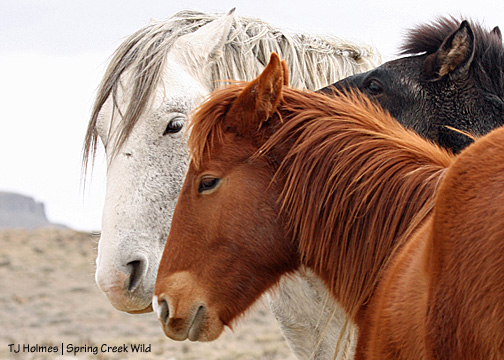
Chrome and Hayden and Rio

Linda on her Beautiful Mustang blog asked me a great series of questions about PZP, and has posted some of my answers, along with photos. Linda adopted a beautiful filly born in 2007 from Beatty’s Butte, Ore., and named her Beautiful Girl. And is she beautiful! (Really, she’s gorgeous!) More answers and photos to come. I’m really grateful to her for giving me another venue. My disclaimer: I am certified to handle and mix PZP and to dart, but I do NOT consider myself an expert. So I continue to read all I can and talk to people who ARE experts.

It was never my intention to use this blog as a political platform, rather I want it to be about the HORSES. Mustangs are an incredibly emotionally charged subject – and rightly so. I still don’t intend this blog to be political. Rather, I’d like it to be educational – both about the horses themselves and what they do for us – emotionally and otherwise – and what we can do for them. I want to encourage discussion and questions and come up with answers. As stated above, I don’t have all the answers, and lots of people have been working on this longer than I have! But after all this time – this year will be the 40th anniversary of the Wild and Free-Roaming Horses and Burros Act – we have enough information *to* CHANGE.
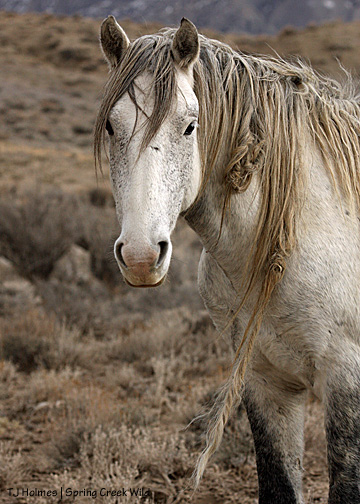
Chrome

I highly recommend at least these books:

Wild Horse Annie and the Last of the Mustangs by David Cruise and Alison Griffiths

Mustang: The Saga of the Wild Horse in the American West by Deanne Stillman

America’s Last Wild Horses by Hope Ryden

Please recommend others, if you like, but I found these books to tell an amazing and not always happy history of horses and humankind. I read Mustang first, about two years ago; it was published in 2008 . Last winter, I read America’s Last Wild Horses for the first time, first published in 1970, and I was struck by one major thought: Nothing has changed. I read Wild Horse Annie right after Christmas, and I thought again: Why has nothing changed? It’s not for lack of letters. Not for lack of schoolchildren – and adults – writing and writing and writing, talking and cajoling and pleading and demanding and insisting that wild horses be protected and managed in the wild.

Why has nothing changed?!
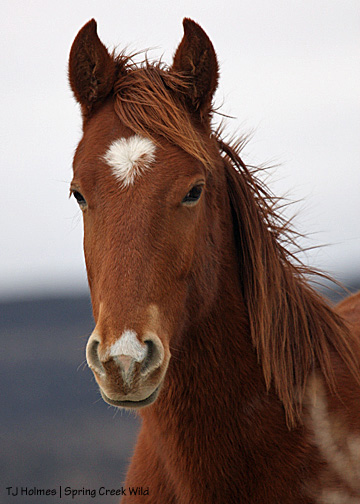
Hayden

I don’t know, but I share the conviction of many, many people that it has to and will.

I joined this fight – and it obviously is one – just a few years ago. I know people who have been fighting for 30 years. Best science is available, and many people are willing to carry it out for the benefit of our mustangs.
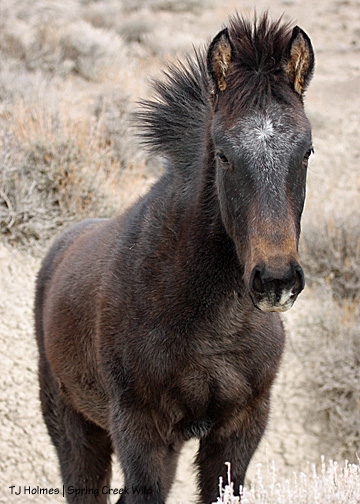
Rio

On my little blog, I’ll put out my opinion (what a scary proposition) and try to be a little more detailed about what we’re trying to do in our little corner of the wild horse world. And I’ll always – always – keep it about the horses.
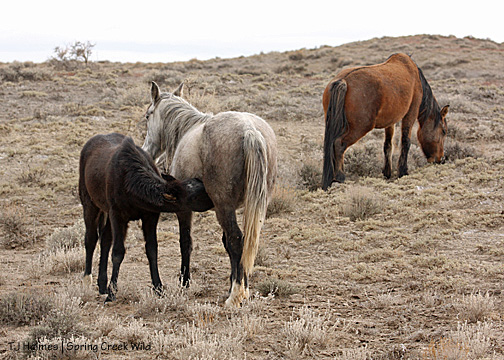
Rio, Two Boots and Jif