*Good* snake

26 06 2025

A warning if you’re squeamish about snakes: Pix below. Very good snakes, these (Colorado Parks and Wildlife info says they’re an “invaluable species to have around homes and in gardens” for rodent control (and, some say, for rattlesnake deterrence, though I have no experience to back this up, and some experience to negate it)), but still, if you’re looking for a pic of a mustang this morning, a scaly slitherer might be a bit of a shock. …

Ready?

Here we go:
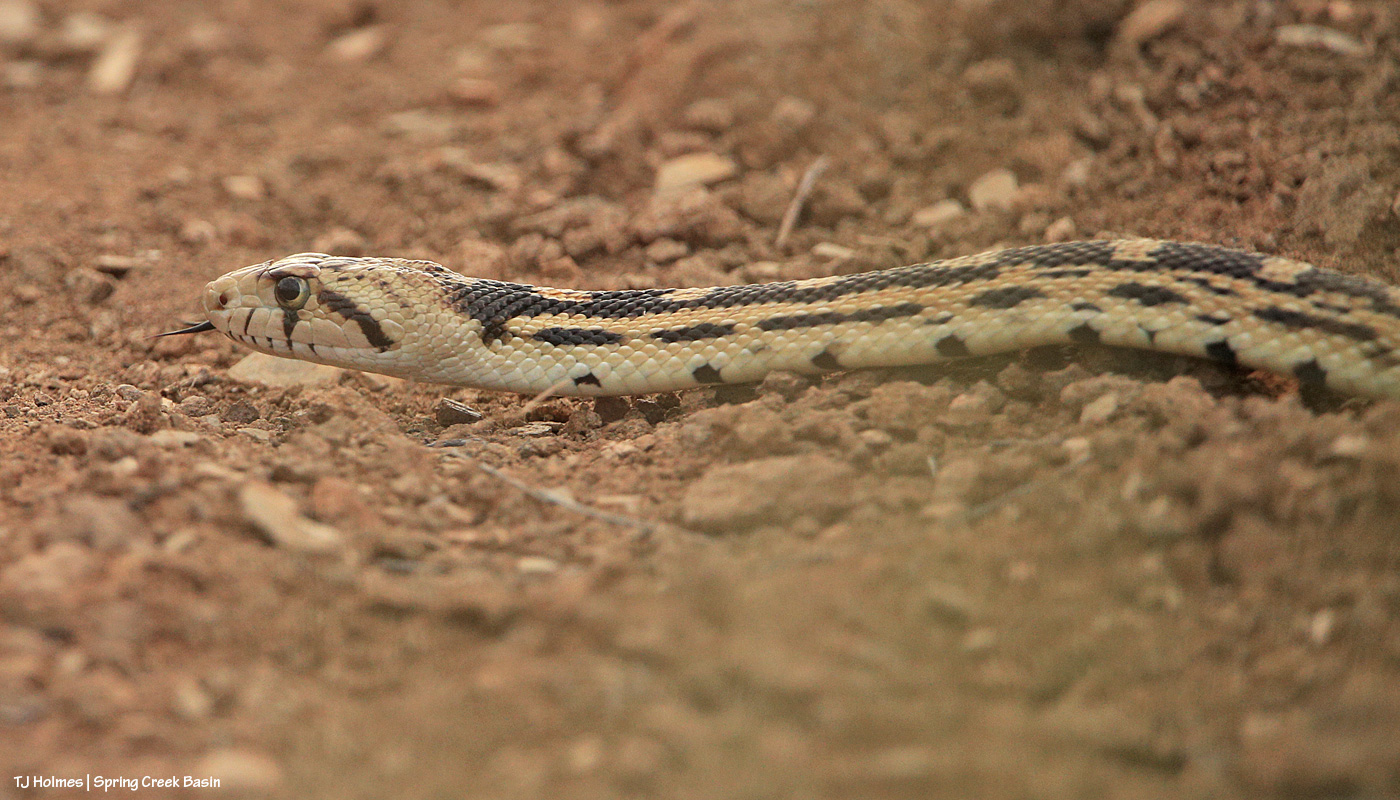
This is (I think) a bullsnake (one word, says Colorado Parks and Wildlife), found very close to sunset, very close to the basin’s western fenced boundary above the rimrock. I was following a band of mustangs toward lower ground when I caught sight of the movement of this little guy or gal, far enough away from my path through the shadscale, sage and bunchgrasses that my world-renowned (or maybe that’s just me) ability to levitate did NOT engage.

Actually, though, according to Colorado Parks and Wildlife: “While all snakes of this species are called bullsnakes in Colorado, they are actually subspecies of gophersnake. There are two species of gophersnake in Colorado: the Pituophis catenifer sayi, or bullsnake, and the Pituophis catenifer deserticola, or Great Basin gophersnake. The bullsnake is mostly found on the eastern plains of Colorado and the Great Basin gophersnake is on the western slope, but they do intermix in southern central Colorado, especially in the San Luis Valley.”

So technically, according to the above, what we have here is a Great Basin gophersnake. (Again, I think; my pix of my little friend don’t look exactly like the pic on the CPW website.)
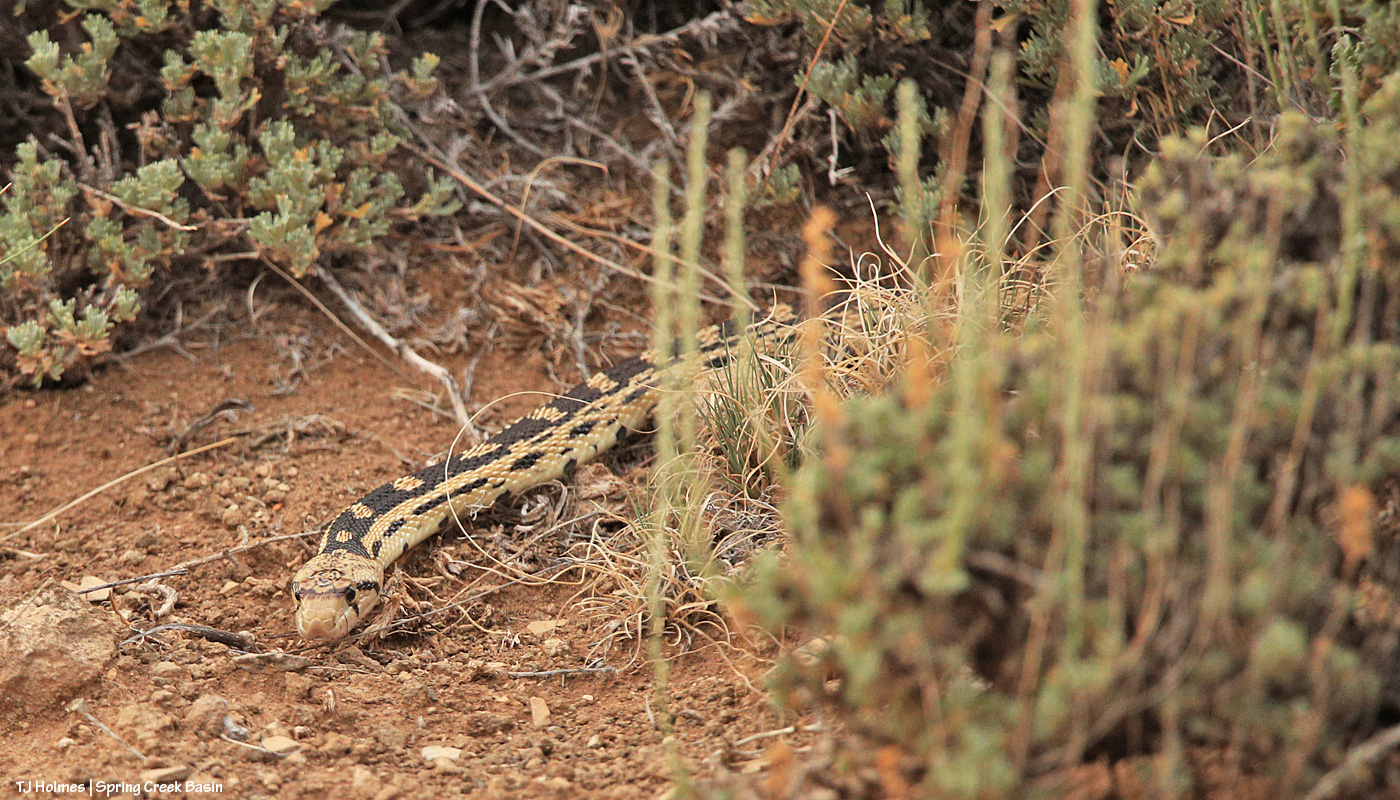
Is it just me, or is there a smiley face on top of this critter’s head?

S/he was completely uninterested in either me or the mustangs, and we went our separate ways with respect and appreciation (at least on my side).



Flying prairie

25 06 2025

Prairie falcon, that is. Soaring over Spring Creek canyon.

Through the camera viewfinder, I didn’t know what it was. Then I saw it on the computer screen and may have let out an exclamation of sheer delight! They’re not *uncommon*, but I was super glad to see this winged beauty!


Not on my watch

24 06 2025

While her stallion was busy protecting another mare in the band at a water source, Mariah took it upon herself to act as protector of the whole band against a stallion who was semi-patiently waiting in the wings with his own mare to get a nice, cool drink of water.

The quiet female force that gets things done when the guys aren’t looking. 😉


Diagonals

23 06 2025

Flash returns to his band after a chat with a neighboring stallion near a water source.

Love the soft light and his quiet determination.


Nursery

22 06 2025

Cute, cute, cute!


Solstice glow

21 06 2025

Well, the ponies certainly put out the memo and made themselves available for summer solstice evening!

Heat, wind (“fire-weather (red-flag) warning/watch” and “wind advisory” – no joke), haze and dust aside, it was a gorgeous evening with four bands at the western boundary above Spring Creek canyon.

Winona and her band were the last left in the last light at the very top of the rimrocks, and she’s *always* a gorgeous model. Solstice night was no exception. 🙂 God and we love her.


Summerlight

20 06 2025

Summer solstice is at 8:42 p.m. Mountain time – tonight. Sunset is (officially, at least) at 8:40 p.m. our time. (I say officially because the ridges to our southwest and northeast always make official times and actual times of sunset/moonrise and sunrise/moonset a bit different, sometimes up to half an hour different, depending on where you are relative to those ridges.)

This pic of Chipeta was taken a few days ago as she went with her band to evening water, but the lovely light illustrates that longest day of the year that marks the beginning of summer. That’s what all the experts say, but I tend to think of it more like almost midsummer because we’ve already been hot and dry and summer-like, and at this point, our planet’s tilt means we start shortening days and lengthening nights (I know, I know, it’s not at all scientific; living by the seasons, I tend to go more with feeling than straight science!).

Today and tomorrow, I’ll be out to try to get other solstice-evoking pix of the mustangs, and of course, I will share the best results. 🙂

Fortunately, we do still have decent water and abundant grasses and other vegetation, though I’m also eager for monsoon season later this summer, when we will *hopefully* be getting good rains to replenish ponds and catchments and vegetation … and spirits!


Loveliest of lovely

19 06 2025

It wasn’t my intention to post pix nearly back to back of some of our lovely ladies of Spring Creek Basin, but they must want to be seen – and they’re too beautiful to NOT be seen.

This is lovely Piedra again, looking lovely the other evening as she watched some other mustangs across a deep arroyo from her band.


Gravid girl

18 06 2025

Remember our last little collared lizard friend? Very bright turquoise, and I’m pretty sure that one was a male. THIS one, pictured above and throughout this post, is a female, I’m pretty sure.

And I also think she’s pregnant. 🙂 Look at that belly!

From Google:

A pregnant female collared lizard can be identified by the presence of naturally occurring orangish spots, similar in color to chigger mites, on her body. These spots develop when the female is gravid, meaning she is carrying eggs. The spots are a visual indication of her reproductive state. 

Here’s a more detailed look:

Female collared lizards develop these distinctive orange spots when they are carrying eggs. 

Mating Behavior: . During mating season, males will approach females and may engage in head bobbing and wrestling. 

Egg Laying: . After mating, the female will lay her eggs, often burying them in sand or soil. 

Egg Care: . Some females may guard their eggs for a few days, while others will leave them immediately. 

Hatching: . Hatching typically occurs within 40-55 days. 

Post-Hatching: . Newborn lizards will have their yolk sacs attached for a couple of days and then begin to feed on small crickets dusted with supplements. 

She was super calm while I took photos of her from all kinds of angles.

Super cool little dragon-dinosaur-lizard soon-to-be-mama (!?) girl. 🙂


Swishy strands

17 06 2025

Terra, patiently waiting … save the relentless swish of her tail against gnats and heat.