OK, it’s really not that secret; it’s a narrow little forested strip on top of one of the lower ridges. I adore any pix I’m able to get of the mustangs in a treed setting because it’s so rare to find them in a treed setting! It does sometimes make them a bit hard to spot (yay for the greys!).
The dapply light was lovely on Kestrel’s emerging dapples … emerging as she sheds her winter coat for her summer finery.
Little Mister Maiku found a swampy place to roll. 🙂
How DOES he see through that marvelous forelock?!
After the crazy, muddy winter, we are super dry again. But there’s water in numerous places this spring in Spring Creek Basin, and the wild ones know where to find them all.
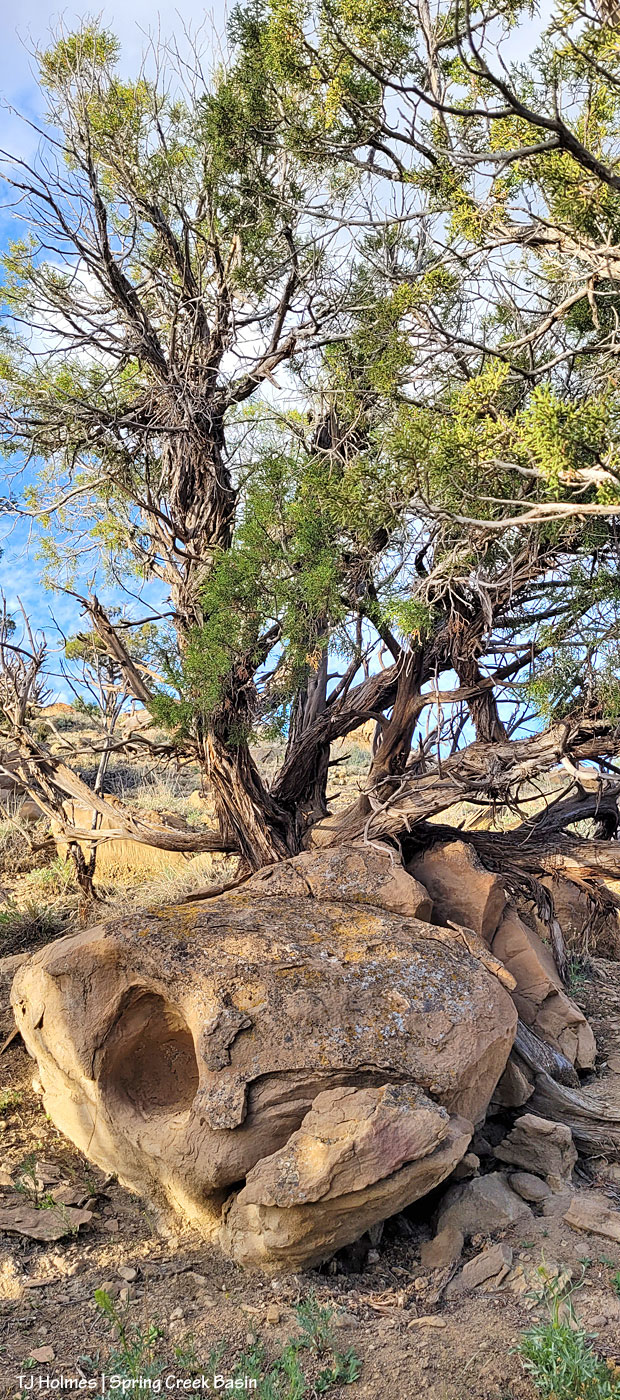
If you look closely, you can see a mustang grazing at upper left. If you look a bit closer, you might be able to see that this old juniper is growing out of a (crack in this) sandstone boulder.
This grandmother tree certainly made sure to send up many fingers through the available space(s).
This is the view from the other, downhill, side … and it’s the view that got me interested in walking up to investigate further. Bit of a grumpy-rock missing an eye, eh? And I looked, but no Excalibur did I find also buried within the stone.
Think of the seasons and years and heat and cold this tree and this stone have witnessed, together. And the stone likely thinks the tree is just a wee, youthful thing.
As a colorful bonus to this post …
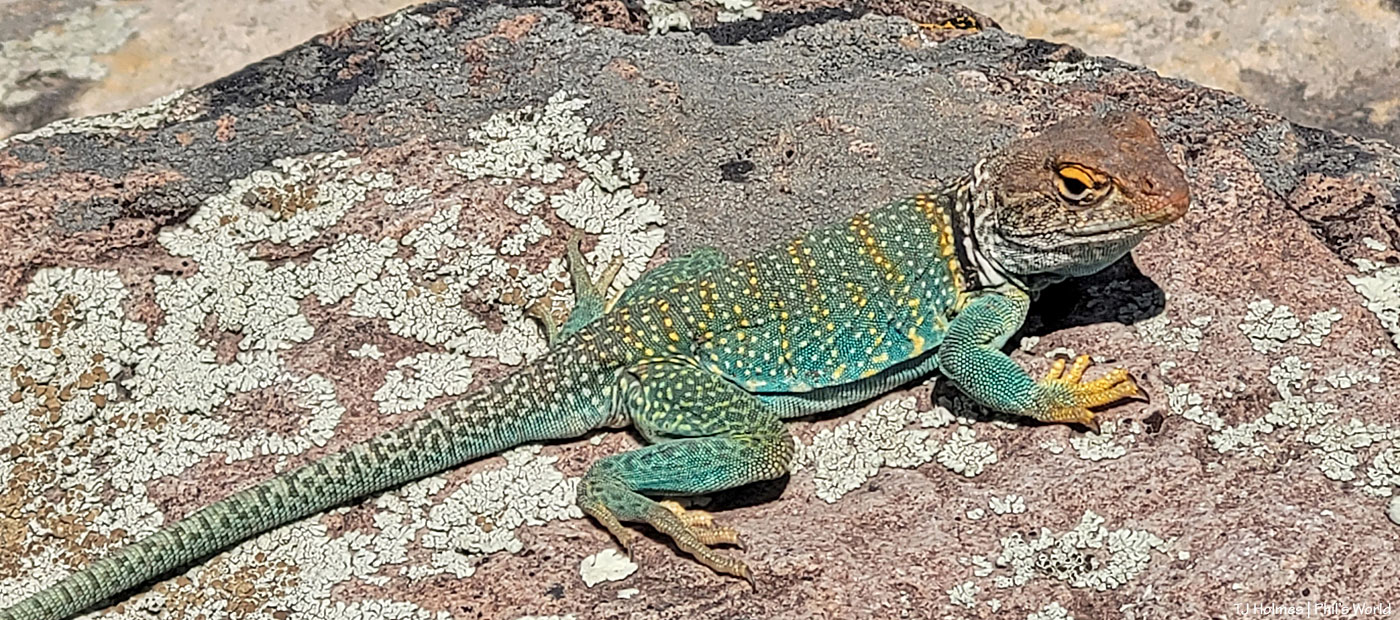
This uber-handsome fellow was not in Spring Creek Basin – or even in Disappointment Valley. He was a good bit farther south (still in Colorado) and stopped to catch the rays along a bike trail where I stopped to gasp and puff … err, catch my breath. I couldn’t believe he stayed still long enough for me to fish out my phone and snap his portrait, but he did, and I was happy as I love these beasties at least as much as I love our horned lizards! It won’t be long, and we’ll be seeing our own Disappointment Valley-native collared lizards.
**Update: I saw my first Disappointment Valley-native collared lizard just yesterday – also while riding my bike, as it turned out. It was MUCH too quick for my full admiration, but temps are warming, and soon they’ll be sunning and lazy.
Storm’s band has a knack for staying out of sight in the back-of-beyond backcountry of Spring Creek Basin. Then, just as I’m really putting out the effort to find them – not just “casually” looking for them – they appear, in the best-most-beautiful place.
Because of course they do. 🙂
Despite our recent unsettled weather, rain remains elusive (nearly as much as Storm’s band).
(Storm himself isn’t actually in the above pic, but don’t worry, he’ll make an appearance here soon.)
It is with a shattered heart that I report that Dundee’s big, handsome dun colt, Ranger, shown above with his aunties, Aiyanna and Rowan, has disappeared. It’s so hard to bear the unfairness and suddenness of it that it doesn’t even seem real. Dundee was a fiercely protective new mother and did everything right in all the times I saw them together. … It’s a reminder that our beloved wild ones ARE wild and that life is not guaranteed.
Kestrel gives me an eyeball while she searches for fresh, yummy, actual grass around the bases of the green greasewood on a bench just above one of Spring Creek Basin’s main arroyos. The horses definitely eat the greasewood, but at this particular time while I was with them, they were all about that grass, which was a few inches tall where sheltered by the woody stems of the greasewood. It must have been satisfying for *them* to eat … *listening* to them snip the bunches of grass with their teeth and chew was incredibly satisfying for *me*! 🙂
It’s worth noting that this is also a season for “bling.” As the horses forage among the greasewood, bits of the branches get tangled in manes and forelocks. You can see a bit in Kestrel’s mane already.
Because we’re really celebrating the onset of spring this year after what seemed like a lengthy winter, some examples of things we’re celebrating:
The horses in the band I was with alerted me to this handsome fellow. He or she paused here and looked back at something (not the band I was with), then continued to run across the area before disappearing. S/he was not close to us (not even close to close! hence the very blurry image), and the horses, though watchful, were not bothered.
These little yellow flowers are coming up now in Spring Creek Basin. The petals are closed here, but my handy-dandy new plant/flower identifier app on my phone says it’s called “Chambers’ twinpod.” This gets a 77% chance of correct ID.
And an update on this little beauty: It *might* be “soft popcornflower,” if you can believe there’s such a name! I’m not completely convinced – and neither is the app; it gives a 23% chance of that being the ID. But that name is so delicious, I hope it’s right.
UPDATE: It’s called Gypsum Valley cateye! When in doubt, ask the BLM guy! 🙂 Thanks to Mike Jensen, who was actually in the basin May 3 to look for this little plant, for the confirmed ID!
I’ve seen a slender-lizard or two skittering away out of the corner of my eye a couple of times recently, but this is the first horned lizard I’ve seen this spring. And look at those orangey little “eyes” on its back! They make me think of patterns reminiscent of some kinds of moths or butterflies? I don’t think I’ve seen that adaptation on any of the other horned lizards I’ve seen, but I love it!
One of my very favorite early birds of spring is the meadowlark. This bright ray of feathered spring sunshine was warbling (! trilling? that wonderful liquid sound they do) sweetly from a greasewood close to the road.
Look at these beauties! They were looking at the horses (and me) as we were looking at them. I like to think there was mutual admiration (among the four-leggeds, at least) and maybe a little curiosity (it was all admiration on my part!). They’re still a little rough, but they’re shedding fast like the horses.
And to end on a fluffy note, here’s little Peter or Petra cottontail. This little critter was much closer to the horses I was with and also moseying along among the greening greasewood.
Not all of these “signs” are limited to spring, of course, but they’re all things I’m always happy to see.