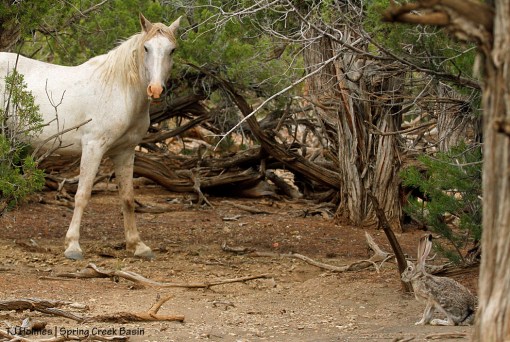
Corona didn’t seem to know what to make of her little friend, but when she walked on through the trees, Jack turned and hippity-hopped after her.
Corona didn’t seem to know what to make of her little friend, but when she walked on through the trees, Jack turned and hippity-hopped after her.
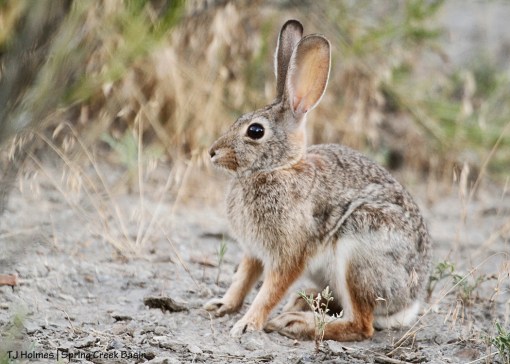
Hippity hoppity! This little cottontail held its ground as a band trailed through a wide arroyo on a summer evening, and that made it a perfect subject for a bunny portrait. 🙂

Howdy, handsome! My, what excellent horns you have!
Some of the horses kept looking over a hill, and I thought another band might be there. Nope, just these awesome creatures!
I was just walking along when …
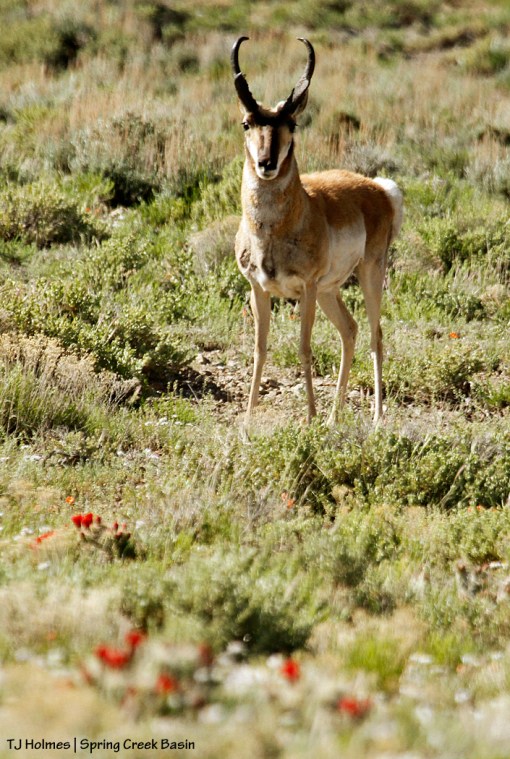
This pronghorn buck was napping when I crested a little hill and saw him. He stood up, and I stood still. Apparently, he didn’t detect a threat, so he laid back down.
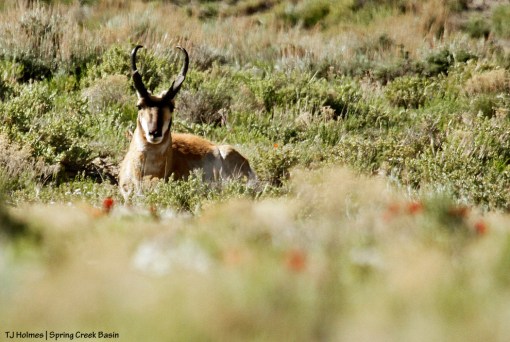
Note: All the little red bits are blooms of claret cup cacti, which seem particularly spectacular – and prolific – this year.
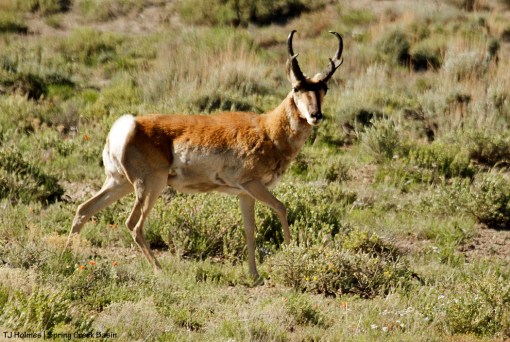
These photos all are significantly cropped. Pronghorns are much warier of intrusions by two-legged intruders than the mustangs. 🙂
Interesting trivia:
They’re the fastest North American land mammal – actually, the fastest in the entire Western Hemisphere, according to Wikipedia.
Wyomingites call pronghorns “speed goats.”
Pronghorns are not antelope, which is why it’s correct to call them pronghorns (pronghorn/pronghorns for plural animals? that’s one I’m not sure about).
Pronghorns prefer crawling under fences to jumping over them, which is why wildlife-friendly fencing that takes elk calves and deer fawns into consideration also considers this knowledge about pronghorn behavior – stringing the lowest wire strand at least 18 inches off the ground.
Pronghorns aren’t currently hunted in Disappointment Valley because their population is low (likely *because of* previous hunting). They seem to be working toward recovery because while they’re infrequently seen, they ARE seen.
Visit Wikipedia for more information about these cool mammals.
A fantastic book (thanks, David Temple!) is Built for Speed: A Year in the Life of Pronghorn.
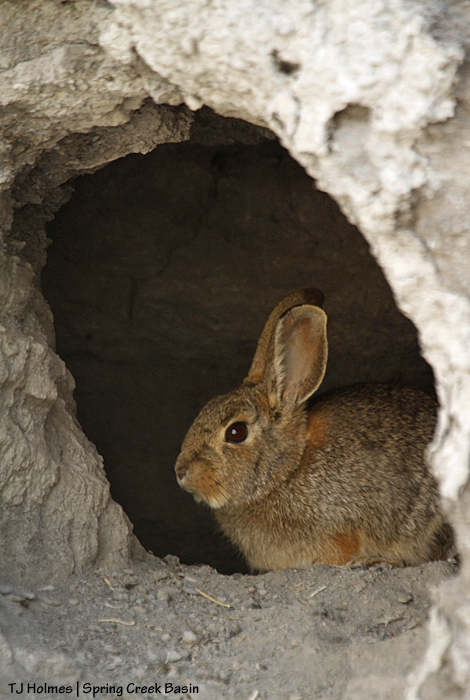
This cracks me up so much there are hardly words for it. That’s Peter (Petra?) Cottontail in his/her arroyo-wall den in the wilds of Spring Creek Basin.
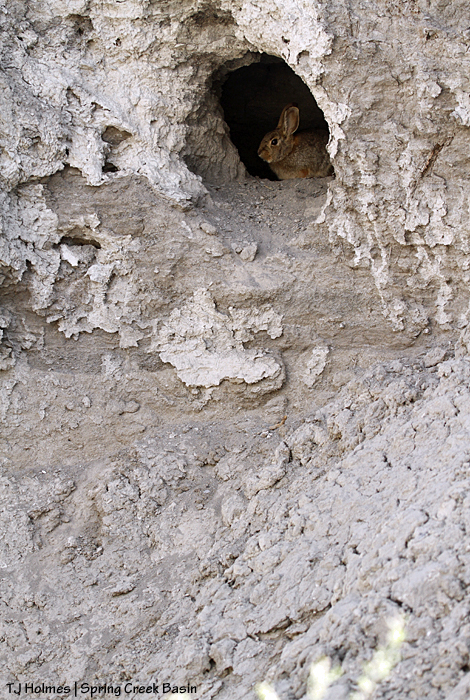
There’s probably 2 feet of arroyo wall above the den, and there’s probably another 4 or 5 feet below the bottom of the pic to the bottom of the arroyo. (The long lens is great for photographing mustangs at a distance but not so handy at capturing smaller critters closer at hand!) Pretty clever and pretty safe, really, though I don’t know if the bunny is the original excavator.
In addition to Peter (Petra), Jack (rabbits) abounds (har) in our little slice of heavenly planet.

It’s dry out there, but don’t you think you’re taking things a little far with the peeling skin?
I found Mr. or Mrs. Horny Toad the other day while visiting with Hollywood’s and Comanche’s bands. Don’t you love these prehistoric little dragons? I’ve seen several this year.

This pronghorn doe was looking for water the other night in the basin. She found other visitors already there, and she decided not to stick around.
No pix, but a group of two-legged visitors and I saw a mama pronghorn with a fawn on a different visit! Very rare to see the babies. Very cool!
The mustangs share Spring Creek Basin with other wildlife, including these beauties I saw during my last visit:


They were in a big group, too spread out to capture them all in one photo!
I came over the crest of a hill and saw them – and they saw me! – and off they went. Naturally, I took photos while I waited for them to put some distance between us! You can see the road in the background of the lower photo.
Disappointment Valley is a major wintering area for mule deer and elk. Seeing deer is nearly an everyday occurrence, but it’s pretty cool to see elk – and this many at one time!
… to bring you a different kind of “beast.”
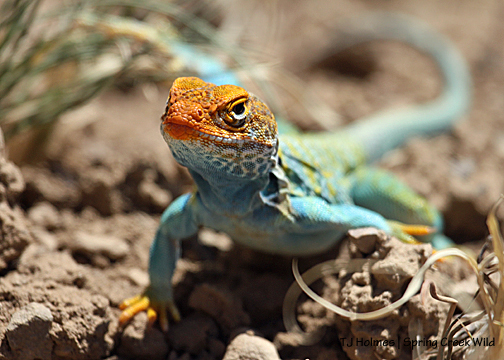
I think he’s smiling at me.
Our herd manager came to the basin today to check the water situation. Four ponds still have water. All but one were dug out in 2009 and 2010 (and one pond dug out in 2009 and one dug out in 2010 are dry). We have talked about water enhancements in the last year or so – and money for that is in the works, thanks to the Director’s Challenge grant we got. We’ve talked about a second water catchment (our current one is about 10+ years old, thanks to the National Mustang Association/Colorado chapter), water guzzlers, enhancing seeps and springs and digging out more ponds. Two more ponds are scheduled for dig-out this year, also thanks to the Director’s Challenge funds.
It’s all about cooperation.
Kiley and I saw the collared lizard on a rock right off the road. I made him stop for a quick portrait shoot. I love these tiny dinos!
It’s dry out there, folks. All rain dances – of all durations, to any music, any style (!) – accepted. 🙂
… for some non-horse critters.
People ask about what other kinds of wildlife we have in the basin. Deer, elk, pronghorn, coyotes, badgers (I saw one big as a small dog the other day!), rabbits (both Jack’s and Peter’s families call the basin home), chipmunks, ground squirrels, lizards, all kinds of birds! I don’t often get photos of them, but they’re great to see!
I always forget to include these guys in that list:
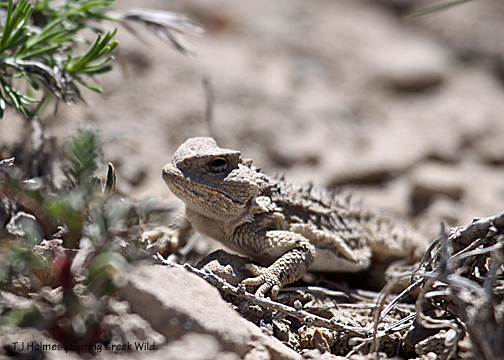
A horned toad! Isn’t s/he awesome? I “caught” him as I was walking back from checking on Tenaz.

The bellies on these girls are showing signs of growing life, too. They were just up the hill and across an arroyo from Grey/Traveler’s band. I don’t know much about pronghorn: They make a sort of twangy-banjo-like barking noise as an alarm (at least the bucks do?). They don’t jump fences, so if they can’t get through or under, they’re stymied. In Wyoming, they’re called “speed goats”! (Thanks, N, for that tidbit!)
I mentioned the phlox blooming – more and more coming on every time I’m out, it seems. And the Indian paintbrush is getting started, too. The grasses are greening up along with other things. It’s very dry, but there are signs of spring all over!
 Spring Creek Basin Mustangs