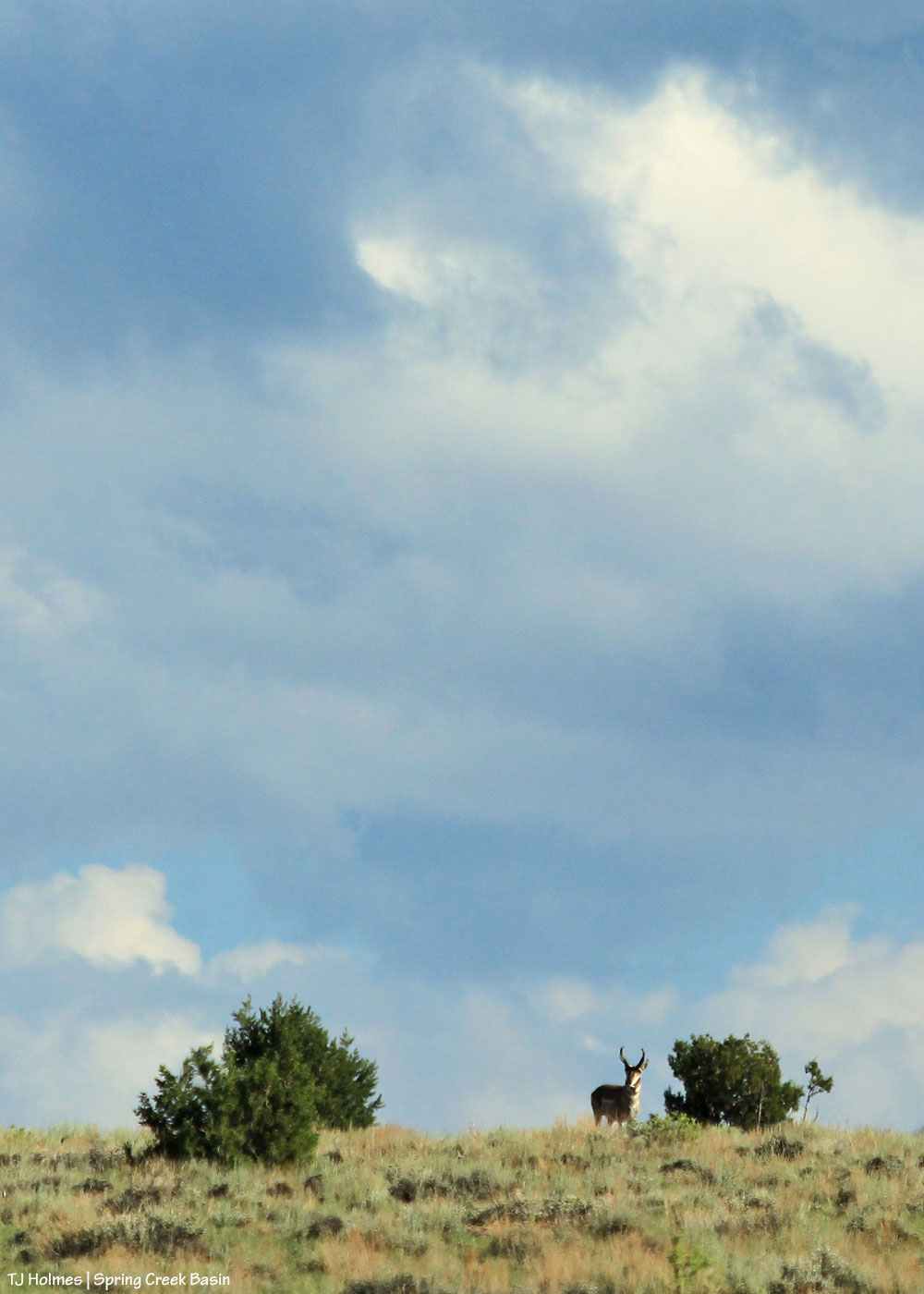
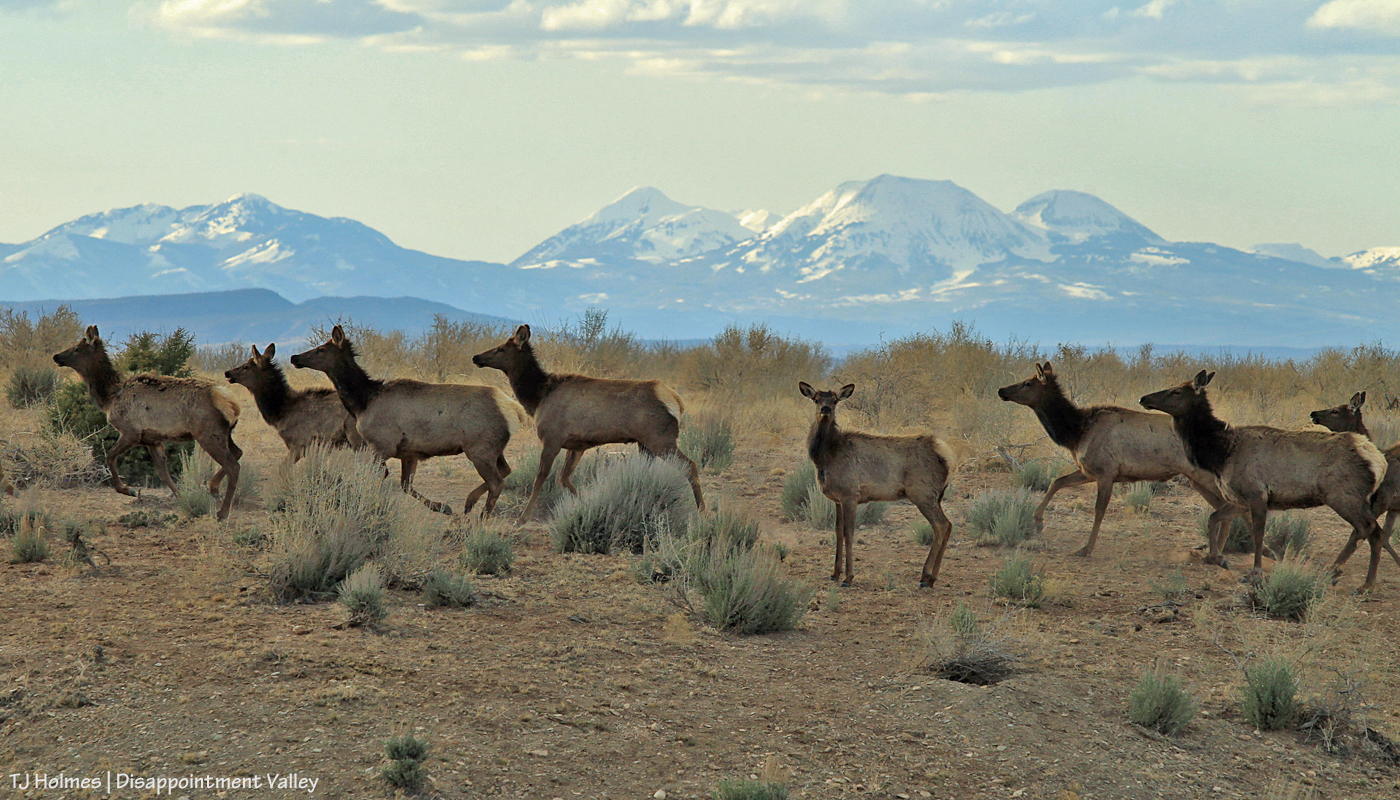
When this critter crossed the horizon line above a band of horses a week or so ago, they took notice but weren’t alarmed. He stopped a couple of times to look toward us, but he kept moseying on.
Trivia: In Wyoming, pronghorns are affectionately (!?) called speed goats.
They are North America’s (the Western Hemisphere’s, according to Wikipedia) fastest land animal.
They are not true antelope. This is a great site about them: San Diego Zoo.
A fantastic book about pronghorns is “Built for Speed; A Year in the Life of Pronghorn,” by John A. Byers.
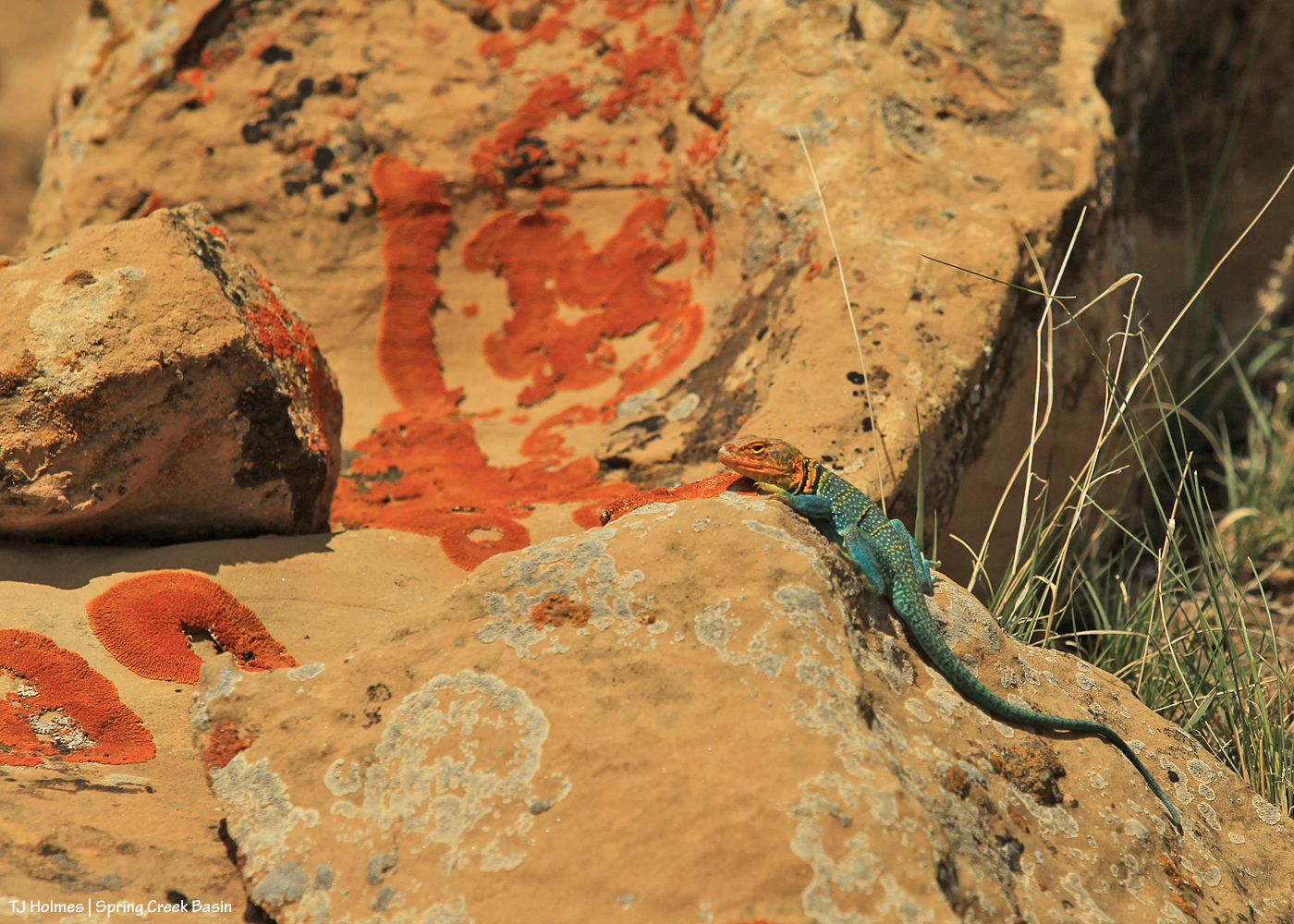
Kudos to eagle-(lizard?!-)eyed friend Pat Amthor for spotting this collared lizard on a rock as we drove by on a gorgeous afternoon in Spring Creek Basin! And she didn’t see it from this angle; she saw it from the left (I’ve backed up here when she shouted “lizard”!), where only the head was visible – almost the same color as the rock.
I LOVE these bright, awesome little dinosaurs!
P.S. We got around 0.21 inch of rain early Monday morning. The green is noticeable, and the wildflowers loved the infusion of moisture. 🙂
P.P.S. I’ve been trying to attach the pic to this post for hours without success; hopefully WordPress or my Internet will allow it in the morning, when I’ll try again.
What’s better than a grumpy cat? (A happy cat, of course, but that’s not the theme of this post.)
A horny toad that looks like an actor straight out of one of those men’s cologne commercials (does anyone really feel the urge to run right out and buy the stuff after viewing those??).
As usual, it took movement right under my nose (err, feet) to notice the spectacularly well camouflaged little guy or gal. But then, unusually, s/he decided to pose for a few minutes so I could get down on my belly and find the focus distance (long lenses do not like to focus very close to their subjects).
According to Wikipedia, “horned lizards (Phrynosoma), also known as horny toads or horntoads, are a genus of North American lizards and the type genus of the family Phrynosomatidae. The common names refer directly to their flattened, rounded bodies and blunt snouts.
“The genus name Phrynosoma means ‘toad-bodied.’ In common with true toads (family Bufonidae), horned lizards tend to move sluggishly, often remain motionless, and rely on their remarkable camouflage to avoid detection by predators. They are adapted to arid or semiarid areas. The spines on the lizard’s back and sides are modified reptile scales, which prevent water loss through the skin, whereas the horns on the head are true horns (i.e. they have a bony core). Of the 22 species of horned lizards, 15 are native to the United States. The largest-bodied and most widely distributed of the U.S. species is the Texas horned lizard.”
About Texas horned lizards, Wikipedia provides this helpful tidbit: “The horned lizard is popularly called a ‘horned toad,’ or ‘horned frog,’ but it is neither a toad nor a frog. The popular names come from the lizard’s rounded body and blunt snout, which give it a decidedly batrachian appearance. Phrynosoma literally means ‘toad-bodied’ and cornutum means ‘horned.’ The lizard’s horns are extensions of its cranium and contain true bone.”
I don’t begin to know what exact type of horned lizard we have here in Disappointment Valley and Spring Creek Basin, but after wandering through some of Google’s fascinating information and images, I noticed that our little friend above isn’t NEARLY as “horned” as many (most?). Maybe it’s young? Though it also wasn’t nearly as tiny as many I’ve seen. Maybe it’s a *she*, indeed, and not as needy of horned accessories. 🙂
Also, and MOST fascinating, is this, from website We Are Navajo :
“When the Navajo Twin Warriors went to kill the Giant, one of the twins, Born for Water, stayed a distance behind. The other twin, Monster Slayer, went to fight the Giant.
“As Monster Slayer went to battle with the giant, the giant swung his club and nearly got him before he could jump. Giant threw his hands down and smashed the ground, missing Monster Slayer as he jumped away. All his efforts to kill Monster Slayer were near death, until Monster Slayer placed the Horned Toad on top of his head. As soon as he turned around to face Ye’ii Tsoh, the giant became frightened. Eventually Monster Slayer killed the giant.
“Navajos are taught to give an offering and prayer whenever they come across a horned toad. Upon giving offering, with water and corn pollen, they place him gently on their hearts moving him in an X motion. This is done for their own protection because the Horned Toad is the grandpa of all Navajos.
From the story: “Whenever we come upon a horned toad, we gently place it over our heart and greet it. ‘Ya ateeh shi che'(‘Hello, my grandfather’). We believe it gives strength of heart and mind. We never harm our grandfather.”
There are many fascinating things to learn about horned lizards!
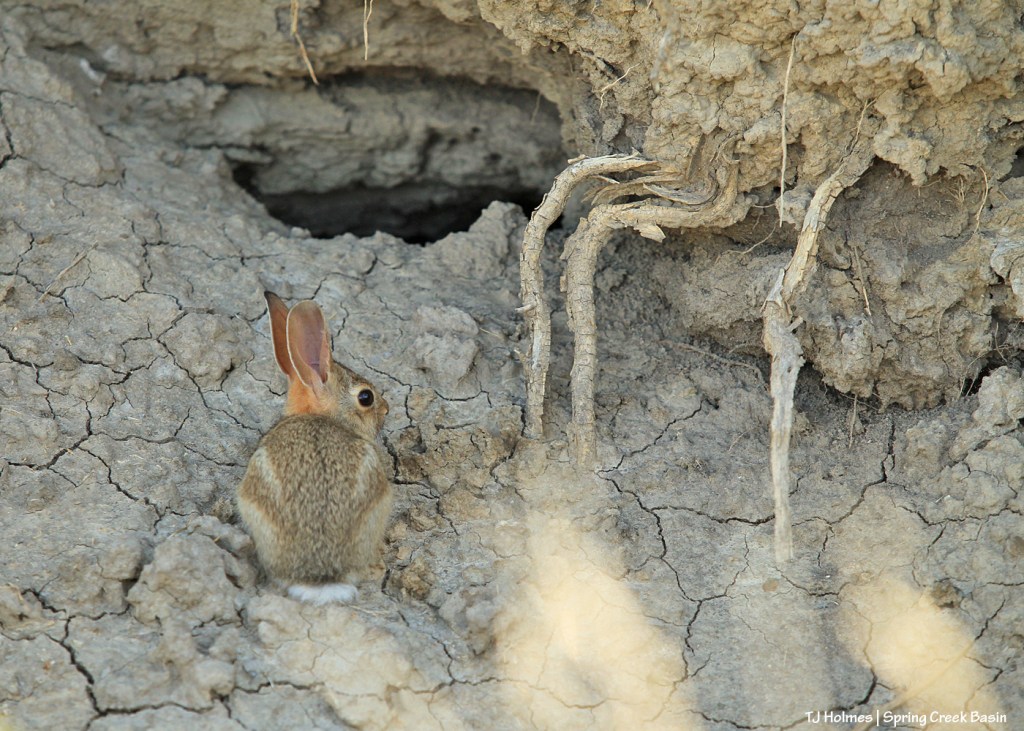
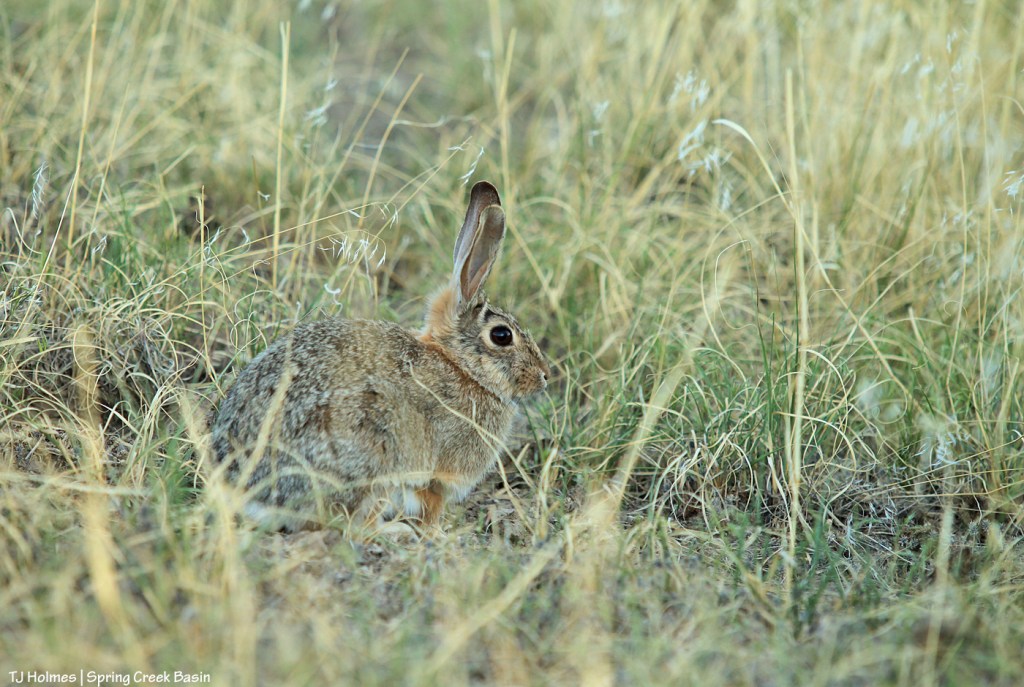
I almost forgot that I’d seen this little guy (or gal, in which case … Ms. Jane Rabbit?) in the basin on Monday as I was hiking down off the hill from my visit with the last bands of the day.
These are pix from my cell phone. My camera in its backpack isn’t easy to get to in normal conditions, but add 57 layers of clothing and vest and shirts and straps and bungee cords and buckles, and it’s impossible when presented with a critter this fast.
This guy (or gal) zoomed across my path and stopped. I fumbled to get my cellphone out of its case (under at least 39 of those layers) before he zoomed back in the direction from which s/he came.
Jack the Rabbit was about the size of his mortal enemy, Bob the Cat (OK, maybe not quite, but s/he was large!). And just as handsome in his thick coat.
Another teeny critter in the basin. The hole is in a very shallow little arroyo that leads to a bigger, deeper arroyo. I think this critter also is a youngster, based on its size.
Rather than allowing our “differences” to divide us, why can’t we celebrate all the wonderful colors and shades and nuances that make us *unique* – and beautiful?
When did “different” become “bad”? And who gets to decide that they are the baseline of “normal” so that “different” from “normal” also is “bad”?? So what, then, is “DIFFERENT” – and when the heck did it become something to hate and bully and demean? Is that “just” human nature? With all the diversity of this planet … what possible evolutionary advantage is there in being same?
What a world this would be if LOVE ruled our human behaviors. If “different” means that we’re only HUMAN, after all, only one species among many on this big blue (and yellow and red and pink and purple and green and brown and tan and orange and grey and turquoise and black and white) ball. If “different” means engaging our curiosity and asking “how can I get to know you better than I *think* I already do?”
As a journalist, I always thought I was a bit of a square peg trying to fit into a round hole because I never was a “news hound” for “if it bleeds, it leads” type news. My favorite tenure during my journalism days was my time as editor of the Dolores Star, during which I got to learn about people in the community, which also meant celebrating the community and those who lived in it. I liked telling positive stories about the people I met, doing all the interesting things they were doing.
A collaborator once accused me of being a cheerleader. I was cheered by that label, though I never would have embraced it in high school (and I wasn’t; I was in sports and band, and, of course, a horse girl) because it means that I embrace the positive; I embrace collaboration; I embrace partnership; I embrace the successes that come from all of it.
If we *embrace* more – more people, more love, more diversity, more hope – we can celebrate more … more people, more love, more diversity, more hope. See how that all comes around full circle?
Even during COVID-19 – maybe even especially during this time – can’t we achieve all of that? All of anything we want to achieve in the name of love?
Let’s NOT be color-*blind*.
Let’s be open to all the colors and shades brilliant and illuminated in the world.
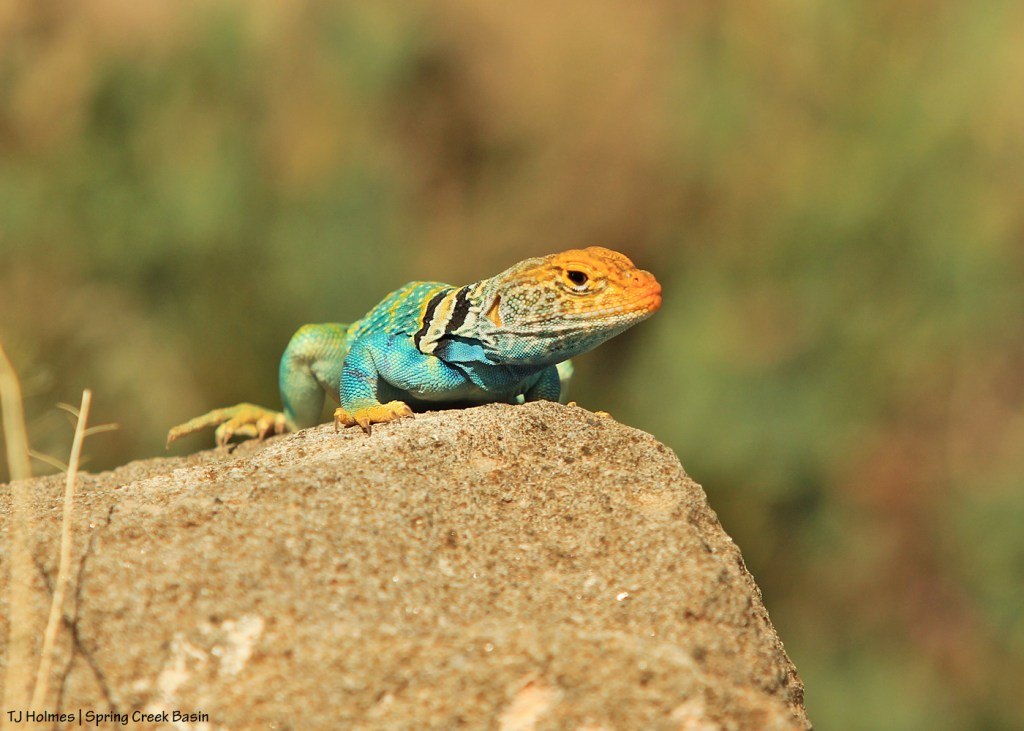
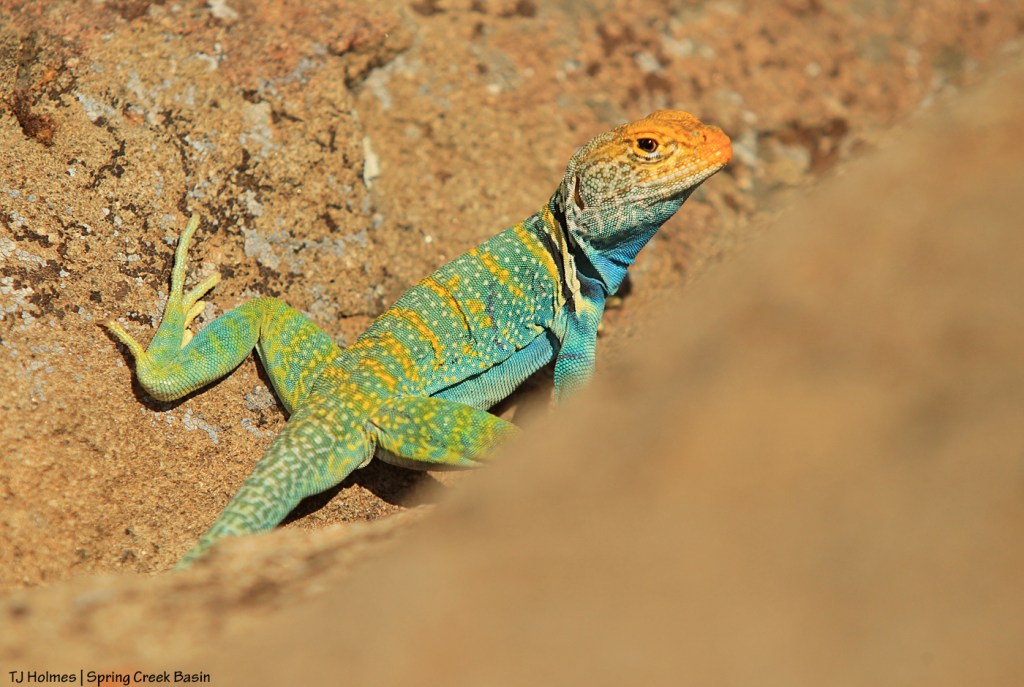
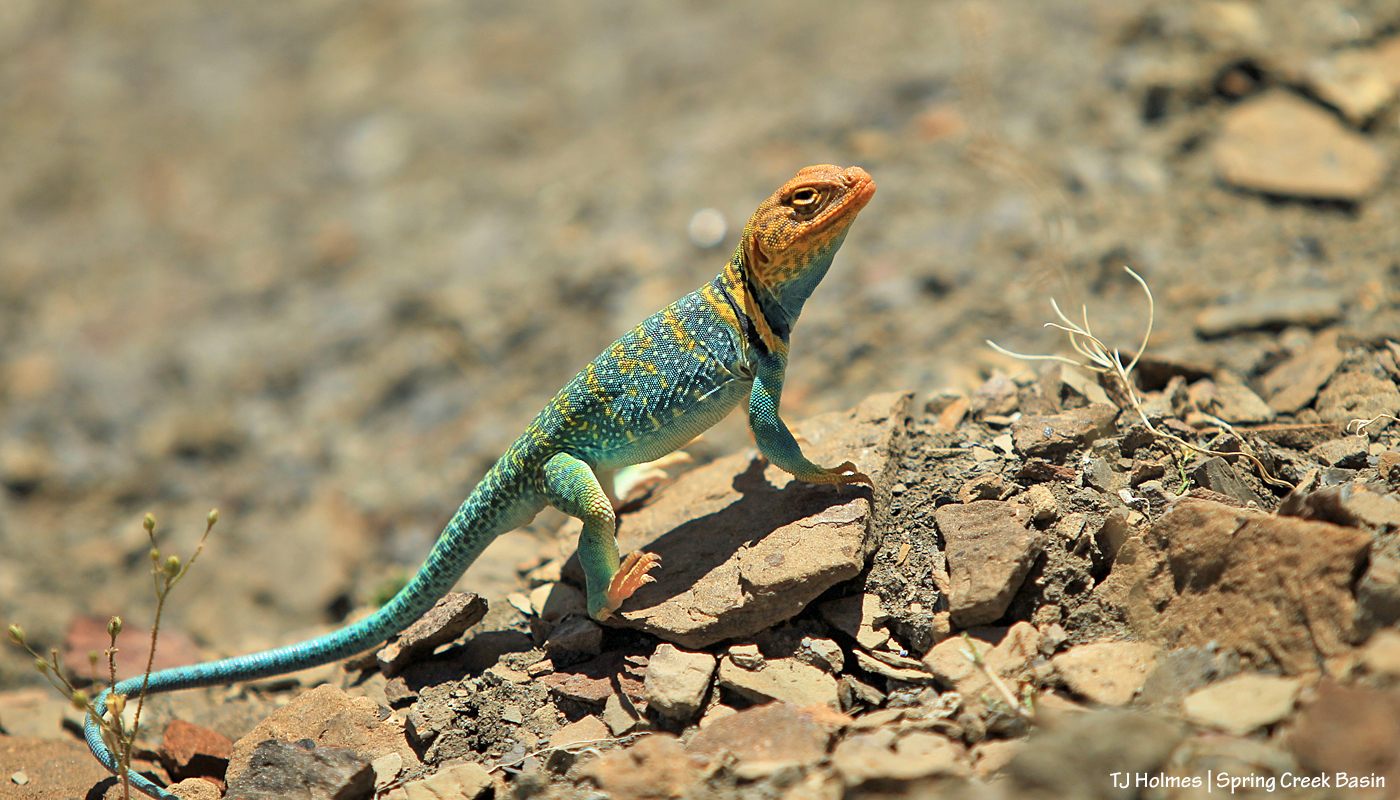
Continuing the theme of interesting critters (besides the mustangs!) in Spring Creek Basin …! This guy or gal isn’t my first sighting of a collared lizard this season (it’s my second in just the past couple of days), but it’s the first one that was bold and willing to pose (momentarily).
It’s a total miniature dinosaur! Look at that face!
Do you think the dinos were so wonderfully, brightly colored? I’ve never really understood the environmental benefit to being SO bright in our drab desert land. Ma Nature made ’em very fast, so at least they’re likely challenging for aerial predators.





 Spring Creek Basin Mustangs