
Terra, patiently waiting … save the relentless swish of her tail against gnats and heat.
Terra, patiently waiting … save the relentless swish of her tail against gnats and heat.
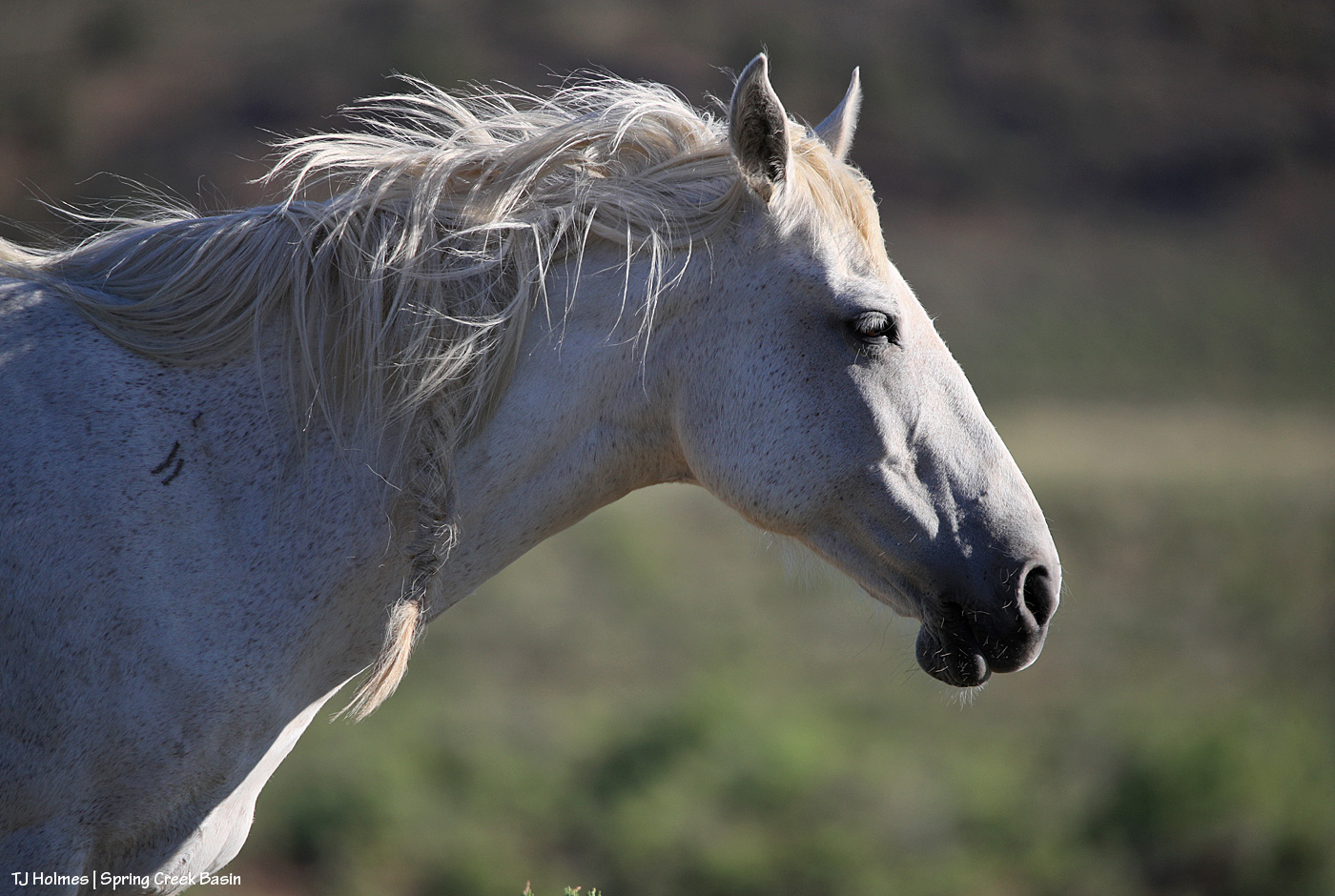
Piedra facing into the wind after the band’s water break. She’s also rocking that single braid. Must be a new basin fashion fad. 🙂

Happy Father’s Day to all the great dads out there! Especially, of course, mine. 🙂
If you’ve been following along for any time at all, you know my dad and my mom both are exclusively responsible for my before-birth addiction to horses. 🙂 They still have horses and work every day to keep them well. I’m so grateful to my dad for taking us on the journey around the world and through life, and for keeping horses at the center of it all. 🙂
I just heard a great song on the radio by band Lanco (LANCO? LanCo?) called “We Grew Up Together.”
It’s perfect for Father’s Day. Chorus:
“You learned to walk, I learned to walk in my faith
You learned to talk, I learned the things I shouldn’t say
You ain’t the only one who’s gonna make mistakes
God made you, you made me better
We both won’t stay young forever
You don’t know it now but one day you’ll find out
That we grew up together”
It makes me think of a family pic we have that shows me as a little redheaded bambino in a pink bunny suit, helping my dad build a stall (?). I think one arm holds me, and the other hand holds a level. We are both completely focused. It’s one of my very favorite pix of me and my dad.
Listen to it at the link above. Think about your dads. Give them a call if you can. If you can’t, remember them with more joy than sadness.
I love you, Dad!

Terra (and her stallion) circles the water trough while the “upper” members of the band drink first. They were impatient, but there was plenty for everyone.
Now we start to enter the truly hot days of summer, and water is at a premium. We’re grateful for the recent rains that put (more) water in the catchment tanks!

No hint of clouds this evening, but clouds and light made the most of the beautiful, simple act of a mustang (Buckeye) grazing among the grama.
The scenery to be seen around Disappointment Valley is NEVER a disappointment!!!!!!!!!

Rainbow over Spring Creek Basin from the Disappointment Valley road. … See the double? Unfortunately, we didn’t get any rain out of this one.

Sunset was just about (or more?) dramatic! This is looking eastish; the cloud-glow is from sunset behind me.

And this pudgy little jackrabbit posed for me right near the road with some reflected sunset light giving him/her a lovely glow. 🙂

Just one little braid. … She’s a fan of simplicity, our Winona. 🙂

A couple of nights ago, as I was walking away from mustangs to leave the basin post-sunset, I saw, for the THIRD time, a hummingbird on a cluster of wild flowers!
The first time was a hummer on claret cup cacti flowers a couple of weeks or so ago.
The second time was a hummer on a gorgeous bouquet of prickly pear flowers (this is the year of the prickly pear flowers; I am NOT kidding) a few days ago.
The third time was a hummer on a beautiful bunch of 4 o’clock flowers (which are just coming out with the rain/moisture of the last week) just a couple of days ago. All of these were in Disappointment Valley; the last/most recent one was in Spring Creek Basin.
Note: The above moth (?!?!) is NOT a hummingbird. 🙂 That hummer, like the two previous ones, had no patience for a silly photographer who either didn’t have her camera, didn’t have her camera ready and/or didn’t have her camera in-hand because “the good light” had slipped over the west hill from evening toward night and she (I) was already packed away. DOH. (Note to self: “You miss 100 percent of the shots you don’t take.” I don’t remember who said that, but it’s so true.)
The moths were particularly hard to photograph. (There ended up being at least two that came back to the 4 o’clock, but the above is the same moth.) They were fast. They were the very definition of flutter-bys – impossible to predict their flight patterns (and focus). The light was very low.
I am holding high hopes to be READY for the fourth hummingbird visitor – on any kind of flower – and you can be sure that I will share if I *catch* that, I will share that moment with all of you. 🙂
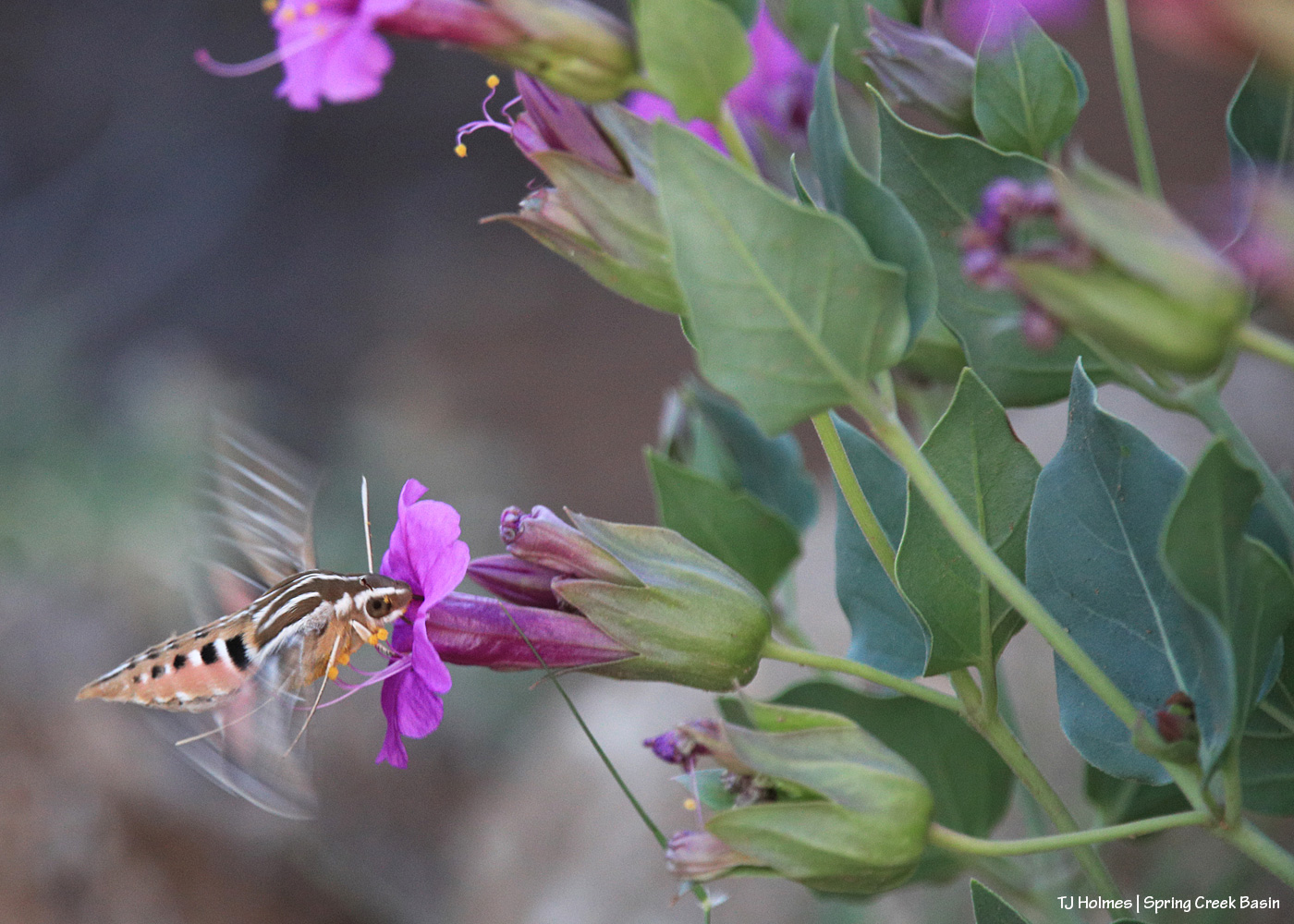
If you know what kinds of moths these are, please let me know? They were REALLY large, and I’m not at all sure they’re a “moth,” though they’re some kind of insect.
*** Update: ChicoRey left a comment about the bee a couple of posts ago that made me look up “sphinx moth,” and sure enough, I got a hit that makes me think what I saw were “white-lined sphinx moths.” Thanks, Maggie, for IDing these moths before I’d even posted! (This post was scheduled a few days ago. :))

Buckeye here is laser focused on a cow elk not far away on the west side of a hill on the western side of Spring Creek Basin. She was alone, as far as we (I) could tell. The mares watched her with brief interest and went back to grazing, but Buckeye was *intent*. That focus helped me spot her in the growing dark of the approaching storm (and yes, that rain did get to the basin!).
I was zoomed in on her, then swung the camera to him without changing focal length. … Intensity!

In all my excitement about the rainbow over the mustangs that came at the end (nearly) of my visit in Spring Creek Basin a few days ago, I nearly forgot about this busy little buzzer that I spent a fair time focused on (trying, anyway) as it buzzed around some rain-reinvigorated prince’s plume in the northern part of the basin. There were big ants on several of the plumes, along with much tinier little bugs (dreaded gnats?).
There were several smallish plumes growing from this one plant, and the bee diligently visited them all.
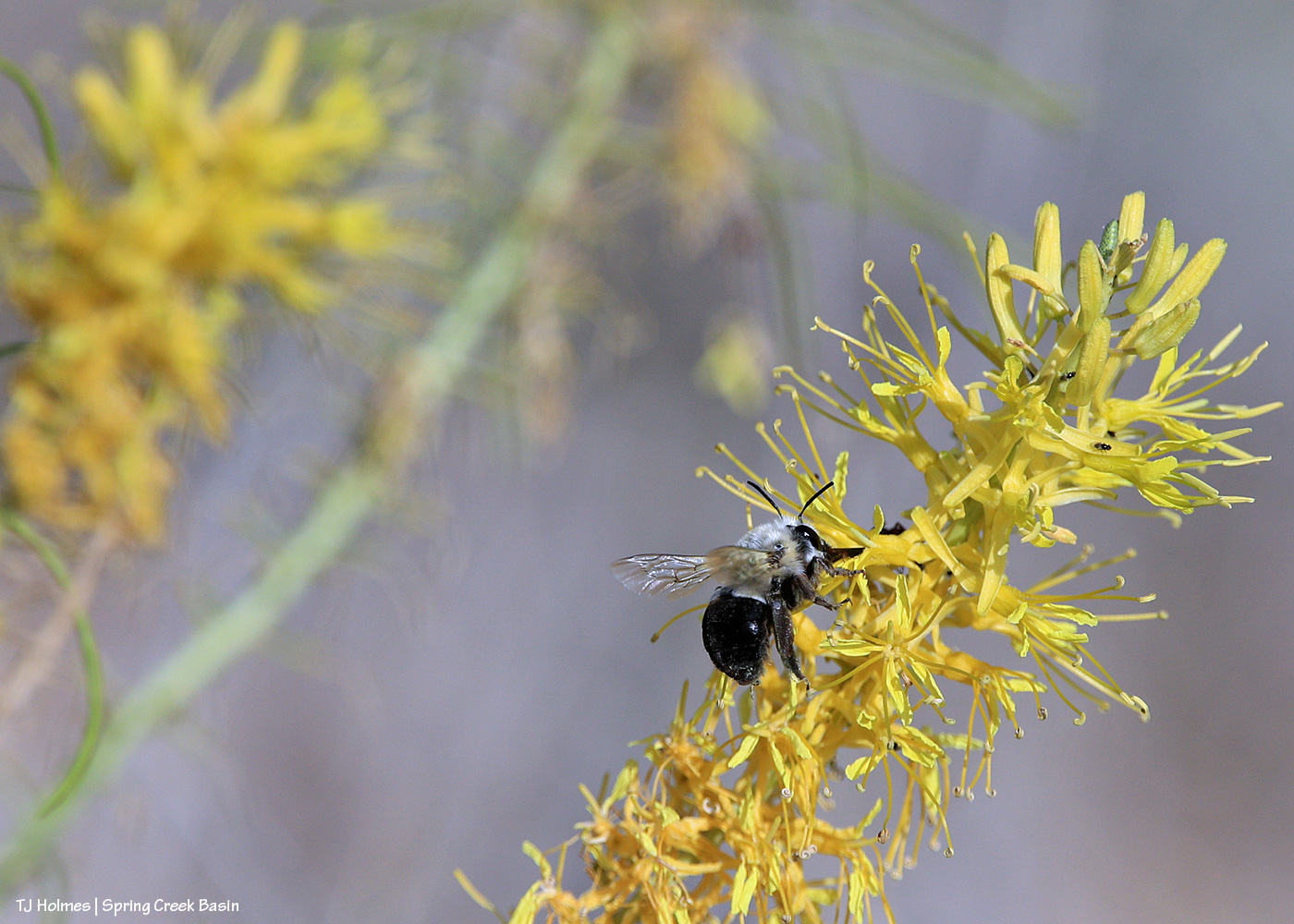


If you’re not a fan of bees on pretty spring desert flowers, I assure you that mustangs will return tomorrow. … I was quite fascinated with this little bee, and (to nerd out for a minute) I’m stoked at how well my camera and lens captured all its little details! I mean … NATURE! Am I right?! 🙂
 Spring Creek Basin Mustangs