Moved by purpose

9 10 2011

Yesterday, I sent a friend a quote I read on another blog:

“Think of all the beauty still left around us and be happy.” – Anne Frank

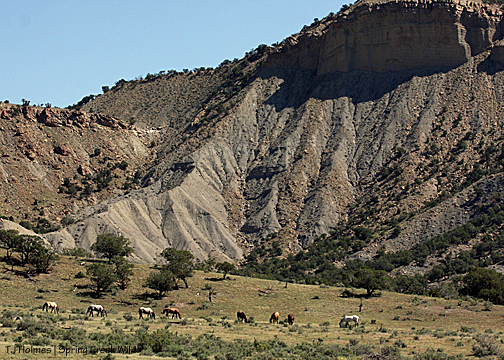
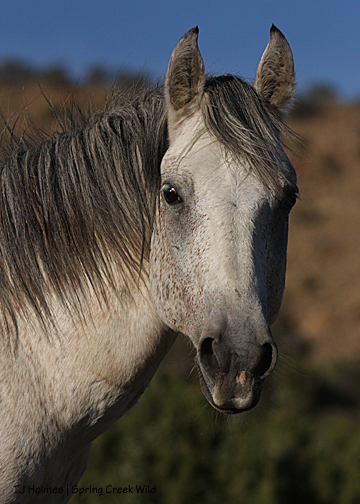
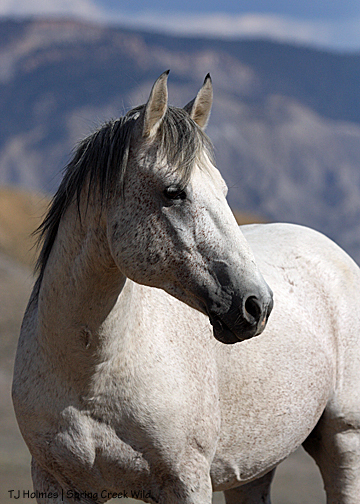
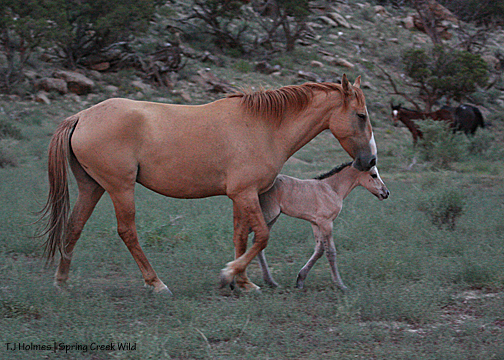
Today, I picked up a couple of the magazines that have accumulated in the last few months, that I’ve been too busy to look at, and read a headline about having purpose in your photography. I’ve tried to do that with mine, of the mustangs of Spring Creek Basin. I couldn’t quite read the article.

Then I picked up the latest issue of News Photographer. Though I no longer take photos as part of my job, I keep my subscription. The story was by an American photojournalist embedded at a NATO hospital in Kandahar, Afghanistan. I read most of it. The photos are intense. One small part of the opening photo, spread across two pages, stays with me, a nurse or doctor, looking over her shoulder at something behind the photographer … her hand under that of the man in the bed; he doesn’t seem like he could possibly be aware.

At the end of the article, after a particularly difficult day, the photographer spots James Nachtwey, war photographer, and stops to speak with him, to tell him about his influence, the reason he’s standing there, at a NATO hospital a world away from his home. The article ends with this quote:

“If you go some place for a purpose, you want to fulfill that purpose. It requires you to keep yourself together, and pay attention and concentrate and get the job done – well.” – James Nachtwey.

That’s exactly – exactly – how I felt at the roundup. A dear few, much respected and loved people helped me keep it together; I would have been lost without you. I would have been lost all along without the purpose of the horses. To all of you helping with that purpose … I thank you again and again and again …


Mustang nutrition

30 09 2011

Thanks to Elizabeth Testa from Four Corners Back Country Horsemen for passing this along!

Adopting a wild horse this year?

Guidelines on feeding the horse in transition from wild to domesticated

By Juliet Getty, Ph.D.

If there’s one thing we can say about the benefit of being wild, is that wild horses are generally far healthier than domesticated horses. Think about their diet for starters …  they have so much variety – grasses, flowers, berries, leaves, seeds, fruits – providing all the nutrients their bodies need. Once they  leave this natural setting, however, they typically eat only hay and it’s the same hay every day. Hay is dead grass and no longer contains the vitamins found in their previous diet.  Therefore, to fill in the nutritional gaps:

* Provide a comprehensive vitamin/mineral supplement along with flaxseed meal for omega 3s.

Horses in the wild rarely experience colic. One of the main reasons for colic in the domesticated situation is the rapid change from one feed to another, leaving the bacterial hindgut population little time to adjust.

These microbes are responsible for digesting the fiber found in forage (hay and/or pasture) and need to be protected. To help your new horse’s digestive system adjust:

* Feed a potent probiotic that contains billions of colony forming units (CFUs). 

Ulcers are common in domesticated horses, especially when transitioning to a new environment. Horses are trickle feeders – they need to graze continuously to keep the digestive system functioning normally.  That means they should have quality hay  24/7. Horses are awake and moving most of the time and will take 15 to 20 minute naps intermittently throughout the day and night.  The best way to protect your new horse against an ulcer is to:

* Feed him in sync with his natural instinct to continuously graze by giving him hay, free-choice.

Many wild horses are young. They require the variety of feed sources that they had in the wild that offered quality protein, fat, vitamins, and minerals to support new growth.  To accomplish this, add some alfalfa to your horse’s diet (about 30% of the total hay ration), along with either a supplement or a commercially fortified feed. Avoid cereal grains (oats, corn, etc.) and molasses – they can interfere with normal bone and joint development. In general:

* Feed growing horses extra protein, vitamins and minerals, and flaxseed meal to provide omega 3s, while avoiding high amounts of starch.

Respect your horse’s need to roam, along with other horses. Naturally curious, they enjoy seeking out feed in various locations, feeding their bodies, but also providing movement to keep the digestive tract muscles in good tone.  And being prey animals, they depend on the companionship of other horses to protect them against threats, real and imagined.  This transition phase can be stressful – new sights, smells,  people,  and other animals can create a hormonal response that can lead to a variety of health problems, including ulcers, colic, and laminitis.  All of these can be avoided by making slow adjustments, filling in nutritional gaps, and doing as much as possible to simulate a natural setting.

Feed him like he was meant to be fed – like a horse.


Back to work

27 09 2011

Prepare yourselves for information overload. You want it, and I have a good bit to share.

But first, I know people are crazy to know about this little girl, especially:

Mysterium is right as rain. Taken this morning.

Daddy Kreacher, however, has lost the band to Sundance. This happened right before the roundup. The last I saw them, Kreacher was trailing Sundance – and Chrome. I saw Kreacher today and yesterday, and this morning, he was fairly close to Duke.

Lots of photos to go through to illustrate the info I have, but here are some tidbits to tide you over:

* Mona is still pregnant. At this point, I don’t expect her to foal before October. Yep, that’s late. Naught to do but watch. (Interestingly, Roja also was a month “late” this year … ‘course, for her, “late” was May instead of April.) We’re supposed to have another La Niña winter in this part of Colorado …

* Almost all the stallions and mares that were together before the roundup have returned to each other. The exception is Bounce, who lost Houdini to Traveler in the last week … but hasn’t (yet?) gotten Alegre from Traveler.

* Grass looks really great in some areas, and most of the ponds are brimming with water after that rain we got.

* The horses look amazing and are headed into winter in just about the best possible condition.

* I found all but three horses (stallions): David, Poco and Roach.

++++++++++++++++++++++++++++++++++++++++++++++++++++++

Things are still up in the air about the horses at Canon City, but some people are working to provide all of them with great homes. If you’re interested in helping with that effort (looking for monetary donations for equipment/hay/board, etc.), please let me know {mtbgrrl (at) fone (dot) net}, and I will put you in touch with the appropriate people. Thank you!


After

20 09 2011

The last few days have been hellish tough.

THANK YOU to ALL who worked to make this as safe as possible for the horses and people attending. Those folks had a thankless job, and I hope I thanked you as often as I saw you, and as far as I know, they handled the event with professionalism and compassion. They certainly helped me.

We had some issues …

And we had tragedy: Cinch broke his neck in the alley while we were sorting the stallions for Canon City and adoption. I did not see it happen. The APHIS veterinarian made the decision to euthanize him almost immediately. I wish I could give you details … I wish I knew how it happened. What I’d like to know now is how to prevent that from ever happening again. I know it happened when or right after Hook crawled up and over the panel into the mare/foal pen. I won’t sugar-coat it. Cinch died, and that’s something I’ll always live with. He had at least two potential adopters waiting for him … one simply connected with him in the pen, and he reminded another of the very first mustang she had. I wish he was waiting for them right now.

It was a learning experience. (What an understatement.)

I learned that even though I thought I had prepared myself for the difficulty of it all, it was harder and more painful than I could ever have expected.

I learned to rethink some pre/misconceptions that don’t help us move forward.

I learned people and horses will surprise you in surprising ways … good and/or bad … surprising.

I kept learning that change is possible, and it probably never comes easily.

I learned that our Spring Creek Basin mustangs have touched people from Telluride, Colo., to Washington, D.C., and beyond. (WOW.)

I learned my heart wasn’t yet as shattered as I thought … and that what breaks it can also heal it – the horses.

I found solace in what brought me here in the first place.

Yesterday. Traveler. With a new family.

The horses … it’s always for the horses.

The last few days, I’ve been focused completely on the horses. Although many people had remarkable cell service, I had zero. I’ll apologize now, but all my energy was on the horses, and I couldn’t deal with the public with everything going on. My undying thanks and love to, especially, our Disappointment Wild Bunch Partners volunteers for talkingtalkingtalking. You bore the brunt of everything, and I can never repay you for your amazing fortitude.

You have questions, and I’m not sure I have all the answers. In fact, I’m sure I don’t. All the people involved did an amazing job with the circumstances we were dealt, and I will be forever grateful to all of them.

This was a hard, harsh, difficult thing, and I stand behind my belief that it was necessary for the overall health of the Spring Creek Basin mustangs and the Spring Creek Basin range. The horses look fantastic, and the range looks amazing.

Rain and rain and rain and a plane. … We never look down our noses at rain here, but the plane was absolutely an unnecessary danger to the horses.

Some numbers – because I think simple facts help in the overall understanding:

40 horses were ultimately removed.

42 horses are now on the range (this is shy just one horse of what was on the range after the roundup in 2007) – with one due any day.

22 are stallions (“males” of varying ages).

20 are mares (“females” of varying ages).

37 adults, 5 foals (this is the same number of adults and one foal shy of post-roundup 2007).

We released 5 stallions: Traveler, Bounce, Comanche, Chrome and Hayden

We released 5 mares and 2 foals: Kestrel, Juniper, Piedra, Houdini, Gaia, Alegre and Aurora

Six stallions went to Canon City: Mouse, Bruiser, Hook, Steeldust, Butch, Mesa

Five mares and one foal went to Canon City: Kiowa, Hacho, Luna, Alpha, Mahogany, Gemma

That means just 12 horses went to Canon City, and if you still wonder “why the roundup this year?” – this is why: So we didn’t put even more horses through this and send even more horses to Canon City next year or the year after.

Twenty-five horses will be offered for adoption:

Colts:

Gideon – yearling

Fierro – yearling

Rio – yearling

Wind – yearling

Sage – 2

Ze – 2

Cuatro – 2

Milagro – 2

Whisper – 2

Pinon – 3

Fillies:

Liberty – 2

Sable – 2

Hannah – 2

Spook – 2

Ember – 3

Iya – 3

Two Boots – 4

Baylee – 4

Foals also will be offered at adoption: Deniz, Eliana, Briosa, Boreas, Cougar, Varoujan, Coal

I’ll put up pix of all of them in the next few days.

Last night, I saw Traveler – with Alegre, Aurora and Gaia; Chrome with Hayden; Bounce with Houdini; Ty with Chipeta, Puzzle, Reya and Maiku, Copper following; Tenaz with Corona; Aspen; Seven’s band – Mona still pregnant.

“The foal.” Partly because of the delay caused by the unsafe actions of the plane, the roundup was delayed at least a day. The second day, the helicopter pilot found a large group of horses (15-20) bunched around a foal (Chipeta’s). He couldn’t easily separate them, so he left them alone. When he went back, the horses had separated o their own, and he saw the mare (Chipeta) but not the foal. The foal was later found and brought to the trapsite and cared for. He has been adopted by a local resident who took him to her vet (the same vet who was there as a volunteer with our Wild Bunch folks). He is doing very well.

I can’t say enough good about the helicopter pilot. He bears the brunt of people’s hostility, but he did an amazing job. Because of the rain and mud in Spring Creek Canyon, the trapsite was moved to the west side of Filly Peak. I was initially worried about that location because of the broken terrain on the “back side,” but in many ways, it turned out to be a much better location than the canyon.

If I can address the viewing location, too, for a minute … I know people were upset that they were so far away, but with safety of the horses paramount, the overall view was much better there than it would have been at the canyon – and I believe the horses were safer coming to that trap location than they would have been at the canyon. The second morning, the helicopter pilot had to bring horses in from that hill. Lots of things had to tie together to make this a successful operation, and one of those things was that we had to capture horses in order to make good decisions about who to keep and who to remove – and how many. Because of the rain and sloppy road that morning, very few people were on the hill when he brought that band in. If the crowd had been on that hill when he was trying to move the horses, the safest thing for the people would have been for him to abandon that band. Maybe you think that wouldn’t have been such a bad thing, but I was already upset about the lack of horses I was going to be able to release.

Thank you again for your patience. Please don’t ignore the positives here, which are many. I won’t ignore the negatives, either – as long as we can use them to effect change. That’s what got me into this, and it’s what keeps us going.

One last thing for now: I did not take a single photo … until yesterday with the horses when it was all over. I will post those as soon as I can. Too much else going on, and I owed my attention to the horses, not to my camera.


Time

13 09 2011

Thank you to all who have offered your support, your tears, your concerns, your optimism and hope. I can’t begin to tell you how much it means.

The last four years (and before that … 13 years back since others in our group have been advocating for our Spring Creek Basin mustangs?) have been difficult … The last few days have been more difficult still. It will get better. We have been working too long and too hard and with too much single-minded purpose to settle for any other outcome.

I’m packing now. I need to buy food. I’ll be at work till midnight, home around 1 a.m., and then I’ll be on the road to the basin in the morning. I’ll know more tomorrow … with probably no way to relay it here.

Again, BLM plans to have a hot line to call for information about each day’s roundup activities: (970) 882-6843.

I do not think I will have enough of a signal to connect to the blog via my cell phone for updates, so anything from me will have to wait until I return home, which probably won’t be until Monday.

The horses are strong. They’re in excellent health. They’re resilient and they are just damn tough. They will adapt. We all will – because we have to. The coming years will bring even more changes – positive changes. The roundup is not the end of the story, just the end of a chapter, and as time goes on and it’s further in our past, it will be yet another thing to learn from and channel our management into better forms. We have to get through this to get there.

Thank you thank you thank you thank you thank you thank you thank you thank you thank you thank you thank you thank you thank you …

… for all your care.


Adoption flier

11 09 2011

While we’re posting this flier about the coming training demonstration and adoption (Sept. 23-24) around the region, I thought I’d post the flier here on the blog as well. You never know …

Thank you to all the volunteers posting this in Farmington, N.M., and Moab, Utah, and as far away as Montrose and Grand Junction, as well as locally in Cortez, Dolores, Mancos, Durango, Bayfield, Pagosa Springs, Norwood, Ouray, Ridgway and Telluride! Thank you!


The adoption

5 09 2011

Time to talk about the adoption related to the roundup. We have some educational opportunities in the works that I think will both draw adopters and help people keep their mustangs.

Our groups – Disappointment Wild Bunch Partners, made up of representatives from NMA/CO, Four Corners and Mesa Verde Back Country Horsemen, and San Juan Mountains Association – are already working to promote the adoption. I’ve been doing it with my talks that started in February this year, we have letters to the editor and “public service announcements” out to several local newspapers, and we are going to post fliers in locations around the region. BLM also will do some advertising. No matter how BLM divvies up the horses post-roundup, probably 25 or fewer horses will be available for adoption.

NMA/CO has enlisted the services of a local trainer, Ems Rapp of Durango – who adopted a Spring Creek Basin colt (Rock On) in 2007 – to help adopters with their new horses. NMA/CO will pay for her services, and we will encourage each adopter to take advantage of this offer.

It is important to note that this is an offer made by the COLORADO CHAPTER of the NATIONAL MUSTANG ASSOCIATION and has nothing to do with BLM.

We hope it will help folks get started on the right “hoof” with their mustang, and we hope it will lead to greater retention of adopted horses.

If you are local, plan to adopt and want more information, call Pati Temple (NMA/CO board member, adopter of several mustangs) at (970) 564-8400. She will be coordinating training help with Ems.

All the activities related to the adoption will take place at the Montezuma County Fairgrounds, a few miles east of Cortez, Colo., on U.S. Highway 160.

From 5 to 7 p.m. Friday, Sept. 23, the evening before the adoption, Ems will give a presentation at the fairgrounds with her gorgeous boy, Rock On, now a 6-year-old. (Incredibly, I don’t have any pix of them!) This also is a change from the usual – instead of pulling a terrified young mustang away from his/her compadres, Ems will show potential adopters all the great potential of their mustangs, using Rock On as an example of mustangs in general and Spring Creek Basin mustangs specifically!

Rock On does, in fact, rock, and we think you’ll love him as much as we do. He also will be on-site the day of the adoption (Saturday, Sept. 24) as an ambassador for Spring Creek Basin mustangs.
In addition, Vern and Jeri Friesen (4CBCH members) will be ambassadors with their mustangs, Dolly and Lipton (2000 adoptees), and Wayne Goodall will be there with Tumbleweed II (2005) and his grandson, who also has a Spring Creek Basin mustang, adopted in 2007, I think. Vern and Jeri have taken their mustangs back to Spring Creek Basin almost every year to ride during 4CBCH’s annual wild horse count, and Wayne has a long history as a mustang ambassador. Dolly, Lipton and Tumbleweed are awesome!

Adoption activities will start at 8 a.m. Saturday, Sept. 24, at the Montezuma County fairgrounds. I believe this is when BLM will start taking applications from potential adopters. The bidding will start at 10 and end at 11 a.m.

This will be “silent bidding,” as opposed to “auctioneer-type” bidding – you’ll write your bid on a sheet that corresponds by number to particular horses (they’ll have the number tags by then) – and update your bid as people bid against you (and you against them!).

For each adopter, I plan to have available a packet that contains information about their horse – photos, sire and dam, birthday, siblings and simple history, including any insights to their personalities and/or fun stories. I will be at the fairgrounds both days to talk to people about the horses. Another thing I’m thinking about doing pulls another idea from Matt Dillon of the Pryor Mountain herd, who had information sheets at the 2009 Pryor Mountain adoption that listed each horse by number and name. So if you’re familiar with the horses through this blog, you’ll be able to find them by name.

Our groups will have volunteers present to also give advice and information about their experiences with the herd. Some of these folks have been visiting the basin for up to 15 years!

Mesa Verde Back Country Horsemen will have drinks available right at the table where Disappointment Wild Bunch Partners will have other information.

We want the adoption to be more than “bid and haul.” We want to provide information that will help ensure that our horses, which are becoming your horses, have long, happy lives with you who adopt them.

Again, if I can answer any questions, leave a comment or email me at mtbgrrl (at) fone (dot) net.


Guest post – Tami Lewis

3 09 2011

TJ’s note: I met Tami Lewis last summer, when she and her daughter, Laura, visited Spring Creek Basin from Florida. Tami works with reassigned mustangs through a BLM contract in Florida and has seen the worst of the system. It was quite an eye-opener to talk with her about her training experiences, and coming up on our roundup and, particularly, adoption, I thought it would be helpful to have her talk about what she does. It was so cool to hear her relate the horses’ natural, wild behavior to the techniques she uses to connect with them during “training.” That’s almost too formal a word, I think. Some of the horses she works with don’t need “training” as much as they need a quiet voice and gentle hand to rebuild their confidence and give them a different view of humans than what they’ve learned since leaving the wild.

She was in the process of writing a book when I met her. Overcoming the Fear Factor has been published and is available at Amazon at that link. Although it deals mostly with horses that ARE overcoming their fear, it’s an essential read for how to avoid that altogether.

**********

With the Spring Creek Basin round up just days away I wanted to share some thoughts based on my experience. I have been fortunate to have the opportunity to observe the magnificent wild horses of the Spring Creek Basin.  I am preaching to the choir when I say that TJ Holmes is an exceptional  woman dedicated  to the welfare of these American icons and providing the tools for a fundamental management model conducive to their survival.

TJ and her Wild Bunch have created a program of herd documentation, immunocontraception, specifically PZP, as a viable, effective and humane method to decrease reproduction rates and have encouraged the future implementation of bait trapping for removal. There is not a more valuable resource for the BLM when considering the management plan for Spring Creek.

As a wild horse trainer, listed with the BLM, it has been my experience that the specific selection of wild horses to be removed yields far better success rates for adoption and is cost effective long term.  Wild horses removed in a less stressful environment with consideration to DNA, family bands and social structure are more successful domestic partners in a horse-human relationship than those removed under severe stress.

While wild horse rounds ups are typically bounded by deep emotions, involving many public stake holders, this is the time for serious consideration about the health, safety and welfare of these innocent creatures. I preach daily about anthropomorphism but love this analogy because it makes my point crystal clear. Imagine for a moment losing your freedom and being separated from your family and friends. For a herd animal this separation is devastating to its sense of security. As you know from this blog, mustangs live in bands with sophisticated social systems and are constantly interacting with each other. Now imagine being removed from your home and being placed in a crowd of strangers. Visualize being a child or a mother separated from her child.

When a wild horse is captured it will immediately view humans as predators. The more noise and chaos created by humans will paint a forever picture in the mind of the horse about humans.  I work with horses and humans to try and reverse the fear evoked by humans. Contractor behavior during a round up is paramount to the success of an adoption since these initial interactions with humans are everlastingly.

Wild horses respond to the slightest pressure and our human bodies are enough pressure to move a herd without uttering a word. Since horses live in a world of non verbal communication and synchronization, they can be moved effortlessly with a quiet, non threatening approach.  I hope that the BLM will do everything possible to ensure proper contractor behavior.

I want to share with you the story about my beautiful mustang mare, Dixie, who inspired my book. Dixie was born in 2004 in the wild at the Jakes Wash Herd Management Area Nevada. Dixie was rounded up by the Bureau of Land Management in 2007, at the age of three.

Dixie was held in a BLM holding facility for about two years before being adopted and taken to Florida. The person who adopted Dixie professed to be a trainer.  She applied an ineffective and harmful technique referred to as “rope and choke” to halter this beautiful wild horse. She used this method as a method of control rather than building trust between the horse and human. Imagine fearing for your life with your only known predator, a human, at the end of the rope.

The severity of the wounds indicated the degree of her struggle. Dixie was a lovely palomino mare that should have been on her way to bonding with humans, but instead we were working to reverse the fear evoked by humans.

Dixie was an extreme fear case that arrived at the Wild Horse Rescue Center with serious rope wounds around her neck, swollen hind legs with cuts and covered in lice. She was about 200 pounds under weight and would not allow a human anywhere near her.

Initially, Dixie was placed in a safe paddock next to another familiar mare where she could take in all of the barn activity. Movement, of any kind, sent Dixie snorting and running. Her head was always held high and tight, and her eyes were wide. The pressure of a human walking by her paddock was too much for her. Left alone for several days to take it all in, Dixie learned that she wouldn’t die. Since Dixie believed that she would die if a human got a hold of her, this step was a breakthrough. Without a proper step one, Dixie would have injured herself being in such an exaggerated flight state. Leaving her alone, to make her own assessment, on her terms, allowed desensitization to people and movement.

This has been a long process of proper training, love and respect for her wild horse nature. I can not say that our journey has been without challenges but this work is a life long passion for me. Dixie lives with me today and my hope is that she may become who she is meant to be.

Why do we hold a sense of reverence for these iconic, free-range animals to the point of great debate? Historically, since the genesis of man, humans have sought freedom. The desire for freedom resides in every human heart as it does in the wild mustang. We live in a country founded on the principles of freedom. The freedom that I speak of stands opposed to constraints. Constraints that hinder our own desire, bridle our innate creativity, growth, and joy. Pictures and stories of the wild mustang enchant us because we are envious of his power, nobility, and independence.

Please pray for TJ, her dedicated volunteers, the BLM and the wild horses of the Spring Creek Basin.


And the winner is ….

30 08 2011

Rachel! With her guess of Aug. 22!

Baby has an “official” birthday of Aug. 21.

Thank you to readers/guessers Zacharias and Maria, who were very close!

(Thank you also to my long-suffering co-worker Katie C-C for pulling the name out of the basket – again!)

If I’d been more organized, I’d have set up a photo to use with this post – but I have numerous pix of this girl to post later … and many future visits.

Rachel, can’t wait to hear what you come up with as a name for Kootenai’s gorgeous baby girl! No pressure! 🙂 And your calendar will come to you toward the end of the year!

Update: I decided that I couldn’t let Zacharias walk away empty-handed after his also-excellent guess, so I offered him a calendar, too. And yes, I’m definitely planning to hold another vote about calendar images this year – hopefully earlier so I can get them done and out earlier! Really, I’m thrilled with their guesses (especially because I originally thought “no way she’ll foal that early!”) – and with Maria’s Aug. 24 guess, too. I’ll have to figure out something for Maria – maybe a print of Kootenai’s filly. September-guessers – I would have been with you! Until I saw Kootenai on Aug. 19, I thought for sure she was going to head right into September before she shared her baby!

Here are a couple other photos to round out this post:

Baby girl and mama. Such a teeny thing, and mama looks fabulous! You can see big brother Apollo and his mama, Raven, in the background – Kreacher was just to the right of them. It was cloudy enough (and we’d already had several waves of light rain) that it was “dark” before it was dark. My camera was having a hard time “seeing,” but I was having a hard time putting it down! This was just after the sun had actually set … we got a teeny bit of light when the sun dropped out of the clouds … before it slipped back into clouds and around the curve of the world …

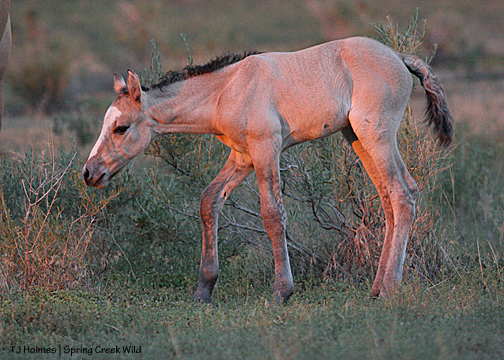
Baby girl in that soft little red glow that lasted just minutes. … And yes, I think she’ll stay dun. I don’t think this girl is destined to go grey. Notice Kootenai’s legs – she has the stripes, with that lovely “webby” sort of pattern, but they’re darker “orange” than the rest of her body coat, not dark or black, like Hollywood’s are.

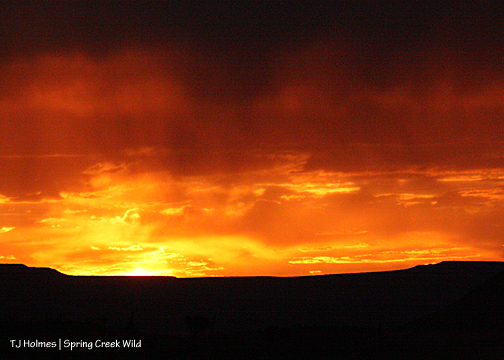
Can’t forget daddy Kreacher! Little bit of that glow on him, too, and lighting up the eastern “wall” of the basin … caused by …

Wow, right?!

Beautiful day to find a beautiful girl. 🙂


The roundup

25 08 2011

With the Spring Creek Basin roundup just about three weeks away, the time has come to address with more in-depth explanations what’s coming with regard to the Spring Creek Basin roundup. Along the same lines, I’d sure like to start discussions about what YOU are most interested in knowing. What are your concerns, fears, apprehensions regarding this roundup? I will answer as fully and candidly as possible – based on my knowledge. I can yak about things I *think* you’re interested in … but if you have something specific, please do ask. If I get enough questions, I may do a specific post, addressing each question, rather than leaving them in the comments sections.

My email – if you would rather not leave a public comment – is mtbgrrl (at) fone (dot) net.

A couple of disclaimers to start:

* I feel the need to explain this again: Because of the size of Spring Creek Basin (slightly less than 22,000 acres of high desert), it cannot support a population that is considered by many to be genetically viable on its own. Please don’t get carried away with some “certain” number that would make the Spring Creek Basin herd viable. The finite nature of the herd management area – and its water and forage resources – makes a population other than what the basin can physically support a moot point. To achieve that balance and maintain both herd and range health, this roundup and the removal of some horses is necessary.

* Because I will be working with BLM does not mean I am in full agreement with all its policies and/or procedures. In fact, quite a bit of the status quo that CAN be changed is what I am working very hard TO change. But we must work within the bounds of reality, and with that in mind, we have accomplished quite a bit here.

Follow this link to get to a PDF map of Spring Creek Basin Herd Management Area. Warning: It takes an obnoxiously long time to download – and I’m on a high-speed connection. Then, when it was “done,” it was black. I clicked the + button at the top to bring it into view. The blue line denotes the boundary of Spring Creek Basin, and the G at the western edge denotes the location of the trapsite.

So let’s talk about the roundup.

As a representative member of Disappointment Wild Bunch Partners and president of the Colorado chapter of the National Mustang Association, I will be involved with BLM during the roundup. As documenter of the herd, with specific knowledge of the horses, I will be intimately involved. This is not precedent-setting; it happens with at least three other herds I know of. It’s one of the things that most impressed me before I started documenting the Spring Creek Basin herd – and why I realized I had to make it happen here.

What it means is that I will be at the pens the entire time, attached at the hip, so to speak, to Jim Dollerschell, manager of the Little Book Cliffs herd, who will be at our roundup in the capacity of “contracting officer.” What that means in practical terms is that Jim has lots of experience, and Spring Creek Basin does not have a herd manager at present (though it is hoped one will be hired by the time of the roundup). Because of Jim’s specific experience as manager of the Little Book Cliffs herd – using native PZP successfully (their roundup this fall was canceled, remember) and working with an active and dedicated advocacy group (Friends of the Mustangs) – I am extremely grateful to be working with him, in particular.

My main duty will be to advise BLM about the identities of each horse captured, as well as advising BLM – and, in turn, the helicopter pilot, with whom Jim will be in contact via radio – of the identities of horses on the range, especially as it comes to bands that should NOT be targeted for roundup. Specifically, two of those bands will be Kreacher’s and Seven’s, which include Raven and Kootenai (in Kreacher’s band), and Mona (in Seven’s). The reasons here are two-fold: 1) Raven, Kootenai and Mona were introduced in 2008 for their genetics, needed in Spring Creek Basin to keep our own genetics strong. 2) Kootenai just had her foal, and Mona is due to foal Sept. 15, the day the roundup is scheduled to start. Beyond even what BLM says, it would, indeed, be a “PR nightmare” for very young foals to be killed during the roundup – especially when they’re *known.* The third band will be Ty’s, which includes yearling Puzzle and her dam, Chipeta, who is due to foal Sept. 1.

Bringing in by band

We have talked with BLM about bringing horses in by band – as opposed to large groups of unrelated horses. BLM has not made any promises whatsoever in this regard – I don’t believe it *can* make such promises. But the biggest problem, as I see it, is that no matter in what “organization” the horses come to the trapsite, they are immediately “processed” and sorted into gender-specific pens – in other words, separated from their families and put in with unfamiliar horses, which causes fighting among stallions as well as mares protecting foals. This has no bearing on the current roundup, but it’s worth saying: Keeping families together – until the point of actually selectively removing a particular horse or horses – is just one benefit of bait trapping. However, because of the very nature of the helicopter-driven roundups and related “efficiency,” I really don’t see how it could be done other than the way it will be done. (That it NEEDS to be done differently is one thing we’re working on!)

Dates/timing of release and number(s) of horses to be released

Some specifics here via what we learned at our meeting yesterday (Aug. 24): The horses to be released (including mares, who will get the PZP primer) will most likely be set free as soon as it is determined the roundup is over and no more horses will be captured. The roundup is scheduled to start Thursday, Sept. 15. Expectations are that it will last no more than a couple of days, but, of course, this is subject to on-the-ground realities such as weather conditions. Horses not going to adoption may be loaded onto trailers bound for Canon City by Saturday (Sept. 17), and the horses bound for adoption will be hauled to the fairgrounds Sunday (Sept. 18). I understand that’s because that is the soonest date the Montezuma County Fairgrounds will be available for them. The training demonstration by Ems Rapp and her Spring Creek Basin mustang, Rock On, will be held from 5 to 7 p.m. Friday, Sept. 23, with the adoption scheduled Sept. 24. The adoption details will be outlined in a separate post.

The contractor – Cattoor, same as in 2007 – is expected to arrive in Spring Creek Basin on Wednesday, Sept. 14, to set up, and the roundup is expected to start Thursday, Sept. 15. It is scheduled through Sept. 18, but it may or may not last that long, as noted above. BLM says about 10 horses likely will be released, but that number will depend entirely on the number of horses rounded up and the number left in the basin (not rounded up). We also have not specifically addressed how many horses will be left in the basin post-roundup. The low end of the AML is 35, but 43 were left in 2007 (unknown to BLM; the manager at the time thought 37 horses were left). We hope to use this precedent – as well as logic such as the use of PZP (with documented efficacy of at least 90 percent), no planned introductions of horses and the gender skewing – to leave at least this many horses after this roundup.

Mares to be released will be given the PZP primer (by Jim, hopefully with me being allowed to help) in the chute immediately before release. They will NOT be branded because of acknowledgment of my documentation – which will, of course, continue. (Of interest here is that BLM recently announced that it will pay for the PZP to be administered to Spring Creek Basin mares; NMA/CO had offered to pay for PZP for a period of five years (the expected length of the fertility control EA).)

In addition to saying it’s likely 10 horses will be released, BLM also says (in the Decision Record, at least) that the released horses will likely be six stallions and four mares. In a perfect world, that would represent a 60%/40% stallion-t0-mare ratio. In the real world, BLM cannot know (none of us can) what the make-up of the herd will be when BLM ends the roundup and prepares to release horses. In 2007, still espousing the gender-skewing goal, BLM released five mares, the weanling filly of one of those mares and four stallions (with Traveler released nearly a month later). As it turned out, there was still quite a significant split between mares and stallions. BLM had no idea then of the post-roundup stallion-to-mare ratio before it released those horses. This time, we’ll know – exactly – and the numbers/genders to be released can accurately reflect that. (To be clear, gender skewing is not something NMA/CO (at least) supports, but it was a battle we chose not to fight at this time.)

Contractor behavior

We also have repeatedly asked that the contractors give the horses time to settle in the first pen at the trapsite instead of being choused by the contractor’s cowboys using plastic bags on the ends of whips/sticks after the horses have just been run for miles and captured in pens and are then sent immediately into the chute for “processing.” Again, no promises have been made here – other than they will bring it up to the contractor. However, I believe this is behavior that should not be tolerated unless it is specifically warranted in a specific situation. Wild horses – like other wild animals – move away from pressure, a human being a great pressure. Example: At the last Little Book Cliffs roundup (also in 2007, just a few weeks after ours), only once did the volunteers need to use a plastic bag. Two very small bands came in together – as I recall, a stallion with one mare and a stallion with two mares (with a foal or yearling?). In the close confines of the alley leading to the pens, the bag was used to separate the stallions – then immediately put away.

Yelling and screaming and waving those things in the faces of wild horses that have just been on a terrifying run ahead of a helicopter and then penned with no way out is NOT the time to use it. We reiterated this plea at our meeting yesterday and will continue to do so.

Selection process

Now, about the “selection process,” the thought that prompted this post in the first place (much of this is pre-typed (though, I admit, oft-edited); I was waiting for information from yesterday’s meeting to post it). I want to emphasize here that this is MY philosophy, and based on MY knowledge of the Spring Creek Basin mustangs. This is necessarily tempered by the reality of what I think BLM is most likely to accept.

Part of my selection process is genetics, and the other real part of it is “adoptability.”

I’m going to address specific language in the Decision Record (and in the EA). (If you wonder why I use “roundup” instead of “gather” in my writing, it’s because this is, in fact, rounding up horses – capturing them against their will – sorting them and removing “excess.” “Gather” assumes some gentleness – some emotion. I can be emotional (and will be) as the day is long about these horses – my horses – but logic has gotten me this far, and it has earned me a reputation with local BLM that, in turn, earned me a place at the table (or at the pens). I defend the need for this roundup, but I absolutely will not call it a “gather.”)

According to the Decision Record: “Animals captured within the HMA would be removed using a selective removal strategy. Any horse gathered from outside the HMA would be removed and not relocated in the HMA. Selective removal criteria for the HMA include: (1) First Priority: Age Class – Four Years and Younger; (2) Second Priority: Age Class – Eleven to Nineteen Years Old; (3) Third Priority: Age Class Five to ten years old. Up to 10 of the captured wild horses would be released; of these, about 4 would be mares and about 6 would be studs.”

First, there are currently NO horses outside Spring Creek Basin, so I think this is formal language “just in case.” In 2007, several horses were outside the herd management area. One was moved into the herd area from private property and remains – David. One currently serves with the U.S. Border Patrol on the U.S.-Canada border from Washington state – Justice. (If you’ll allow me some pride … Justice also was one of the 10 Border Patrol mustangs that marched in President Obama’s inauguration parade – just 18 months after he was captured. (An FYI – he was aged at 10 by the contractors – and ripe for removal, no questions asked – but at Canon City, he was determined to be no older than 5.)) And about four horses were captured outside the southwest end of the basin.

Second, my strategy for “selective removal” is genetics-first – because I KNOW quite a bit of the genetics, especially of the adoptable-age horses. BLM goes with age because that’s what it knows (based on the contractor’s expertise in aging by teeth … which wasn’t all that great in 2007, as it turned out (even according to BLM)).

Third … which is related to second … is that I’ll be looking at a combination of genetics AND ages – especially as it relates to “adoptability” – or the fact that horses between the ages of 1 and 4 are most likely to be *offered* for adoption – especially locally, immediately after the roundup.

I will NOT make public the horses on the lists that I have given BLM, but these are the categories: STAY (I will say that Traveler and the introduced horses, at least, are on this list), should stay, can go, can go or can stay. This idea of having multiple lists came from Matt Dillon of the Pryor Mountain herd, to allow flexibility, and I think it’s excellent, so I adopted it (Matt has been a great inspiration over the years in many ways). Necessarily, maybe, the “can go or can stay” category has the most names.

*** Please (I really beg you), don’t appeal to me for your favorite horse(s). As important as I believe this duty to be, and as absolutely grateful as I am to our local BLM folks who have afforded me this opportunity, it’s going to just about kill me to make these decisions. I am trying to make decisions that I can defend logically, that BLM will accept and that will benefit the herd as a whole. Please, please do not make it any harder.

BLM says about half the horses rounded up will be offered for adoption and about half will be sent to Canon City. (Horses CAN be adopted from Canon City, and people can request halter (and saddle) training by inmates at the Canon City facility, to then be transported to the adopter’s home.) Realistically, this will depend on the number and make-up of the horses actually captured and removed.

BLM’s rationale for the half-half deal is that in 2007, only about 13 of the 32 available horses were adopted. As BLM says, it’s a bad economy, the horse market in general is in the tank, and the mustang-adoption market itself is down considerably from happier times.

But here’s “the rest of the (hi)story”: In 2006, BLM held a mustang adoption in Pagosa Springs, in southern Colorado, about 100 miles from the site of the 2007 adoption (it will be here again: Montezuma County Fairgrounds, on U.S. Highway 160 a few miles east of Cortez, Colo.). In 2005, a post-roundup adoption of Spring Creek Basin mustangs was held. So three adoptions in three years? That would tend to “saturate” even a bad market, yes? At the previous adoption – in 2000 – almost all the horses were adopted, according to NMA/CO memory. One of my goals for future sustainable management of this herd is to *create* a market for our Spring Creek Basin mustangs by making offerings somewhat “rare” – infrequent with few(er) horses.

BLM roundup information hot line

A BLM hot line will be available with information about the roundup: Tom Rice, associate manager of the Dolores Public Lands Office and deputy district ranger for the Dolores District of San Juan Public Lands, will update a message by about 10 p.m. each night about that day’s roundup activities. People can call that hot line at this number: (970) 882-6843 (his office number). The time will depend on the day’s activities and how soon he can get away to locate cell service. (Cell service within the basin – within the entire Disappointment Valley area – is bad at best.

I have thought about trying to figure out a way to post updates to the blog through my cell phone, and if I have a strong enough signal, I will surely do so. I am almost positive I won’t be able to post any photos until I return to civilization, which likely won’t be until at least Monday (Sept. 19). I plan to be at the roundup every single day, until the last horse is gone, the last panel is loaded and the second-to-last human being (me being the last) has left his dust on the road. I’ll apologize in advance for being publicly incommunicado during that time, but honestly, I won’t be thinking about the blog a whole lot.

Public observation

I want to talk about observation for a minute. This is a little up in the air with regard to FAA rules about safety of people (and horses) with proximity to the helicopter. In 2007, observers were situated on the rim of Spring Creek Canyon, above the creekbed through which the horses run on the way to the pens, and on a hill “behind” the pens – the route of the horses brought them to the pens almost directly in front of this hill. Until BLM talks with the contractor and pilot, we won’t know for sure where observers can be, but BLM told us that as of now, they plan to allow observation from the hill as before but probably not from the top of the canyon. Local BLM has told us they are committed to transparency, and close observation such as this has been a great thing about roundups here in the past.

Also, we have been told that in this age of “social media,” every/anyone can be considered a “journalist.” What that means in terms of the roundup is that media and public will be treated no differently. If the media can be in a spot, the public can be in that spot and vice versa.

BLM public information specialists are working on a flier/brochure about roundup/visiting etiquette that will be given to observers upon entrance to the basin. This is important: THE BASIN WILL NOT BE CLOSED DURING THE ROUNDUP – unless there is a safety issue. First flights each morning will likely begin around 7 a.m.

Safety

Another word (or more) about safety: An APHIS (Animal and Plant Health Inspection Service) veterinarian will be onsite, a veterinarian with a clinic in San Miguel County (most of the basin is in San Miguel County) will draw blood for Coggins testing, and a local Montezuma County veterinarian (Dr. Sue Grabbe, who has been present at the last two or so roundups) will be onsite again at the request of NMA/CO to observe the roundup for safety of the horses.

Transparency

Finally, I promise to be candid about the event. I won’t defend BLM and/or the contractor if something “untoward” happens – and/or I’ll explain the event/why it happened (such as the mare that was mistakenly put in with the stallions in 2007) – but neither will I allow attacks via this blog on any of them for doing their jobs. We – BLM and our own advocates – have made every effort to ensure this roundup runs as smoothly and as safely – for horses and for humans – as possible.

**********

This is going to be a difficult thing … but it’s something our groups have spent the last four years (specifically) working on to ensure that safety – and other management considerations such as fertility control implementation. Literally, we started almost immediately after the 2007 roundup. Nothing happens with government overnight, and it has taken every one of those years to get where we are now. We’re not done. We’re not going away.

It will always remain the priority of the Disappointment Wild Bunch Partners (and each of our individual groups) to maintain the highest level of welfare for our Spring Creek Basin mustangs.