Surveying bats by sound isn’t what most people would think of as exciting.
You hike out, put up a pole, do some techy stuff, lock the box and hide the wires from mouthy varmints and curious critters, and that’s it. You don’t actually SEE the bats (nocturnal/crepuscular as they are).
…
Ha! Those are the mechanics of it, but what BLM biologists and other biologists and scientists can learn from that type of little jaunt is SOOOOO cool!!
After BLM wildlife biologist Bridget Frederick returns for the pole and things, she’ll take the recording box back to the office and run it through the computer to find out what species of bats are fluttering around the night sky in that area of Spring Creek Basin (location mum to protect the ongoing coolness of future surveys). BLM folks have been monitoring this site since 2020, and altogether, Bridget (and other wildlife biologists?) monitors 21 sites across all of the half a million BLM acres in Southwest Colorado managed by Tres Rios Field Office. (And if you’re a BLM wildlife biologist who invited a recovering journalist along for the adventure (OK, OK, I may totally have invited myself along), you patiently (!) answer lots and lots of questions!)
She uses a program called “sonobat” to decipher the echolocation squeaks of the individual bats and identify the species of bats picked up by the recordings (like listening for and identifying the songs and calls and trills of birds), and it’s all part of the North American Bat Monitoring Program.
And you thought Spring Creek Basin was all about mustangs. 🙂
Hopefully I’ve done some work to dispel that notion, but I’m pretty sure I’ve never written about bats before! To know that we’re (Spring Creek Basin and Tres Rios) contributing to the overall knowledge of bats is just the sort of thing to make me giddy. Bridget said they’re basically surveying the overall population of bats in the area, including fluctuations in those populations because overall, bat numbers are declining, just like bees and songbirds. Part of that might be diminishing habitat, insecticides, challenges to migration corridors (just like with big mammal species like deer, elk and pronghorns) and a particular challenge: white-nose syndrome. That’s a deadly fungal disease affecting hibernating bats in North America, and NABat is tracking its devastating impacts across the continent. While BLM’ers and others haven’t found it particularly in our area, it has been found elsewhere in Colorado and in neighboring Utah.
As if The Colorado Sun knew I was just about to post about bats, it ran this article yesterday: “Colorado’s bats live in surprising places. Biologists, and volunteer observers, are trying to find them; From abandoned mines to high mountain slopes, biologists and volunteers with Colorado Bat Watch are searching for bats to better understand their populations as white-nose syndrome spreads.” Check it out; maybe it will inspire you to join a “bat watch” group in your area.
Bridget sent this about the multitude of different species they’ve heard in the last six years in that part of Spring Creek Basin:
Here is a list of bats that we have recorded at the site in Spring Creek Basin. We started this site in 2020:
Myotis californicus (MYCA | California bat)
Parastrellus hesperus (PAHE | Canyon bat)
Tadarida brasiliensis (TABR | Brazilian free-tailed bat)
Eptesicus fuscus (EPFU | Big brown bat)
Myotis ciliolabrum (MYCI | Western small-footed bat)
Idionycteris phyllotis (IDPH | Allen’s big-eared bat)
Lasionycteris noctivagans (LANO | Silver-haired bat)
Myotis yumanensis (MYYU | Yuma bat )
Myotis evotis (MYEV | Western long-eared bat)
Myotis thysanodes (MYTH | Fringed bat)
Can you even believe all those different species of bats? As anyone who has visited and been subjected to the dreaded gnats and biting flies can attest, we (should) love bats!
Before we go any further, I won’t hear a negative thing about bats because bats are bazinga-cool! (What’s a Batman reference?) Honestly, humans should be doing as much for bats as for butterflies and bees and cuddlier things (ha!). Other than the moon, I’m not real great at photographing things in the dark, but wow, I’d love to catch sight – and a photo – of any kind of bat. If I was confident it wouldn’t be messed with, I’d love to put a trail cam up at the water-catchment trough not too far away. Wouldn’t it be cool to see what critters use it other than the mustangs?
More from Bridget:
“Yes, that is the total list of bats that we have confirmed over the years at that site. It does vary a bit year by year what bats are detected. … We leave the detector up at least 4 nights, but sometimes longer because of weather or road conditions. We have 2 to 3 detectors out at the same time. This is the only site in Spring Creek Basin that we sample. We have 21 sites that we sample across TRFO …”
Now let’s join Bridget for our little excursion!
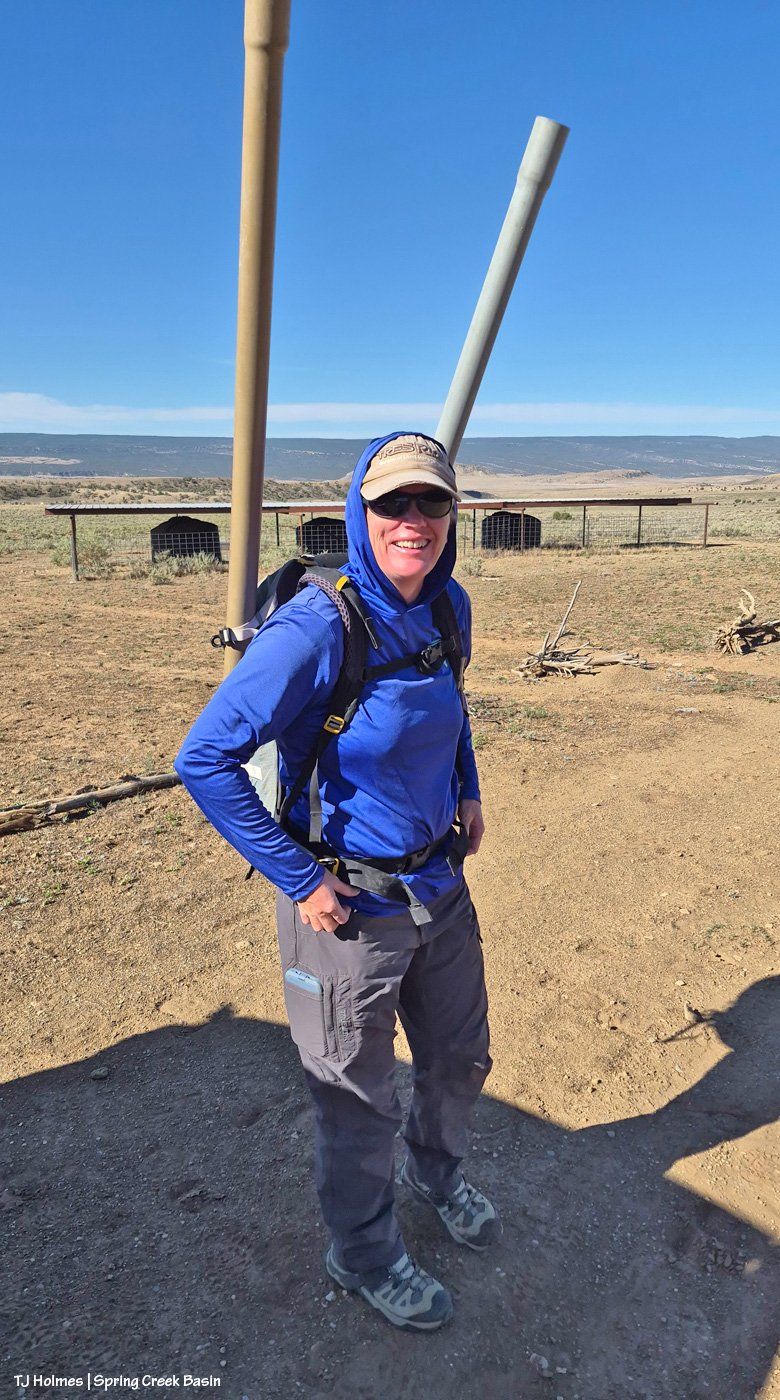
Off we go! The siting of the bat pole in the location where she places it pre-dates the water catchment, which was built by Mike Jensen, Garth Nelson, Daniel Chavez, Jim Siscoe and me in 2021. Just like we saw with the little bird friend drinking with the mustangs there, I hope it has encouraged use by bats! As Bridget said, the bats are likely to be drawn to the water just as much as the insects, their prey.
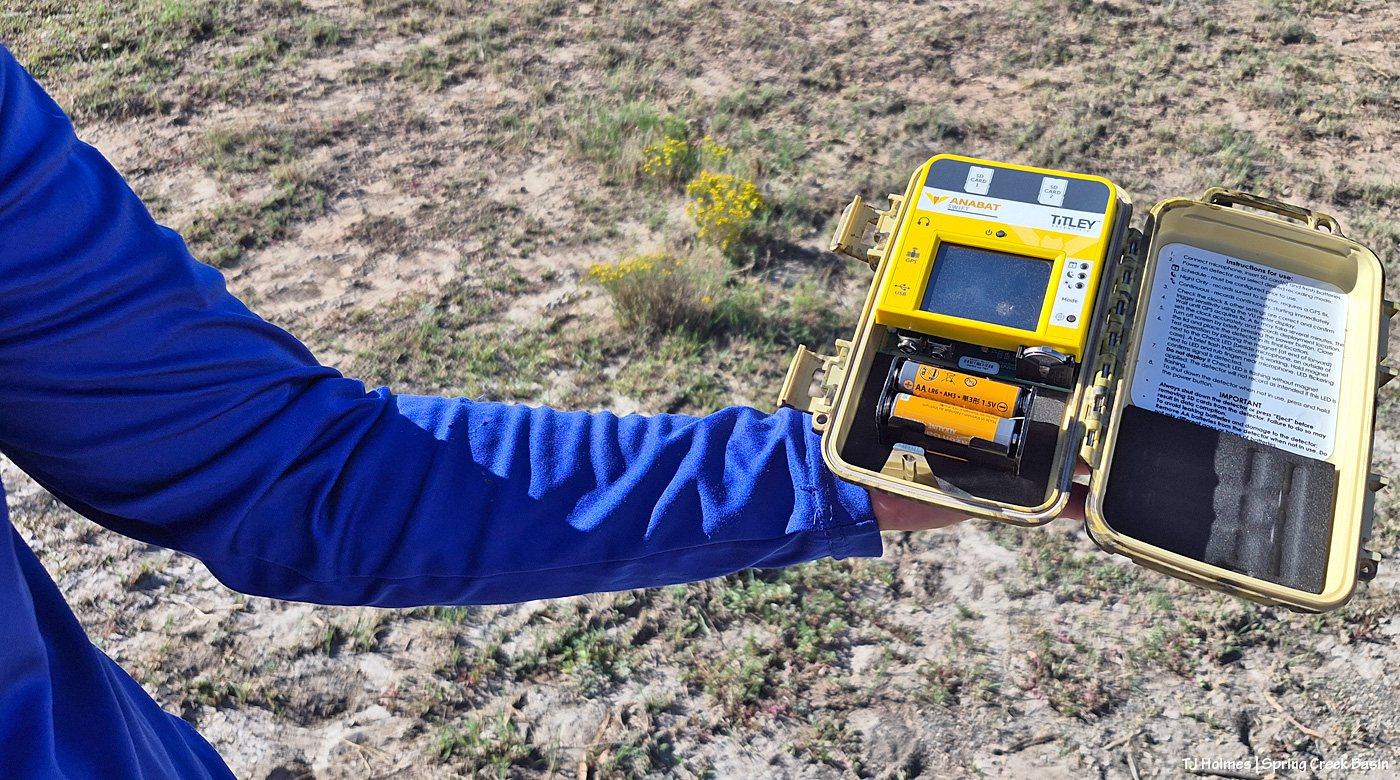
Nope, not a trail camera but a bat listener! I think it will catch the sounds of anything, and she can set it to listen at particular times. For the bats, which are the particular goal at this site, it’s set to record between sunset and sunrise. (I mean, how cool to listen to the quiet sounds of the night in what has to be one of the quietest places anywhere!)
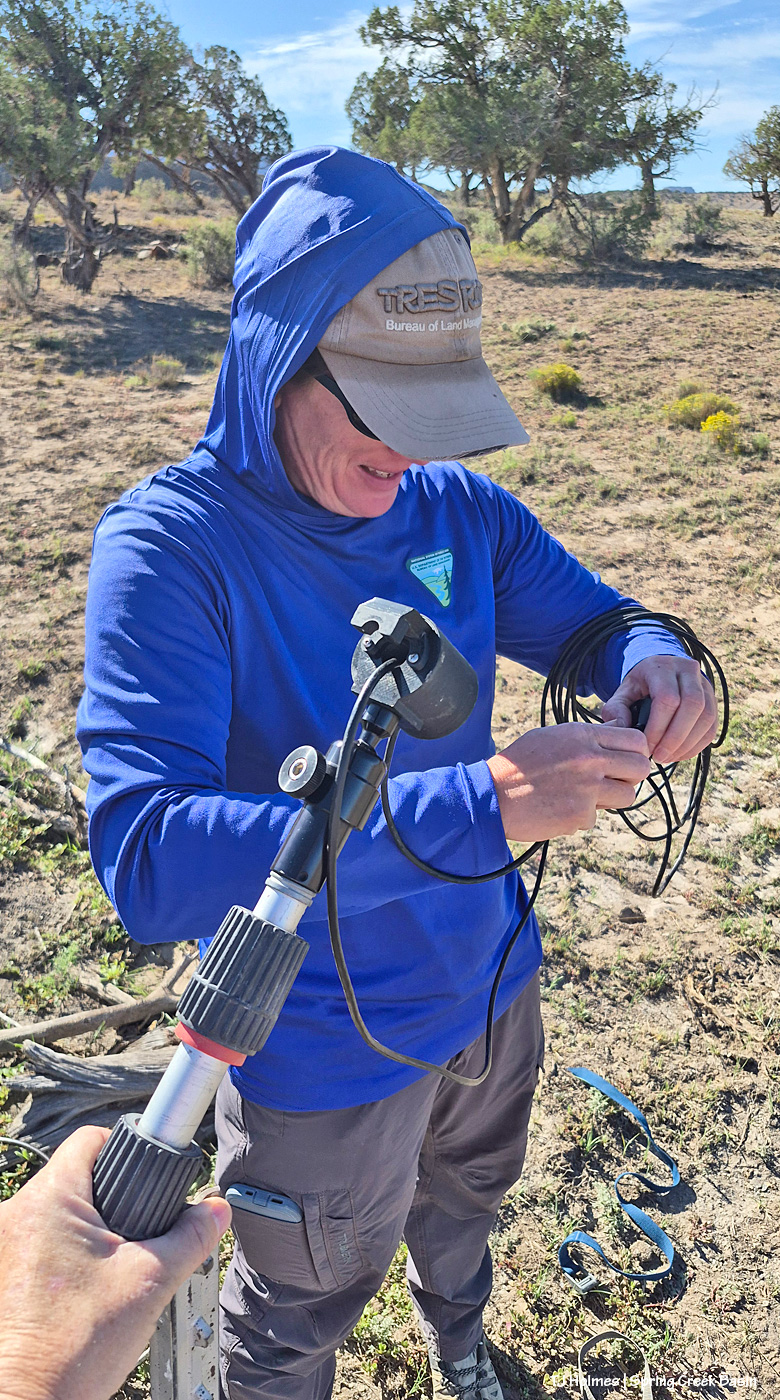
I got to hold the bat pole (!) while Bridget threaded the microphone and cord through the bit on the top (that’s what collects the sounds) and then the other little part that will plug into the listening box.
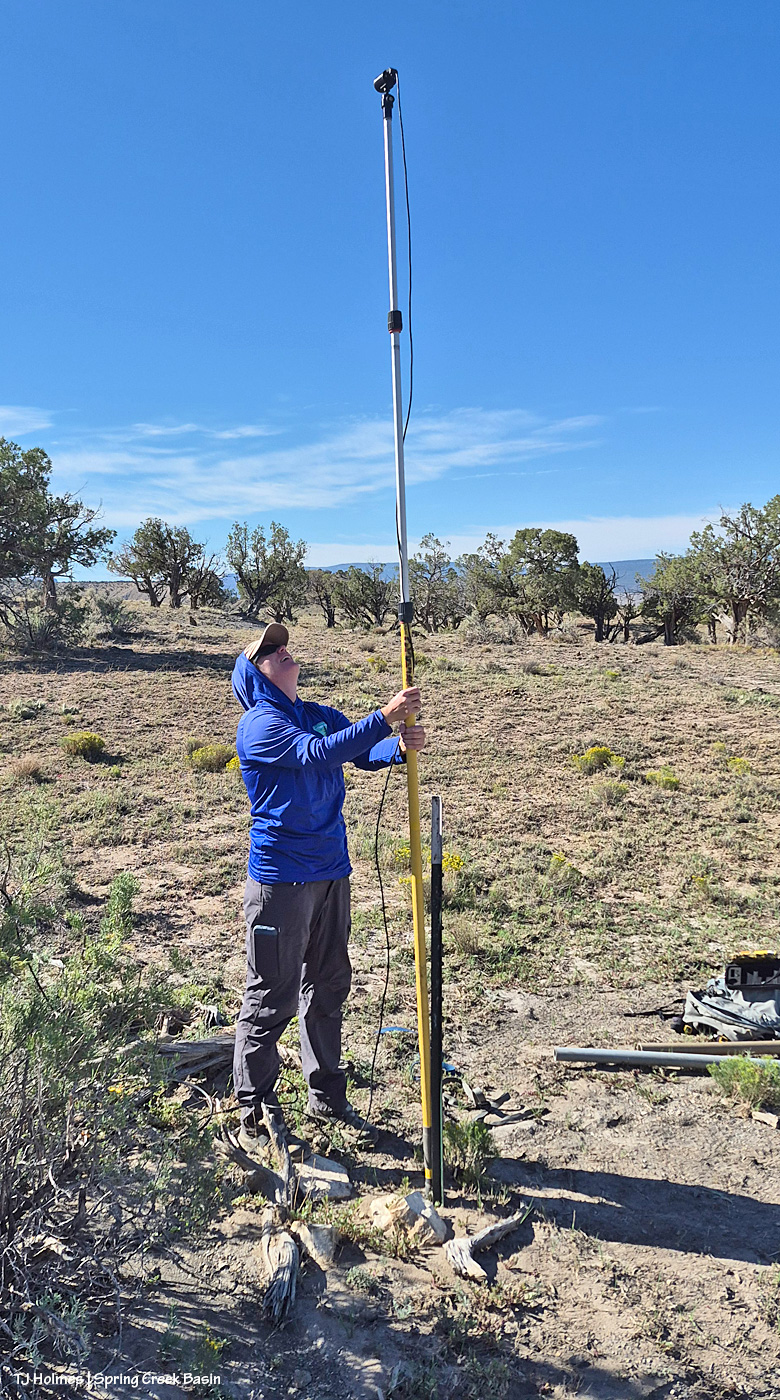
And it’s up! It extends between those black parts, much like the legs of a (really tall!) monopod.
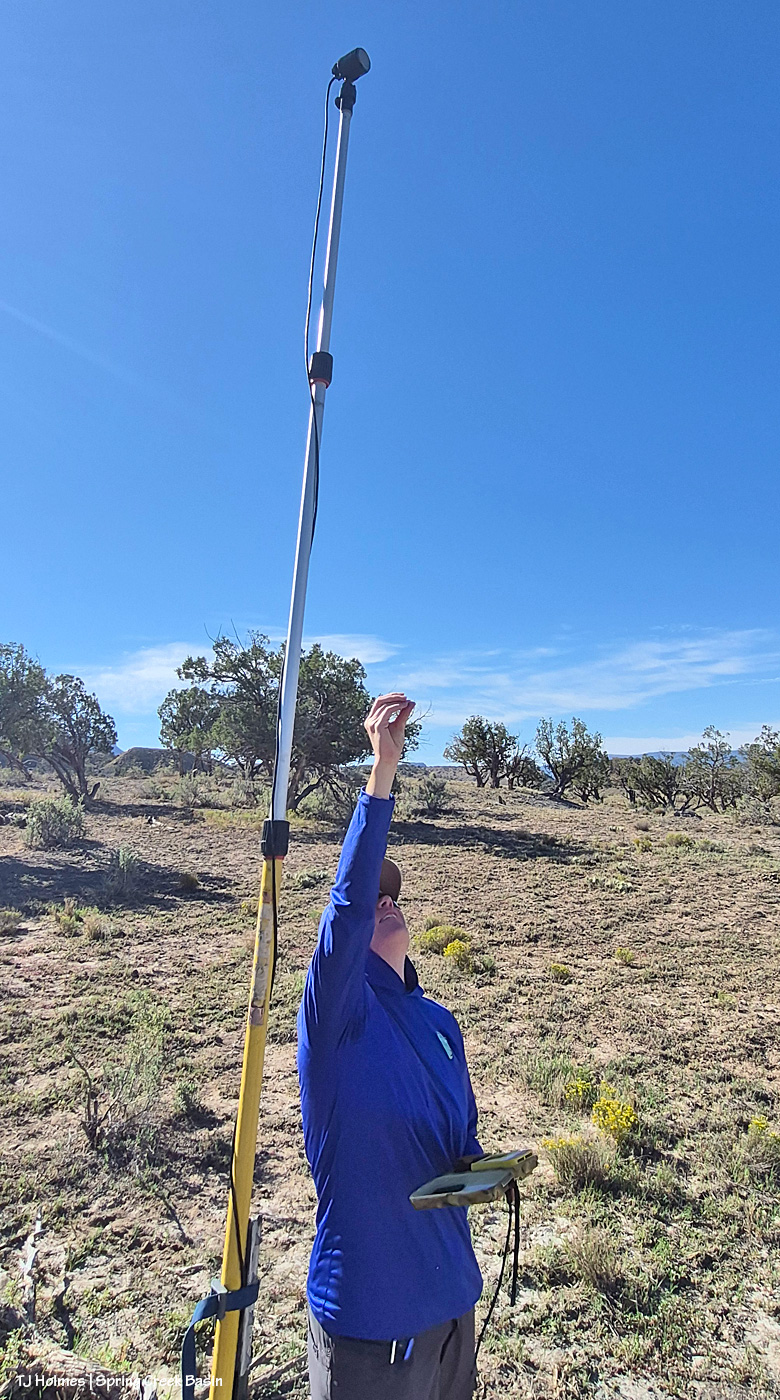
Bridget sets the pole so the microphone – the part at the very top – is that what you call it? it’s not delivering sound but gathering it in! – is facing the big open area. Here, she’s testing to make sure it’s picking up sound.
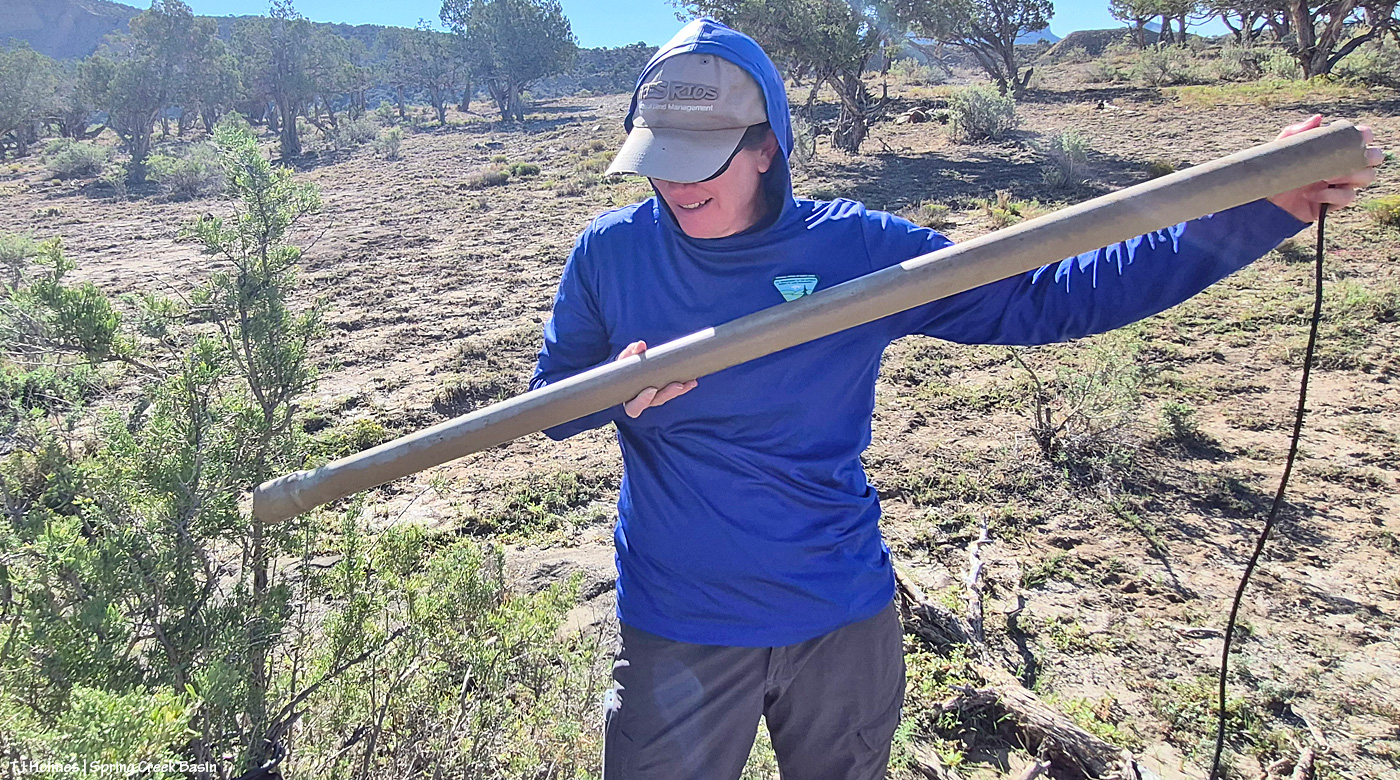
Did you wonder about the PVC pieces Bridget was carrying in the first pic? She runs the cord from the microphone down along the bat pole and then through the PVC piece (and possibly a second one, depending on distance to where she stashes the listening box) to deter curious critters and mouthy varmints! If you don’t already know, mustangs – and chipmunks and ravens and a variety of other wildlife – can be VERY curious critters. 🙂
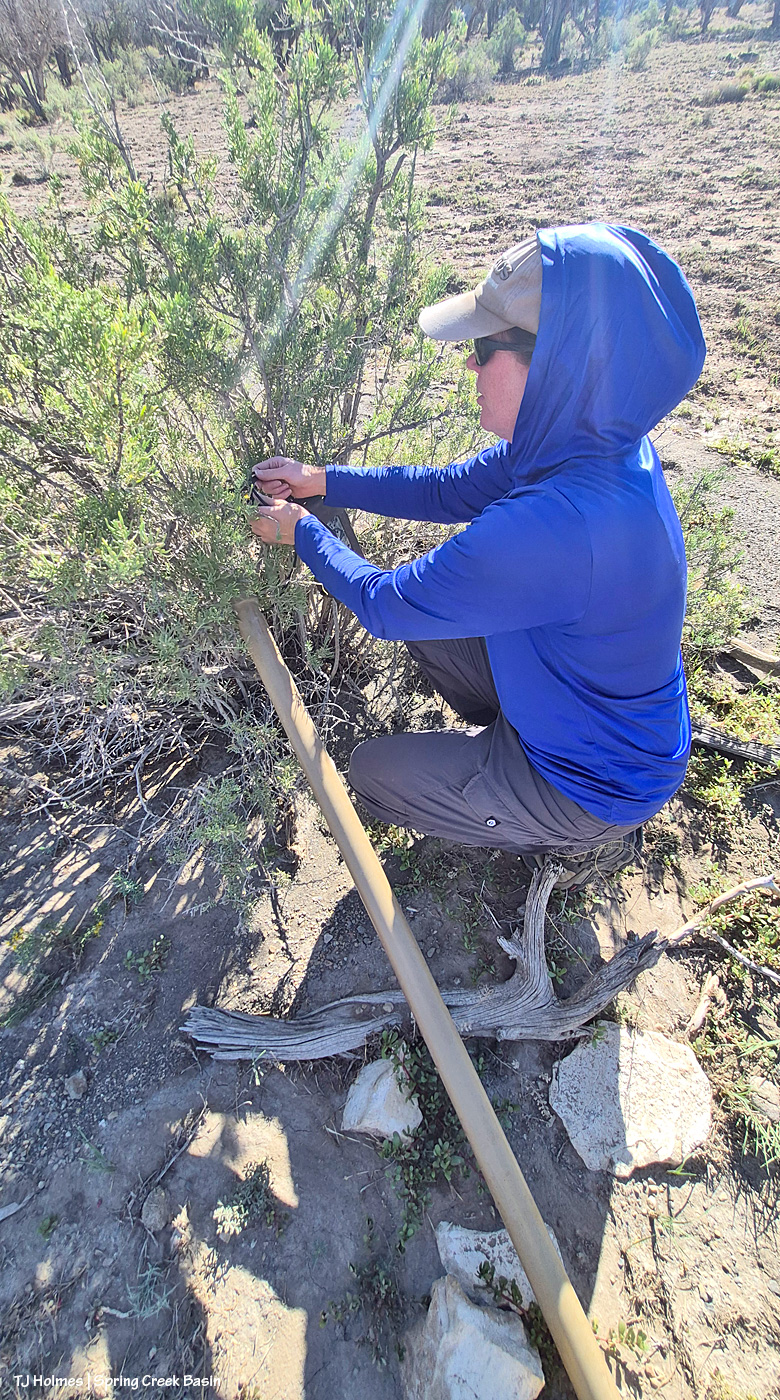
Then she coils up the excess wire between the PVC and the listening box in the (in this case) handy greasewood before …
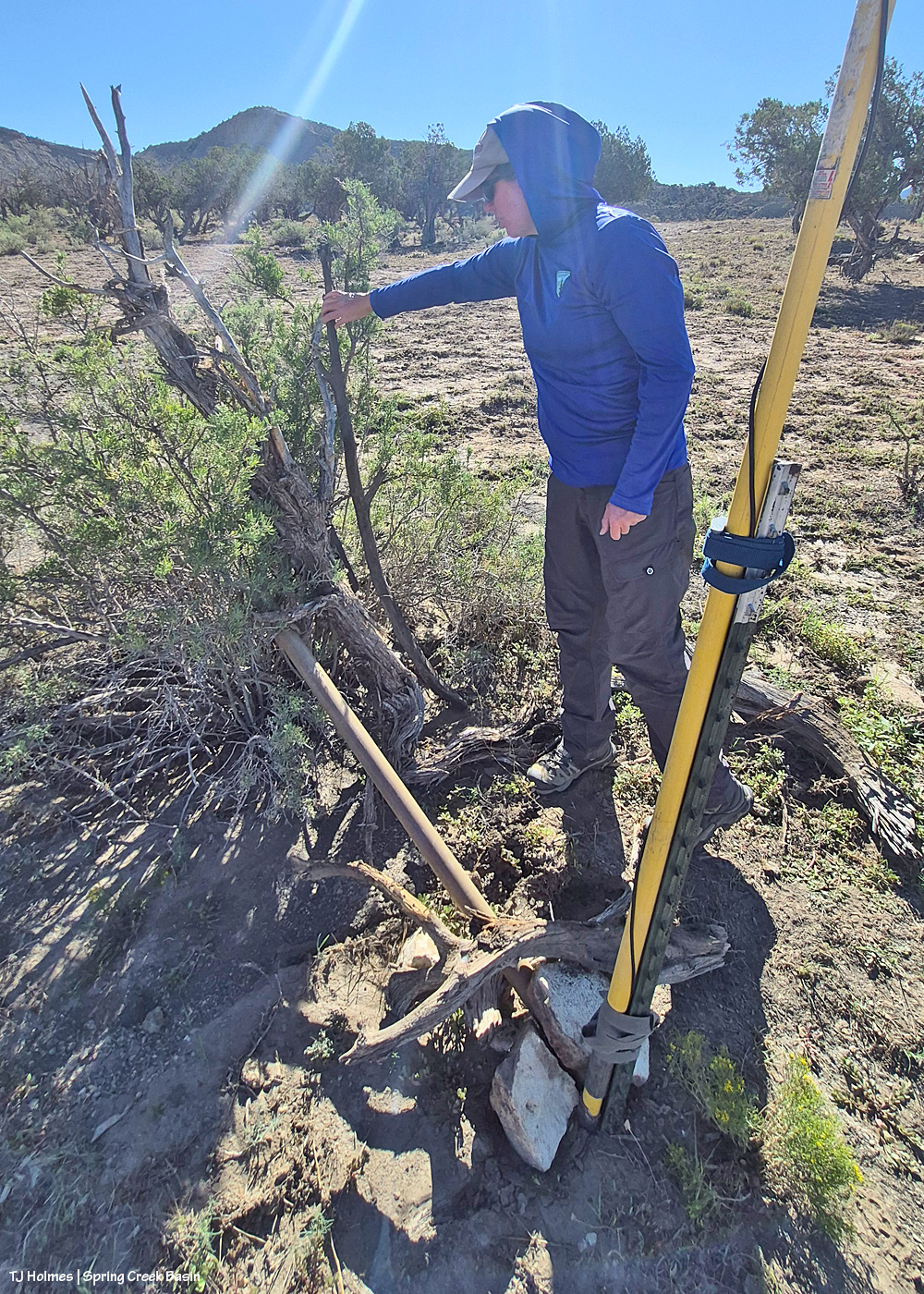
… camouflaging it to try to keep passing critters from noticing and investigating (because they will if they do).
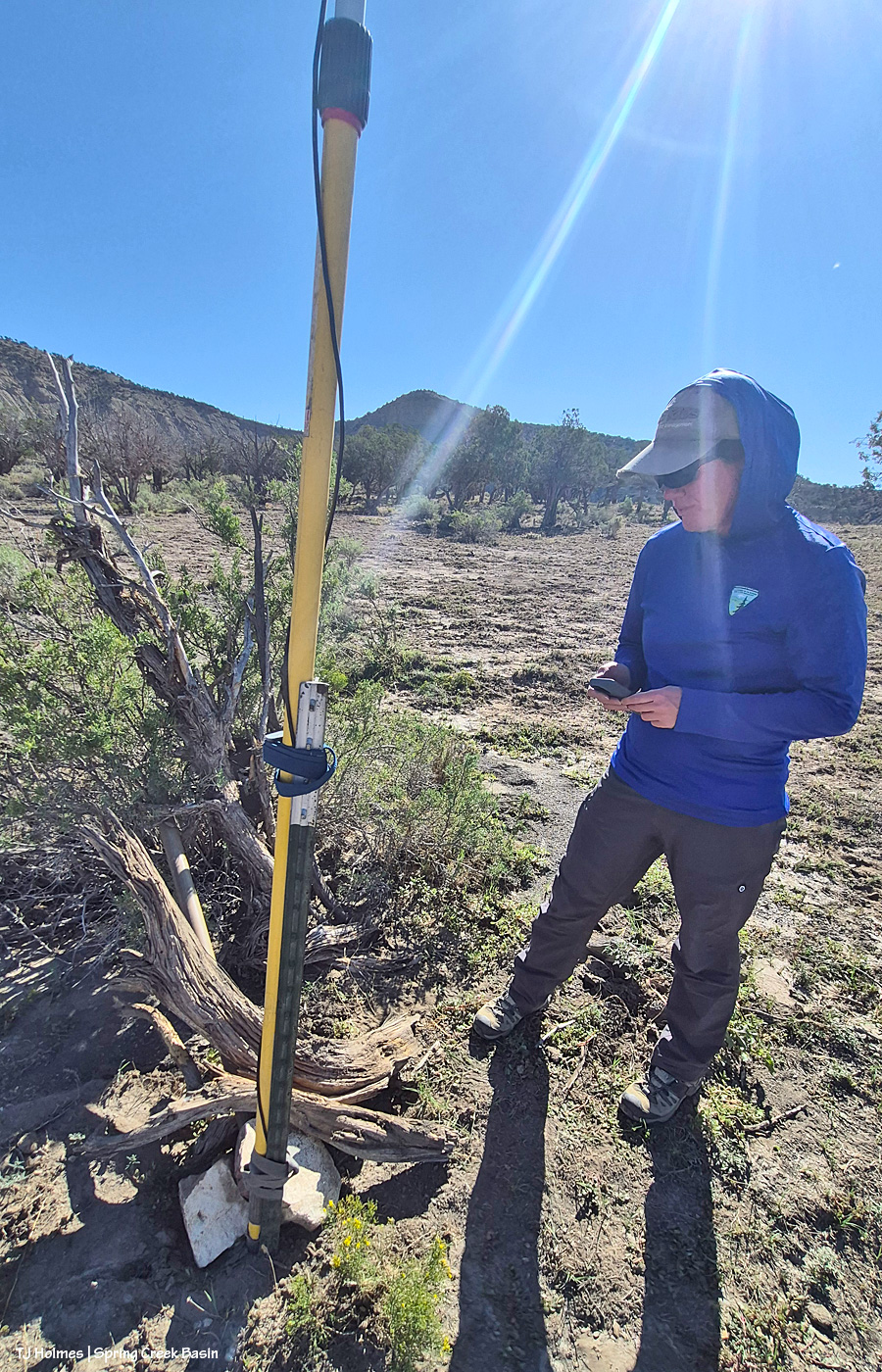
One last check that it synced with her phone, and the bat pole was ready for the business of listening for bats (well, as soon as the sun set)!
Bridget has retrieved the pole by now (she sets them out for about four days on average), and she’ll be listening for the bat squeaks to tell her what kinds of bats have been fluttering around Spring Creek Basin’s night sky! I’ll try to follow up with her to learn what kinds of bats the pole’s microphone and box picked up and recorded this time.
I’m telling ya’ll: Any/all kinds of “-ology” you want to study can be found in Spring Creek Basin (and, really, all of America’s public lands, of course). BLM scientists like Bridget are out there adding to the knowledge base we have of even the smallest critters like bats, and I find that so incredibly fascinating!
If you have any questions for Bridget, ask them in the comments, and I’ll get them to her (and then get the answers back to you). I’ve learned so much from her … from all the BLM folks I’ve been lucky enough to work with here in Southwest Colorado!
(Perk: Yes, we DID see mustangs on our way to place and leave the bat pole! And I’m pretty sure she and her partner for the retrieval saw more when they picked it up. 🙂 )

