It’s dry out there, folks.
That’s neither new news nor surprising news.
We haven’t had any rain since late April, and the forecast for the forseeable future shows perfect yellow balls of sunshine and highs in the 90s. On July 1, we’re supposed to hit 99.
Bleak. That’s what I call that forecast.
Three ponds have water. Wildcat Spring has water. The trickle is trickling. There are random seeps and springs around in arroyos – all small, all not-so-good to poor quality. The ponds all have gone dry in previous years – last year, the year before, that I’ve documented – but the monsoons always come. Some years better than others, but they always come. This year promises to get worse before we get those monsoons.
Our BLM folks at the Tres Rios Field Office in Dolores are well aware of the drought conditions and are taking steps to ensure the horses have water to get through the worst of the dry season.
Among the things our recently awarded Director’s Challenge grant money will fund here: water enhancement projects. From 2009 to 2010, five ponds were dug out (made deeper; they silt in – get shallow – because of the erodable soil), and two more are scheduled to be dug out this year (hopefully before the monsoons come!). We’re talking about water guzzlers, solar pumps on wells (something we’re looking at to enhance “the trickle” into something with a bit more flow) and possibly a second water catchment.
I get a lot of questions about our water catchment. What it is, how it works, how it benefits the horses.
Two aprons are laid out on a slope and fenced (to keep sharp-hooved wildlife out). Water in the form of rain or snow falls on the aprons and drains down to filters, then into a pipeline that runs down to a 16,000-gallon storage tank. From there, lines carry water to two troughs, which hold water controlled by floats. I turn the valve on when the weather starts warming up in early spring, and I turn it off when it starts to freeze at the start of winter (so the lines don’t freeze and break).
This is the only clean water to which the horses have access.
Because of the alkaline quality of the soil, the water is highly saline. I also get questions about the “white soil.” That’s salt on the surface of the soil. Crazy but true. The horses, of course, have adapted. It’s also muddy, and at times like this, sure, there are seeps – where the water comes up and fills salty, muddy hoof-print-size puddles. Not a lot of quantity, let alone quality.
Are you still with me?
This weekend, BLM ordered the first delivery of 4,000 gallons (what the truck holds; more coming) to the catchment, which is about a quarter full after the mild winter and no rain since April and horses drinking.
Can I get a yahooooooooooooooooooooooo? 🙂
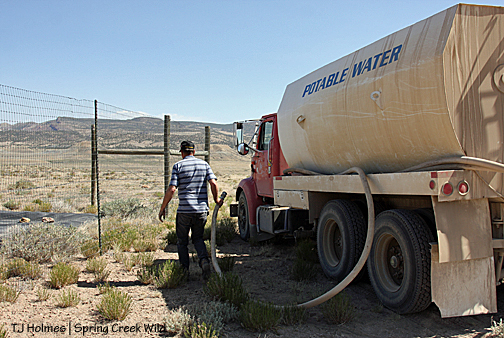
Here’s Cecil Foster of Foster’s Water preparing to drain water onto one of the aprons. Cecil has been hauling water to the catchment for years. In recent years, deliveries were paid for by the National Mustang Association, Colorado chapter. NMA/CO paid for the water catchment to be built more than a decade ago, and there are a couple of signs on the fence that say so. (Remember Pati and David Temple, for whom baby Temple is named? This is one of many projects they have honcho’d over the years through NMA/CO.)
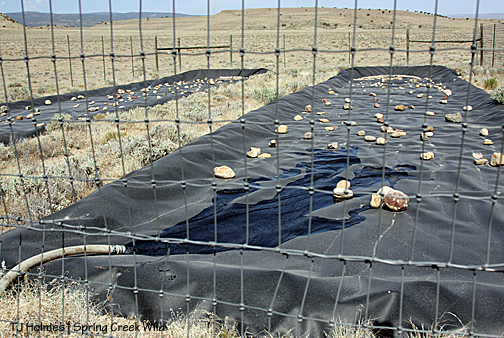
Water starting to flow. This pic shows both aprons.
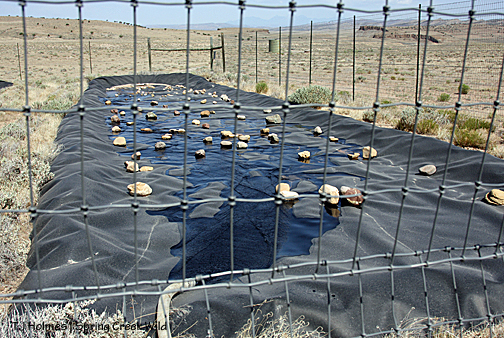
In this pic, you can see the green storage tank and the drinking troughs (very small in this image, barely visible – they’re to the right of the tank) in the background.
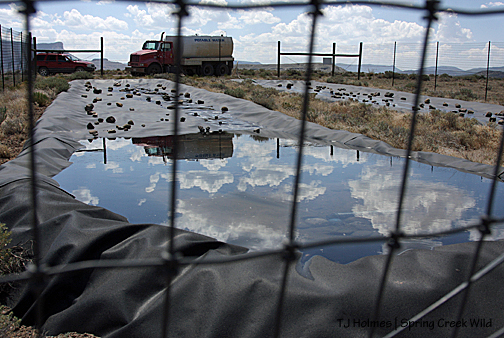
This is the perspective from the lower end looking up toward the road. The filters are apparently a little clogged; the water shouldn’t pool so much before draining. We need to get them cleaned out before the rains DO hit. The rocks on the aprons are just to hold it down.
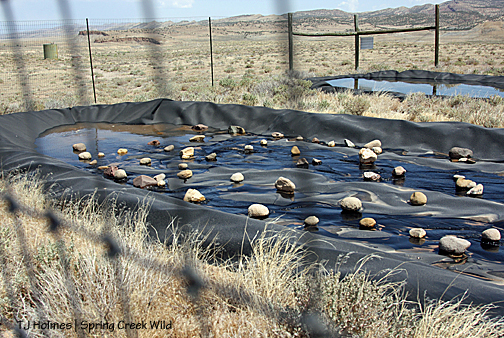
Looking across the aprons to the northwest. One of the troughs is a little more visible in this image.
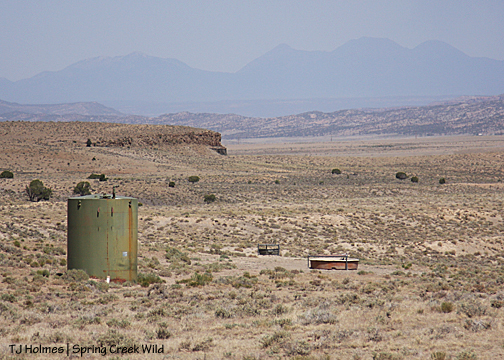
And a better view of the tank and troughs.
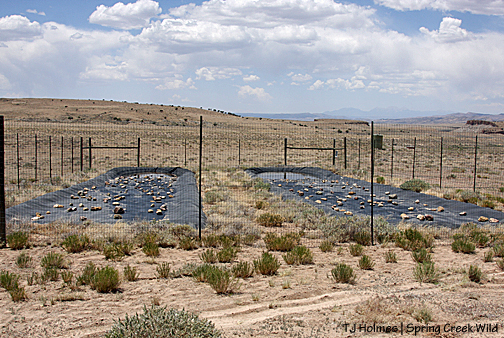
The two aprons of the catchment, side by side.
So that’s what they are, how they work and how they benefit the horses. One slight negative is the location – most of the horses are not in this area. Chrome’s band has consistently called this area home for the last couple of years, and they’re the only ones I know of that drink here consistently. That’s good, but it’s also one of the reasons we’re looking at potential locations for a second catchment (and have been the last several years).
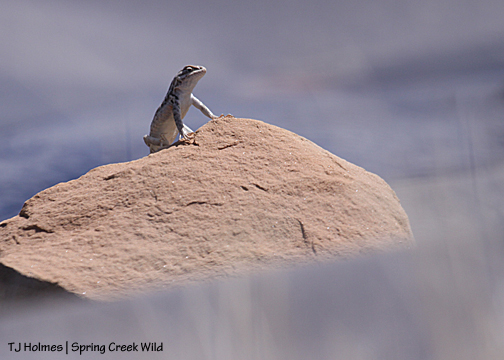
Good water benefits more wildlife than just the horses. 🙂 This little guy (gal?) is perched on a rock on one of the aprons. In the foreground is the blurred berm of the apron; just behind the lizard’s rock is the water from Cecil’s truck flowing down to the filter on its way to the tank to become drinking water for the horses.
Good stuff. Thanks, BLM. 🙂


 Spring Creek Basin Mustangs
Thanks TJ, it’s nice to know some gov’t offices care. Did you ever find little Spirit?
It’s all about the right people. 🙂
Spirit? We don’t have a horse named Spirit here …?
TJ, thanks so much for all the details re: water availability. Sure answered my questions….and kudos to BLM plus the Temples and all others in addition to YOU who do so much for the good of the herd.
Yes, yours was a timely inquiry! I’m so grateful to have our current BLM management folks. And the Temples have earned themselves sainthood for all they’ve done for the Spring Creek Basin mustangs!
Oh, my! What great news that the water was delivered! How do the covers get cleaned if clogged??Hummmmm!
Hi TJ, maybe I’m thinking Sand Wash horses. there was a small black filly that someone named ‘Spirit’ who had disappeared.
I’m sorry to hear that.