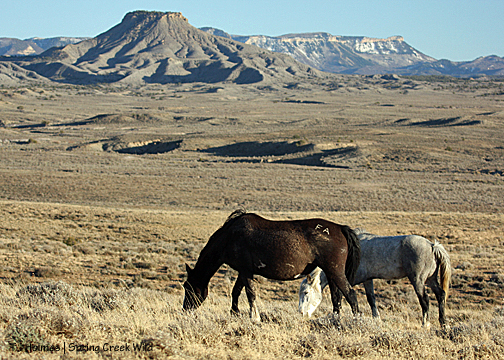
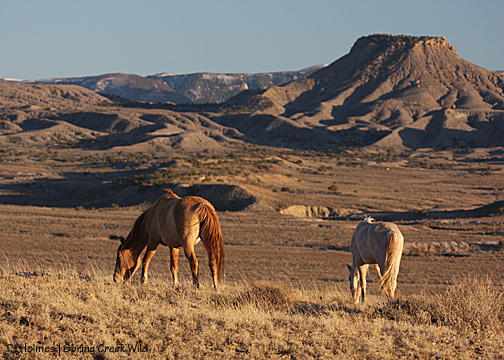
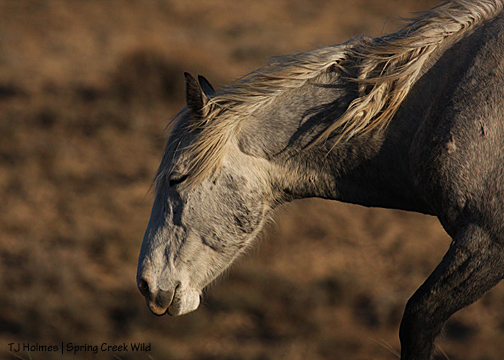
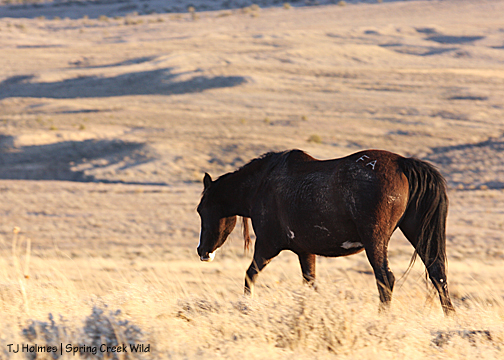
Little Book Cliffs – shining example

9 04 2011

Press release about fertility control out of the Grand Junction BLM office:

March 31, 2011

Contact: Tom Alvarez, Public Affairs Specialist, (970) 244-3097

Fertility Drug Contributes to Wild Horse Population Control

GRAND JUNCTION, Colo. — The Bureau of Land Management’s (BLM) Grand Junction  Field Office’s (GJFO) use of the fertility control vaccine porcine zona pellucida (PZP), used for managing wild horse herd populations, is significantly contributing to successful population control of wild horses in the Little Book Cliffs Wild Horse Range (LBCWHR). The fertility program’s success is due to the support and assistance from the Friends of the Mustangs (FOM), a local volunteer group in the Grand Junction community.

The fertility control program has reduced the annual population growth to an extent that a gather for 2011 will be unnecessary because 2004 foal counts in the LBC herd have declined, with just 11 born in 2010.

“We are not trying to stop population growth,” said Jim Dollerschell, rangeland management specialist for the GJFO. “We just want to slow it down to reduce the frequency of gathers, which leads to less disruption of the wild horse herd.”

The GJFO last gathered the LBC herd in 2007 and typically plans a gather every two or three years.  The next anticipated gather would now be in 2012.

“It’s a wise decision. We don’t have enough horses to justify a gather,” said Marty Felix, founding member and long-time volunteer of the FOM. “Our horses are very resourceful, and they know where to find food. Almost all of them look fantastic. We’re here to help the BLM and help the horses.”

A fertility control research program was first introduced in 2002 in coordination with the Biological Research Division of the United States Geological Survey.  Fertility control continues to be a principal component of management of the LBCWHR, using a one-year vaccine by means of field darting as the primary method used.  GJFO staff and volunteers from the FOM participate in the darting process, as well as keeping required observations and records.

“What we are doing here in the LBCWHR will not work for all herd management areas across the West,” added Dollerschell, “but our efforts do show that PZP is an effective tool to be used in controlling wild horse population growth rates.  Our relationship with the FOM also provides an example of  how partnerships are effective and needed within the wild horse program. When we are working together, positive results will occur.”

*****************************************************************************

This is exactly what we’re working toward here, with a partnership between BLM and NMA/CO and, collectively, Disappointment Wild Bunch Partners. We ARE here to help the horses and BLM, and this is what a successful partnership will look like: Slowing population growth and reducing the frequency of roundups in Spring Creek Basin. And we have set things up so it can work excellently here. All the pieces are in place – I’ve documented all the horses in the herd, I’ve been certified to handle and dart PZP, I’ve spent the time with the horses – we’re ready to start. And it has to start somewhere, like everything does.


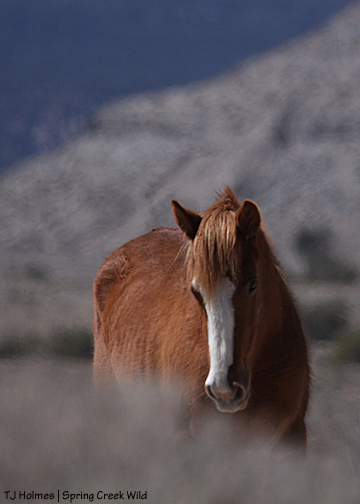
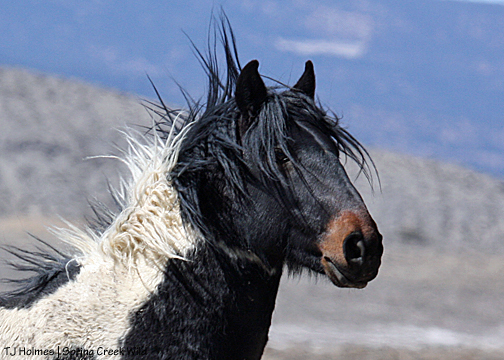
**Scoping is out**

8 04 2011

Here it is. We need comments about using fertility control – specifically the annual/native/one-year PZP by trained volunteer darters.

Use this FAQ card I created to help with your comments: https://springcreekbasinmustangs.com/wp-content/uploads/2011/02/pzp-faqcard-forblog1.pdf

I’ll also write something in the next few days to highlight the components we want to address.

Remember, annual PZP darting on the Little Book Cliffs Wild Horse Range was instrumental in canceling the scheduled roundup there this fall. Please do not oppose this roundup – rather, ask that PZP be used in conjunction with bait trapping, as an alternative to helicopter-driven roundups. PZP will push roundups back to few and far between (the goal is no more than one per decade), and bait trapping will ensure humane, slow, careful treatment of the horses. But it has to happen. Spring Creek Basin simply cannot support a great number of horses. I was looking at pix from the 2007 roundup (which I hate) for an article, and at ~110 horses in the total population, they were so very lean. We don’t want to put the horses in that kind of situation again.

Please let BLM know we want to sustainably manage these mustangs using fertility control – make sure you specify “one-year PZP.” That’s the tool that will do the most to prevent roundups.

**************************************************

FOR IMMEDIATE RELEASE:  April 8, 2011
BLM to hold public hearing and scoping meeting on proposed Spring Creek Basin wild horse gather

DOLORES – The public is invited to a Bureau of Land Management public hearing and scoping meeting on Monday, April 25, beginning at 5:30 p.m. at the Dolores Public Lands Office, 29211 Highway 184, Dolores, on a proposed wild horse gather this fall in the Spring Creek Basin Herd Management Area.  
 
The public hearing portion of the meeting will take place from 5:30 – 6:30 p.m. and will cover only the use of motorized vehicles and helicopters to gather wild horses from the Spring Creek herd.  Helicopters are an effective tool in gathering wild horses and are commonly used in BLM gather operations. Trucks and trailers would be used to transport the gathered wild horses to adoption or a holding facility. The hearing will begin with a brief introduction, and then public comments will be taken on the use of helicopters and motorized vehicles for gather operations. Oral comments will be recorded and should be kept to five minutes in length. Written and oral comments will be submitted into the official public record, and summaries will be available upon request. 

Immediately following the hearing, the public is invited to an open house to learn about issues to be addressed in the preparation of an Environmental Assessment for the proposed wild horse gather.  The open house will include a brief overview of proposed activities and an opportunity for the public to help the BLM identify issues regarding the gather. Public input can be made either verbally to staff or via a comment card at the open house. 

Written comments will also be accepted until close of business Thursday, May 12, 2011. Written input should be mailed or delivered to Tom Rice, Associate Field Manager, Dolores Public Lands Office, 29211 Highway 184, Dolores, CO  81323.  Comments may also be sent via e-mail to: trice@blm.gov.

The wild horse gather is proposed for September 2011, at the Spring Creek Basin Herd Management Area, which encompasses 21,064 acres of BLM lands in Disappointment Valley. The removal of some wild horses is proposed to achieve a population of wild horses consistent with the land’s capacity to support the herd in balance with other public rangeland uses and resources. A local adoption of the gathered wild horses will take place after the gather.

For more information, contact Tom Rice, 970-882-6843.


Spring warm, tinder dry

5 04 2011

With his acquisition of Gaia this winter, Cinch is moving on up in the basin.

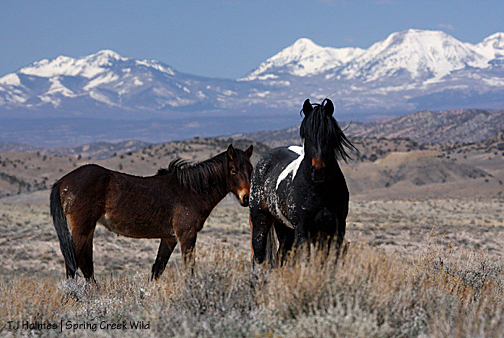
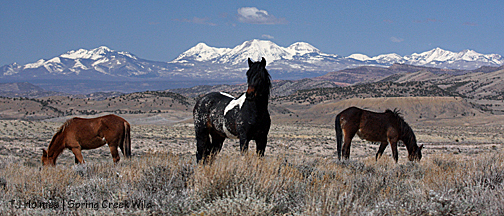
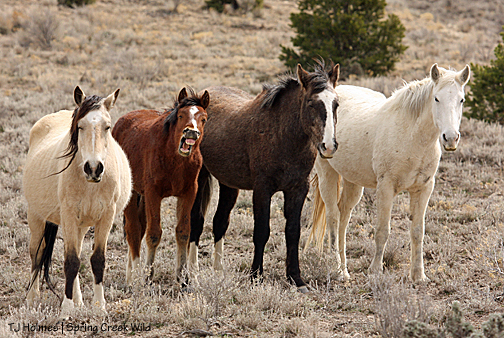
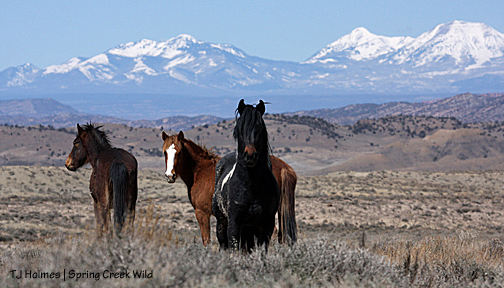
It was hard to catch them with all their heads up, mountains in the background. The girls, especially, having both most recently been with Bounce and Alegre (Gaia is her firstborn), concentrated on grazing, as in the pic a few posts ago.

Liberty is just a tiny little thing, though she’s only a year younger than Gaia. Molly shouldn’t have had to have a foal the year she died … but I wonder how often that happens in the wild? It happened also with Ceal and Shadow.

We used to have lots of sorrels … now she’s one of four. (Which reminds me … oddly … I had a dream last night … about a big band of greys and bays – our dominant colors …)

Three on Earth Day (hence her name). Cinch ought to breed her for her first foal as a 4-year-old. That’s pretty good. We’ll have a couple of 2-year-olds foal this year (Hannah and, probably, Sable) – not so good – and one 4-year-old (Baylee) still doesn’t look pregnant. Another 4-year-old (and orphan), Shadow, will have her second foal this year – she’s due within a week, which should make her the first this year. I saw them (her and David and Wind) last week but not close – other horses and the hunt for Spring kept drawing my attention.

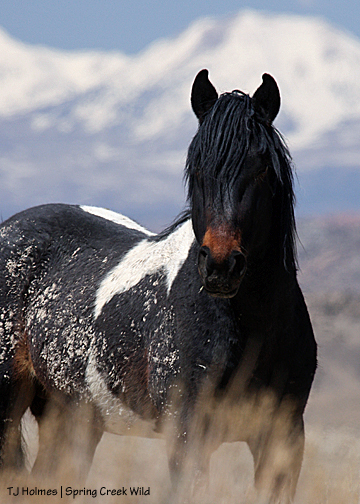
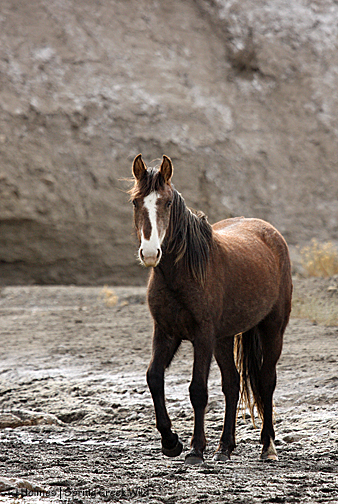
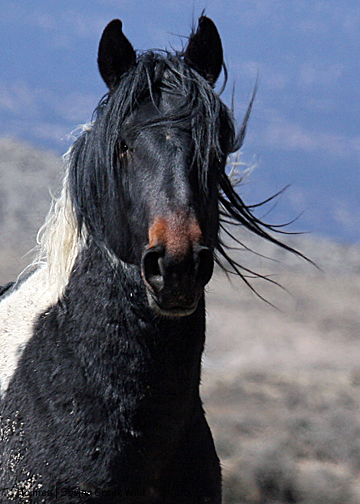
Cinch kept a wary eye on me through that fantastic forelock …

He was more animated than my first visit to them this year … He has a lot of presence that makes him seem fairly big, but he’s a fairly small-bodied boy.

Love the graceful swish of his tail.

Saw lots of this …

… and caught this just before he went back to grazing.

He’s looking back at Gaia and/or Luna’s, who were coming down from their nap near Round Top for their midday drink at the roller-coaster pond (which is off to the right).

Definitely watching Luna’s … Gaia was just behind him to the left, Liberty to the right.

Pretty portraits in front of the La Sals.

The sun was high, but the shine was warm for about the first time this spring, so I sat with them for quite a while. I thought Cinch might lead them off, but they just moseyed around grazing and stayed fairly near. I leaned back like I was on the beach and soaked in the rays, the warmth, the horses, the magic. By the time I walked quietly away, they never even looked up. 🙂

We were supposed to get “significant moisture” over the region Sunday … but locally, at least, it seemed to be confined to the tips of the La Platas. On the west side of the La Platas, we got our first big Apocolypse-seeming dust storm of the year. Another storm system is forecast Wednesday through Sunday, which – if it happens – puts a crimp in my weekend plans, but do your dances, folks, for the horses to get some good rain. It’s so, so dry. Some campers started a 150-acre wildfire near Bradfield Bridge (basically south of the basin) on the Dolores River. The Forest Service and several other agencies got it under control pretty quickly, so you know they’re on alert. Other fires are burning already in other parts of Colorado.


Voices of reason

3 04 2011

Thanks to Karen Herman, I just became aware of this editorial published March 20 in the Santa Fe New Mexican, written by her and Dr. Jay Kirkpatrick. Karen runs Sky Mountain Wild Horse Sanctuary and is the business partner of Dan Elkins (owner of Mt. Taylor Mustangs who does no-chase gathers, also known as bait trapping), and Dr. Kirkpatrick, of course, is the director of the Science and Conservation Center in Billings. This was in response to a New Mexican editorial that espoused shooting mustangs as a “management” tool.

http://m.santafenewmexican.com/LocalColumnsViewpoints/Their-View–Karen-Herman-and-Jay-F–Kirkpatrick-Science-improvi

We were so privileged to meet Karen and Dan two summers ago when NMA/CO invited them to Spring Creek Basin to see the area and meet our mustangs. This was part of our ongoing work to move away from helicopters here to bait trapping … but it hasn’t come to fruition yet.

We want to have “gathers” as few and far between as possible – which will happen, I firmly believe, with PZP – but bait trapping is a much more humane option than chasing mustangs (and burros) with flying machines.


Looking toward sunrise at the onset of another end

3 04 2011

There’s always one … 🙂

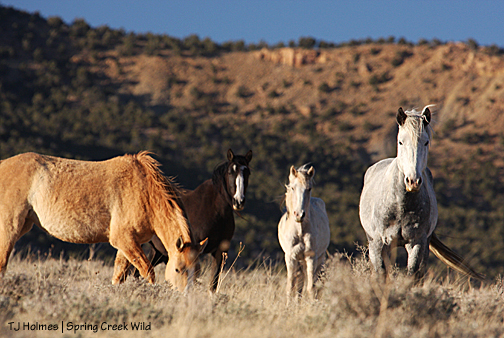
“Photo-horse” – but their ears are all up!

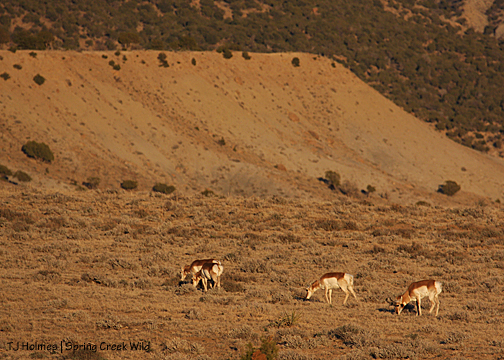
Just to our east, this pronghorn buck (right) and three does.
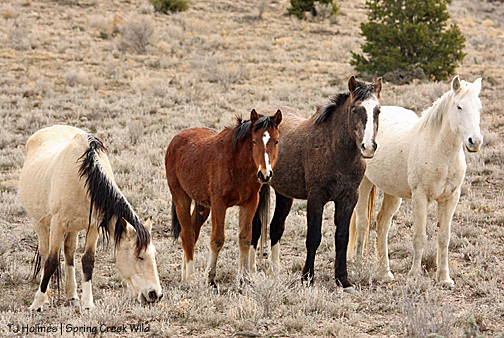
Up on the finger hills with a marvelous view at the end-o-day. The heavily eroded flat-topped “peak” is Brumley Point, in the basin. The far ridges – and yes, that’s still a bit of snow – are not.

Love that delicious light. They felt no need to pose prettily but carried on with their wild lives. Brumley Point again (don’t you think it was really McKenna that deserved the “point” and Brumley the, well, peak, butte, mesa or hill designation? it reminds me of a high-and-tight cut; don’t ask me why). The low, tree-topped, snaky ridge in the near(er) foreground is what I call the roller-coaster ridge. The horses were already swishing their tails like it was summer. Interesting the little things we associate with certain seasons. I was in a T-shirt still at the end of the day, but it’s not yet summer …

Mr. Kreacher

Another PZP-22 success story. No foal last year (like Kootenai), but she looks on track for a spring foal now, eh? And while some of our other girls look a bit scruffy yet, a bit “wintered,” Raven is nearly fat and ready to shine under her spa coating. (The FA brand designates her as part of the October 2008 roundup and PZP-22-receiver from Sand Wash Basin, northwestern Colorado. Kootenai and Mona have the same brand. Our 2007 PZP-22 released mares have a DC brand. Because the horses are so well documented by yours truly, they do not need to be branded to be designated PZP recipients – and we’ll fight hard to ensure that is, in fact, the case.)


Buckskin and grey

2 04 2011

A sight for hungry eyes after the winter. See what she’s going after? And yes, she got each bit! This time of year must be the horses’ Christmas.

Baby girl will have a baby brother or sister soon.

Kestrel and Winona

Sweet girl is looking at stepdaddy Comanche down in the arroyo below.

Don’t you love his handsome face?

Soon to be a daddy!


Beauty in nature

1 04 2011

How many ways can I say it?

Let the magic speak for itself!

Mahogany’s, left, and Hook’s. This is taken from almost as far east as you can get in the basin – below the eastern ridges – looking west-northwest. They had been napping earlier … and later ended up separated again.

Pretty darn beautiful, eh?


Natural beauty

31 03 2011

March is typically our wettest month. We had rain and/or snow just four times this month for a total of probably less than a couple of inches. I think it’s going to be a tough year.

But it’s spring. The phlox has started blooming.

Sure was a gorgeous day!


All up

30 03 2011

Also going back a couple of weeks to photos I didn’t have time to tweak and post. A visit to Luna’s was my last of this particular day.

They were napping out past the double ponds. One got dug out two years ago; the other wasn’t because of some sort of problem. The non-dugout one has been dry for a while already this year. I saw tadpoles there earlier this spring (later this winter?), and the one that got dug out is probably dry now (it was down to a puddle last week) – though it did have a shallow bit of water there when the horses were there.

When I walked out, Mouse was off a bit, napping, and the others were almost all in a row. Luna was grazing (baby is getting bigger all the time), but the others were watching me walk up – I had to go out of their view past the lower pond, into and through the arroyo and up the hill – and I climbed up to five amazing pairs of ears – all but Luna’s at first – greeting me!

You may notice I just changed the “banner” pic at the top of the blog. Aren’t they the cutest? I love Alpha and the boys. It may be because of Storm, but Gideon seems to really have become attached to Alpha. I love their big-to-little arrangement … though Storm’s as big as Alpha! Notice Steeldust. Guess where Mouse is.

I dropped to the ground as soon as I came up the hill to this amazing view – just had to take it all in! Mouse here is framed through the branches of the tree on my left. And between him and the band is … you guessed it. Steeldust.

Well, here, I have five ears of four horses … but only two eyes! The wind was blowing really hard from the south. They were somewhat protected here in this little valley – there’s a tall ridge/hill above the arroyo to the right – but it was still blasting. I love to see them so wonderfully relaxed.

Now different eyes, and Gideon’s letting me know what he thinks about the whole thing.

Before I knew it:

I really love it when they’re this relaxed.

Awww … but you know what’s coming …

That’s karma, kid! I couldn’t help laughing about the times he did exactly this to his younger “sisters” in the band.

Ugh – breath mint lately? he seems to ask.

And over he goes. 🙂 Isn’t he adorable? Soooooo sweet and innocent??? Alpha knows what’s coming, though …

… and she’s outta there. Check out Luna’s expression. Gideon had to step back when Storm rolled up – and yes, his forehead is right against Gid’ th’ Kid’s chest.

And what goes around comes around – literally. When Alpha walked behind them, it prompted Butch to move Luna – and there’s Storm about to come to his feet. Poor guy – his nap was so short-lived.

He went over to stand by mama. Look how big he is.

Gideon went to his mama, but she is in the grouchy don’t-bother-me stage of pregnancy. She IS a mama, though – HIS mama – and he did find some comfort:
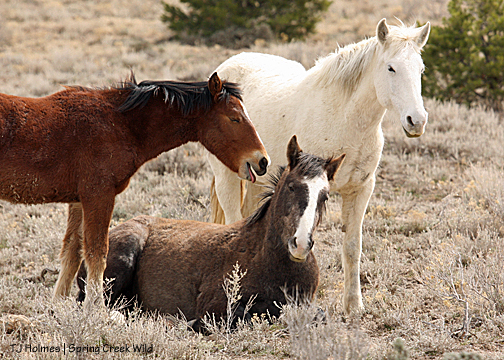
Just don’t interrupt the girl’s nap. 🙂

And I left ’em to it and tiptoed away through the wind.


In deep

30 03 2011

Sorry about the lack of recent posts. I’ve been working on one that’s more of a rant, and I keep deciding not to post it … and I keep reading things that make me really want to post it.

Suffice it to say that no budget for roundups this year will put the Spring Creek Basin herd on rough ground, literally. It’s hard to feel so nearly alone in this “advocacy.” Thank goodness for the work Little Book Cliffs and Pryor Mountain and McCullough Peaks are doing to stop/slow their roundups.

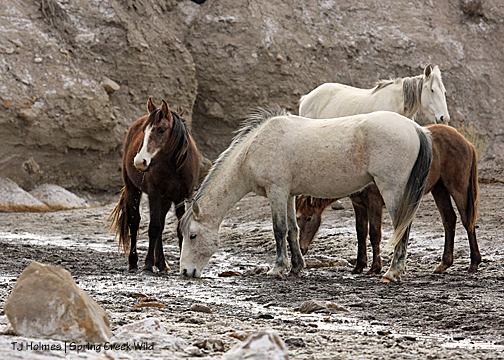
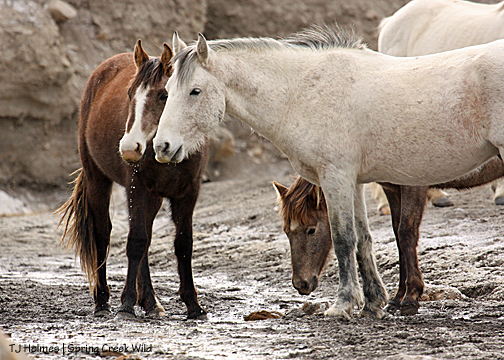
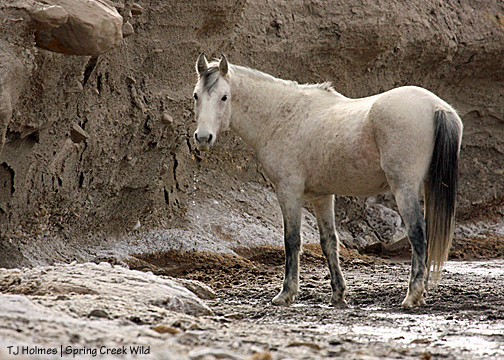
Here are some pix of Grey/Traveler’s band getting water from a bit flowing through Spring Creek a couple of weeks ago. I was walking back to the Jeep, and they were walking the ridge, and we met in the arroyo.

It doesn’t look like much – and it’s not – but it’s actually trickling through (from beyond them (east) toward my direction and past).

Grey and his girls.

All the family. Love the water droplets.

Gorgeous girl

Sharing a moment with daddy … How many foals has he sired? How many has he helped raise … sent away, seen taken … and yes, I still say a roundup is necessary, and PZP is the best thing to put it off in the future. Where would we be now if PZP had already been implemented? He is so good with them …

I have so many hopes for this herd … . I know the public as a whole sees the trauma of roundups – and their aftermath – and focuses simply on stopping them from happening. Think deeper.

Spring Creek Basin needs to have a roundup this fall. We’ll have it this year, when there are more horses than optimum (90-95) but they’re in good shape, or we’ll have it next year and maybe call it an emergency (with around 130 horses). Why should we have to wait until the horses are in bad condition? Why can’t we do it now, when they’re in good condition – and able to withstand the stress? Argh.