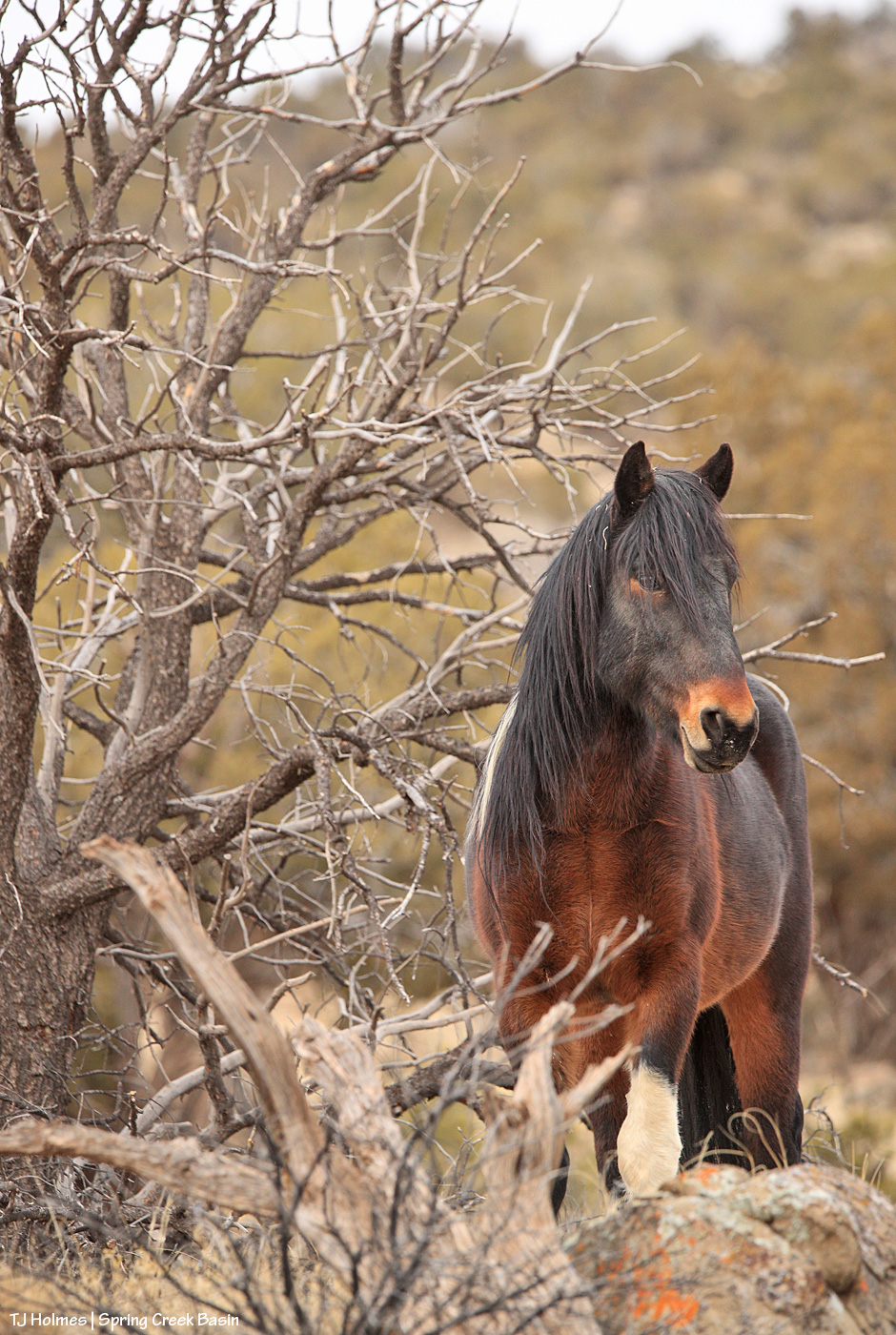
This portrait of handsome Maiku was taken a couple of weeks ago in the northwestern part of Spring Creek Basin. There are more trees in that area of the basin than many other parts, being a bit higher and getting more moisture. … I don’t spend a lot of time in that area because the horses aren’t there frequently, but it’s beautiful, and I love it when they ARE there.
While roaming around with them, I was kinda shocked at the sheer number of dead trees … like the one behind Maiku.
Not to belabor the point, but if we don’t get some winter soon (snow? please?!), we’re going to see a lot more trees succumb to drought. They’re kind of a big red flag.
Maiku’s name comes from the Ute language, as these are ancestral lands of the Ute people in addition to others such as the Navajo (Diné). I try to keep in mind that these lands have an extraordinarily long history intertwined with Native people, and hopefully we can protect at least some of them as much as possible and as their original stewards did and would.
On this website citing facts about Ute people, written mainly for school-age youngsters, I found this information about the Ute language: “maiku (pronounced similar to “my-kuh”) is a friendly greeting.” And I thought that was a great name for him as a uniquely patterned foal. I’ve since learned that it might be pronounced a bit closer to the name “Mike,” but I still pronounce it “my-kuh” when referring to our handsome little pinto stallion with the single white slash across his withers. 🙂 I wouldn’t say that he delivers especially friendly greetings to other bands – or visiting stallions! But he’s still very unique!




 Spring Creek Basin Mustangs