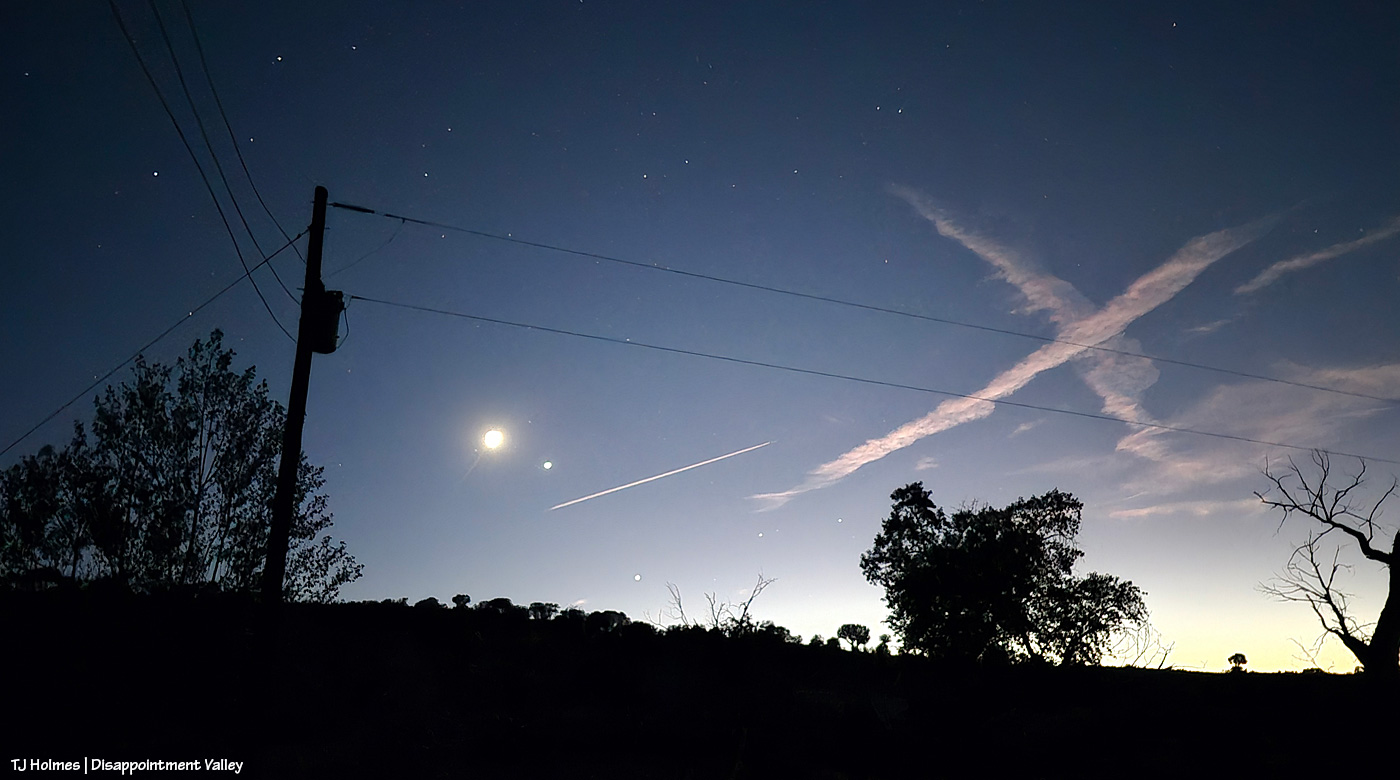
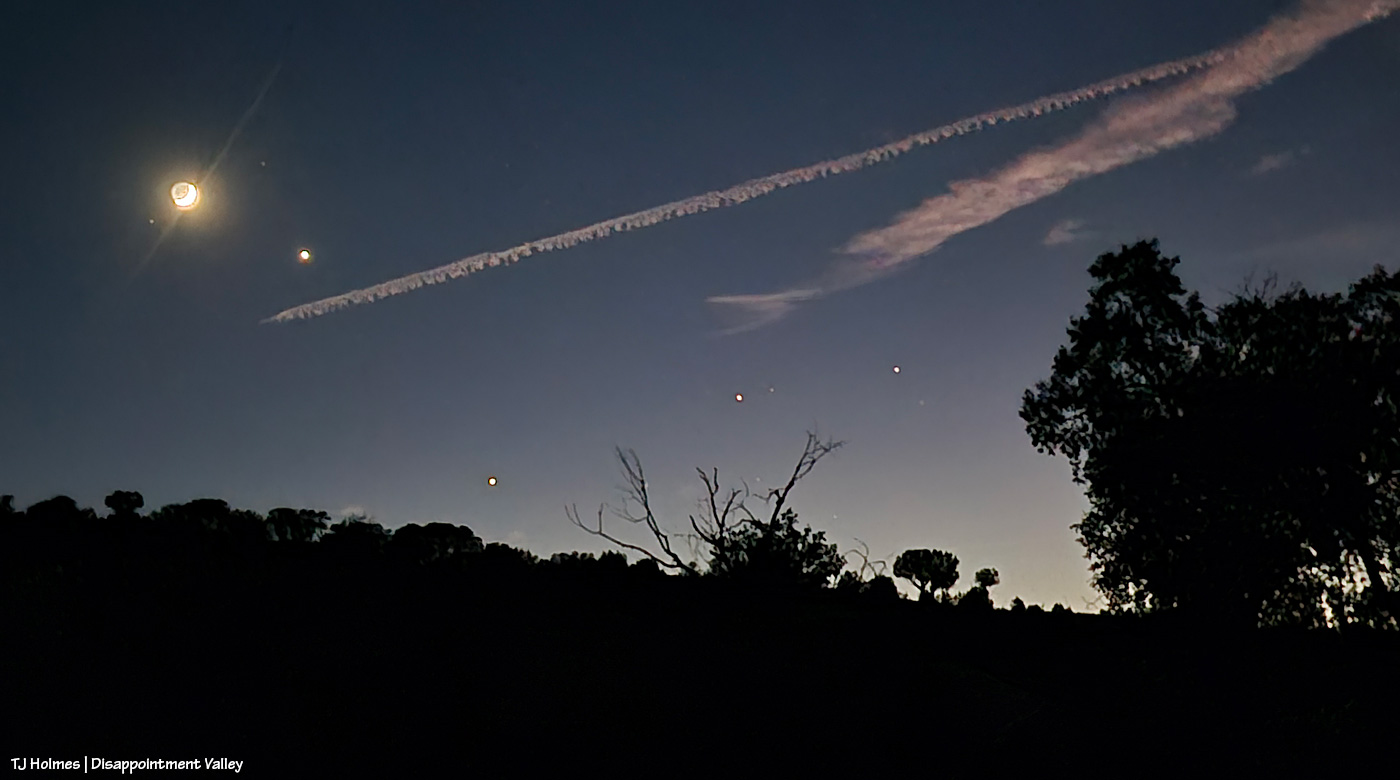
Are you folks seeing this planetary parade in your evening sky?
My phone says these were taken about 10 minutes till 10 p.m., and I took them Wednesday night. It still amazes me that my phone takes such decent pix of the night sky, though I’ll admit that it’s hard to tell that’s a waxing and very delicate crescent moon (setting).
I’ve been watching at least a couple of planets the last several evenings – enjoying, not photographing or even attempting to. Then I remembered that my phone isn’t too shabby at taking night-sky pix. And you have to know by now that I’m a sucker for the moon. 🙂
AI Google says this to explain the above:
You are witnessing a spectacular “mini planet parade” featuring a slender, waxing crescent Moon aligning with the brilliant planets Venus and Jupiter, along with Mercury. [1, 2]
The bright “stars” you are seeing are actually these inner and outer planets, which always shine exceptionally bright and steady compared to twinkling stars. The details of this cosmic alignment include: [1, 2, 3]
- The Planets: Venus is by far the brightest, hanging lowest in the sky. Jupiter, the largest planet, is shining brightly nearby, while elusive Mercury sits lowest on the horizon, fading as twilight sets in. [1, 2, 3, 4, 5]
- The Moon: The delicate crescent is gliding near this trio and is beautifully illuminated by earthshine—sunlight reflecting off Earth’s oceans and clouds. [1, 2]
- The Stars: If you have an unobstructed view and clear skies, you might also spot the twin stars of Gemini (Castor and Pollux) or the Beehive Star Cluster framing the scene higher up. [1, 2]
For the best viewing experience, find a location with a wide, flat, and dark western horizon right after sunset. Binoculars can help you spot Mercury before it slips below the horizon, and they will transform the crescent Moon’s backdrop into a glittering swarm of stars in the Beehive Cluster. [1, 2]
I don’t know about ya’ll, but I still don’t know which is which; is it Venus, “by far the brightest, hanging lowest in the sky” … or Mercury, sitting “lowest on the horizon”? I mean, if they’re both the lowest, which is the *lowest*? Ha. Venus must be the bright “star” just to the lower right of the moon? Expert stargazers, please help me!
Here’s a link from Space.com that mentions the moon and three planets. It would have been accurate for June 17, the night I took the above pix.
I love clear night skies; during the day, I’d sure appreciate some clouds. Picky, aren’t I!? 🙂


I love those clear summer nights with planets obviously visible! “Planet parade.” That’s just cool. Thanks for the sky photos, TJ.
“Planet parade” was not my original phrase! 🙂 I picked it up from the various articles I read. Still very cool, and I do love to see the celestial phenomenons, even if I’m not very good at photographing it. Hope you’re seeing them, too!
Great pictures of the night sky! Thanks, TJ!
Are you seeing it from where you are? I hope so!
It has been cloudy here the last couple of nights! It’s sunny today! will try to get a look tonight!
Ha – what?! Other places have actual clouds?? 😄 How soon I forget in the absence of clouds here. I do hope you get to see the very bright planets on the western horizon after sunset!
Beautiful!
Are you able to see them? You might have too many mountains on your western horizon?! 🙂