… I should do it like this …

Winona and Tenaz
… get pix up to share …

Kestrel pawing through snow
… because they’re the ones that have caught my eye …

Tenaz and daddy Hollywood
… on my first trip through the images.
To me, they speak volumes … but I started wondering, what do they mean to you?
And that led to remembering something I think one of you touched on in a recent question … that led me to wonder, just what DO you all wonder about?
What questions do you have about the horses, their home, their relationships, their history, the future I (at least) hope for them … what else?
Winona and Kestrel
What can I tell you, share with you, increase your understanding of?

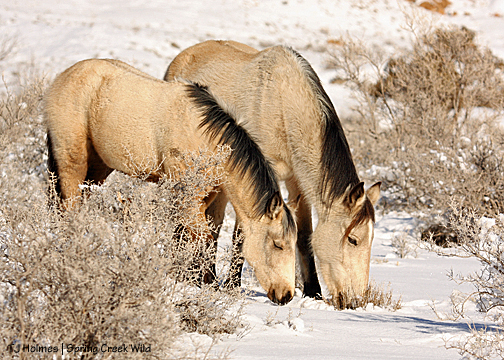
Sharing winter grazing
For example, Winona and Kestrel are finding something yummy here under the snow that occupied them for a few minutes … Baby learning from mama; mama ever-so-patiently sharing whatever she had found …

… until Hollywood’s band, down the hill, caught ‘Nona’s attention, leaving mama Kestrel to finish the morsel.
Some of the horses pawed – almost all of Hollywood’s band members – but some seemed to just snuffle along with their muzzles in the snow and barely pawed at all – those in Steeldust’s band. Why?
Disclaimer: I still have as many questions as I may have answers! 🙂
But I’d like to know your thoughts and questions and topics you’d like to see addressed here. This is going to be a big year of education for us, and what better place to start than the blog? I do plan to talk more about fertility control, but feel free to ask anything.


 Spring Creek Basin Mustangs
Perhaps you would like to get some accurate information on PZP from PhD’s who are experts. See info on below.
I do not know who has this blog but I am not against PZP as was infered. It should not be used IF wild horses are not sustainable however. With so many HMA’s zeroed out (100 +) and most below a sustainable number this is not the case in most herds now. I am against ALL cruel and deadly HELICOPTER roundups as any one can see by the schedule our wild horses are being removed at an alarming rate. The few thousand left still free will not be sustainable in a few more years if the removals continue according to many experts. Some have predicted wild horses on public lands will actually be extinct. See “Managing for Extinction” from the Animal Welfare Institute. These wild horses should not be rounded up and removed and everybody should be trying to stop this .
I am wondering why this blogger only uses their initals for identification? Who employes him/her and what are their credentials ?? Are you a BLM agent?Why dop you say a roundup is necessary of these horses ?
Also Heidi Hopkins was an employee of the BLM and in my opinion her information on wild horses may have been influenced by the BLM and may not always be accurate . The HSUS had a memorandum of understanding with the BLM that roundups were to decrease. However, if any one looks at the schedule they can see they have been increased instead !!
Pat and Jay’s Q&A paper on PZP can be obtained from Jay. See the info below please.
Barbara Warner, long time advocate and rescuer of 3 wild horses from slaughter–many end up there.
THESE EMAILS REMOVED BECAUSE POSTER DID NOT HAVE PERMISSION FROM ORIGINAL AUTHORS TO POST, AND THE AUTHORS OBJECT. IF YOU HAVE POSTED THESE ELSEWHERE, YOU ARE REQUESTED TO REMOVE THEM IMMEDIATELY.
Um. Wow. I banged out a reply … all my years of frustration coming to bear … and then I realized you wouldn’t read it anyway, as I’ve answered your questions previously on this blog that you apparently haven’t read, and here (also linked at the top of my blog): https://springcreekwild.wordpress.com/about/ (hopefully you can figure out my gender from the photo of me on my mare, posted right there at the top).
My employer is none of your business – who do you work for? – but it’s a newspaper. I advocate for the horses on my own time, such as I have. The idea that I work for BLM is ludicrous – would I write like I do about these horses if I worked for BLM?? (Wave to all the BLM people reading this blog, but you have to agree.)
And yes, thank you, I know all the people you referenced above. My training was, in fact, with Dr. Kirkpatrick. Thank you for the references.
I’ve also written about why a roundup is necessary here. You missed those, I’m guessing. Please state your specific qualifications to say otherwise about this specific herd.
This is a blog for good, beautiful, wild horse energy, and given that BLM’s mission(s) does not include education, and given all the inaccuracies about PZP I read and hear about, and the general unrealistic expectations of some, I thought I might share as much of that as I can, from my perspective as someone intimately acquainted with these horses and the range where they live, as well as someone who “would like to get [as someone who has received] some [quite a lot of] accurate information on PZP [and PZP-22 and others] from PhD’s who are experts [from those you referenced as well as others].”
See my blogroll at right (you may have to scroll up): “PZP Q&A” (http://pryorwild.files.wordpress.com/2010/08/pzp-qa-third-edition-june-1-2010.pdf)
Guess I’m pretty naive, eh? Good thing that won’t stop me from spreading information from (at least) the three people you referenced above, from whom I’ve learned so much, as well as my own observations of horses in the wild.
Thank you for your interest in the wild horses of Spring Creek Basin. I appreciate your ideas in the furthering of information about wild horses. And I appreciate your reference to experts – they are all inspirations to me as I continue to learn and ask questions, as well as some you didn’t mention, who do and don’t have “PhD” behind their names. Some good initials to have, I guess.
P.S. As a human being, I make the possibly erroneous assumption that you have permission to post the content of these emails? If that’s not the case, and/or if the authors object – on whatever grounds – I will remove that content immediately upon response to my contact with them.
Oh! I have an idea of why maybe that Steeldust’s and Hollywood’s band eat through the snow differently. It is probably not accurate, but just the first thing that came to mind. Maybe, if they live in slightly different areas of the basin, and they have slightly different vegetation, then different ways of eating get them more food. For example (and I’m mostly guessing here) If the are where Hollywood is has more food that grows slightly closer to the ground and is a bit more durable to pawing then they would paw at the ground to get deeper into the snow, and pawing wouldn’t decrease the amount of food they got. But maybe where Steeldust is the food is a bit longer, and so can be broken and scattered more with pawing, so the snuffle instead. I don’t know, that’s what came to mind for me.
Also, I have a question. In you last post, I saw a very striking resemblance between Winona and Baylee, so also between Kestrel and Baylee. It might just be because of the coat colour and since they have winter coats they are a closer shade, but could they be related in any way?
Barabara–I think you’ve got the wrong impression of TJ. She’s not an advocate for roundups, quite the opposite. She has also written about the long-term effects of PZP–and she’s used those exact figures on reversability.
It’s very important that we do not divide ourselves with nonissues if we really love the Mustangs. As the summit in Vegas has proven–their safety is not a guaruntee anymore.
TJ is out there doing the hard work almost every day and not making any money from it. She’s documenting the herd so that if they are going to do roundups, at least they can keep families together and reduce the time they’re penned. But she’s been very clear that she does not advocate roundups.
Toppyrocks – Good thinking – I had the same thought! But although they were in different areas, the depth of snow and type of vegetation was about the same. It may be that it’s a learned behavior – Winona learning from Kestrel as the photos show? But Kestrel didn’t paw as much as Baylee and Piedra did – and they’re all originally from the same band – Steeldust’s, none of which were pawing that much. Quite a mystery, eh? What if it started with Piedra, say, who figured out she could get to more vegetation by pawing? Wouldn’t that be interesting?! As far as a resemblance between Winona and Kestrel (daughter and mother) and Baylee, it’s at least possible Kestrel and Baylee are half-sisters (sire: Steeldust). I can’t prove that … Although they were all together after the roundup – and none were gathered and released – I don’t know their band status before the roundup. I also think Baylee may be Piedra’s younger sister, which might explain why she left Steeldust’s band for Hollywood’s – after he had taken Piedra. It’s certainly possible that’s what the resemblance means! And good eye!
Linda – Thank you so much for your support! I do very much appreciate it!! 🙂 The horses have brought me into contact with a lot of terrific people. Just another one of their gifts for which I’m eternally grateful. Thank you!
TJ, When I first read Barbara Warner’s post above I thought she must have pasted it into the wrong blog, it’s so far off base from the message your blog portrays. I think you do a good job of letting readers know that you are not a “professional” but rather a person who deeply cares for these horses and is willing to educate herself, and others, for the benefit of the mustangs in Spring Creek Basin and elsewhere. I hope Barbara takes the time to come back to your blog and read it more carefully, including your response to her post. Mustang On TJ!
C/G – Mustang On, indeed! I love that! And thank you, too, for your support!
Please notice TJ did not answer my question why she thinks a roundup of these horses should be done. She stated in a previous blog that she understood why it was necessary. I think she is very wrong about that. Also her info that it takes 7 consecutive doses of PZP to cause sterility is wrong.That is why I contacted Patricia Fazio, PhD and asked her so she sent me the info below. She is a mentor of mine and I admire and trust her information.
I think some of TJ’s info is wrong . If she is going to act like an expert she needs to get her facts straight and get the latest info.
I agree we should not be quarreling but since this is a blog I thought I was entitled to my opinuion. Evidently I am not . Like I said before I am not against PZP but it only needs to be used when there really is an excess of wild horses. This is NOT the case .
I am 72 years old, live in KY and have been a wild horse advocate since at least 1981. I have been to NV to see wild horses and only found a few with the help of friends who live there. I have sent my comments against the cruel and unnecessary roundups and donated to save wild horses and it pissed me off when I read that TC said she would miss some of these horses when they are rounded up but she understood it was necessary.
No, I have not been to CO but I have several wild horse advocate , friends living there who have been working very hard to stop the roundups . Too bad there aren’t more of them.
I did read your reply, TJ, and you can send anything you want to to Pat or Jay.
Also I cannot tell by your picture if you are male or female so glad you cleared that up.
Please notice, Barbara, that I said I HAVE previously answered your question, and I explained WHY it’s necessary. Here it is again, just for you: In 2007, the horses that were rounded up were in extremely lean condition. Based on difficulty getting accurate numbers from BLM, I estimate (nope, I don’t know exactly, but I will this time) there were between 110 and 120 horses on the range at the time of the roundup. The AML is 35-65. The actual population demonstrated to me very obviously that a FENCED, DESERT pasture has a FINITE limit to the number of horses (and other wildlife) it can support on FINITE resources. Obviously, 112-120 horses is TOO MANY for the resources of Spring Creek Basin. The current herd population is again over AML, and with this year’s foal crop will approach 2007’s numbers. I DO NOT ADVOCATE STARVATION, aka “let nature take its course,” in A FENCED, UNNATURAL setting. (I don’t advocate starvation, period.)
Cite your source that “this is NOT the case,” please.
What information have I provided do you think is wrong, Barbara? Guess where I get my information? From Pat and from Jay and from other “PhD experts” YOU claim to admire and respect. As well as from actual on-the-ground observations of the horses themselves (with no agenda other than to learn from them) and reading more documents than I can count or remember or recite the scientific references to. What facts don’t I have straight, Barbara? Guess where I get my facts? Yep, you guessed it – refer to above. Also, apparently you’ve missed the numerous times I have, in fact, claimed that I am NOT an expert, that I read and communicate with experts (busy working for the horses and not writing silly little blogs like this one) – the very experts YOU list as such. I agree the helicopter-driven roundups are cruel and inhumane. I do NOT *ALWAYS* agree that they are unnecessary. Again, I do NOT advocate starvation. Again, I have said repeatedly that I am NOT an expert. Again, I have repeatedly said that Spring Creek Basin and its mustangs are the location and horses I am intimately familiar with.
“Also her info that it takes 7 consecutive doses of PZP to cause sterility is wrong.”
Her, who? Me? I thought you didn’t know if I was a he or a she? Or are you calling Pat wrong? How is it wrong, Barbara? Please tell us how it’s wrong, and cite your source. And tell us what’s correct.
How about this: “The best available data indicates that six or seven consecutive years of treatment are required to cause irreversible infertility.”
You’ll just never guess where I got that information.
Now, kindly cite how infertility in aged mares and/or mares that have contributed significantly to a herd’s genetics is a bad thing. Cite how it’s so unhealthy for them. Cite how they aren’t living longer. Cite HOW ROUNDUPS ARE BETTER – for the mares – and foals – and a herd’s social and genetic structure.
Barbara, come down to Earth. If you have a way to stop roundups – try to steer clear of wishful thinking, why don’t you – please, speak up. But I see a lot of complaints and very little – or NOTHING – in the way of actual solutions. You are entitled to your opinions – do your opinions include solutions? My OPINION is that fertility control is best, by far, than – how did you say it? – “cruel and unnecessary roundups.” Fortunately, I CAN back that up with facts.
Who is TC?
I am a woman, MS. Warner. And for the last few years, I’ve been a very pissed off, mightily frustrated woman who is TRYING, within the realm of REALITY, to do the right thing for these horses I love. Yes, some will get rounded up and removed – and some hopefully adopted to lifelong homes. Yes, more will continue their lives in the wild – and even more if we can make a fertility control program a reality here – and I have dedicated my life to make THAT reality.
My name is TJ, and you cannot even begin to imagine the soul-crushing heartbreak I deal with in light of the life-changing, glorious beauty I see in these amazing wild animals.
To other readers, I am sincerely apologetic. Please (as I also have advocated) read the information available from many sources, ASK QUESTIONS and demand some answers. If you think I haven’t provided enough ideas/answers/solutions (and I didn’t make these up, folks; they exist before and beyond me), please ask. I’ve listed many resources under my blogroll. The whole point was to start a dialogue that seems to be missing from public forums. Can that not happen here? I’d like to try.
TJ –
Well, this was quite the exchange, wasn’t it?! Having known you directly for some time now and spent quite a bit of time in Spring Creek, where I learned each band’s members by sight and name, all I can say is, Ms. Warner does NOT have the slightest idea what is or is not in the best interests of the horses of Spring Creek. We know the hard work you’ve put in, the time spent learning and seeking out the truth! Unfortunately, there will always be people out there who are more about themselves than about the real facts. Such are best ignored when possible but, sometimes, some folks need to be told several times. We’re very proud of the way you responded to this individual. So, you just keep on keeping on! The support behind you cannot be swayed by this sort of (please pardon the expression) but, I’ve got to say it: “CRAP.”
Lynn, Kathy and Molly
Lynn, Kathy and lovely Miss Molly – Thank you so much. You know how much you are appreciated … 🙂
Keep up the great work, TJ!
TB
Thank you, Tom! Hope to see ya’ll in the basin again this spring!
Thanks for the answer on the snow-feeding, TJ! I love trying to figure out that sort of behavioural things. It’s like my dog, is standoffish because he didn’t meet the right sort of dogs when he was younger, because our personality rubs off on him, or because that’s just him? I don’t know.
As for your information, you are one of the more reliable sources I can find because you have first-hand experience with them, and you can back yourself up. Which I really like. And I know that you have their best interests at heart. If anyone were to follow this blog for any length of time, a month or more for example, it would be really obvious that you love these horses lots. Just being able to know most of their personalities and background stories, and know the family ties between them shows that you care at least a little bit about them.
Toppyrocks – The horses’ behavior fascinates me, too. There are so many things we can’t know – past relationships and band dynamics, what happens in all the tiny moments of their lives. They are so generous … waiting for us to catch up to the extraordinary -the everyday – the language they live. Not knowing leads to questions, which leads to exploration … which leads to more questions! 🙂 Answers if we’re lucky. I appreciate your support more than I can tell you, and I hope one day you’ll come visit and stand on the same soil on which the horses stand and look right out at them while the same wind touches your face and theirs and fills you with awe. Believe it!
Hi, TJ I just received my calendar today. It really turned out great. Thanks for the rest of the info,also. By the way, keep up the good work no matter what some people might say. You are doing a wonderful job for the horses.
Thanks, Karen – I’m glad you like the calendar! What a wonderful, collaborative effort – something I hope to continue!
I hope to someday visit and see the wild horses, but it’s not that likely. I live quite some ways away. Someday I would really like to see wild horses, though.
By the way, looks like young Mr. Tenaz is quite taken with Ms. Winona – yes?!
This is a very sweet photo and shows how the youngsters from different bands do, indeed, interact as if they were siblings – neat!
TJ, thank you for the information posted here, but most of all, for the chronicle you give us of these beautiful horses. I live far from CO, but I feel that I know these horses because of you, your words and pictures bring them to life for me. I wish for the perfect world where all the horses could be free, but we live in THIS world, to me, whatever can be done to end FOREVER the horror of the helicopter is a good thing. YOU are out there almost daily with these horses, they are family to you, if , because of PZP, this will be the LAST roundup, if these families will be able to live out their lives in this place; then that is a good thing and a good solution.
Thank you for all that you do, and for allowing me to share with you the wonder of these beautiful animals.
Toppyrocks – Don’t give up the dream. You’re young – many adventures and journeys ahead of you! My friend C is originally from Switzerland. Don’t give up!
Lynn – Yes, Tenaz, and Gideon, too (at least?!) … 😉
Jan – We do hope to end helicopter roundups, but we (I) don’t plan (at least not yet) to use PZP to the degree it’s used on Assateague (with ~150 horses) – where they not only have been able to stop population growth but reduce it without roundups/removals. We do hope to move to the humane method of bait trapping with the money saved and hopefully remove many fewer horses with at least a few more years between. That is something I probably need to make more clear. PZP is not the perfect solution; I don’t believe it will end all roundups. … But I think it’s the best we have to work with right now, especially in places like Spring Creek Basin. The goal absolutely IS to ensure more horses live wild in Spring Creek Basin longer with their families, contribute their genetics and build their social bonds – that they live as naturally as possible in a fenced acreage in population balance with the resources there. We also need to learn how PZP really works within our herd. Maybe it will become apparent that we can balance deaths of elders with births of foals …? No adult horses died last year, for the first time since I’ve been documenting. … How I wish I could be with them almost daily! Almost weekly is the best I can do! 🙂 Thank YOU for caring about them!
TJ I do know that TRNF is conducting a study on PZP usage with their herd, to also be able to use bait-trapping instead of helicopter stampedes. It is posted on the website. The Pryor horse herd is also considering using PZP, that herd is also on a finite range at present. Dayton O’Hyde from IRAM in SD also has innovative ideas about controlling wild horse populations. WHile these ideas may not be feasible everywhere, they offer viable alternatives to what is happening now. I am hoping that BLM will move in this direction this year, as 11 of the proposed roundups are supposed to be treat and release. I am also hoping that they move forward with Madeliene Pickens’ and Return to Freedom’s SAnctuary plans soon.
Take care,
I just wanted to make sure I wasn’t adding confusion to what can be a confusing issue! There *are* these alternatives – and it’s great to see what is being done, that we can adapt it where it IS feasible!
TJ, I didn’t want to ask this question on “The art of self-entertainment”, because the comments are so positive and up-beat, and this is definately a downer.
You said about Winona, “With her outside genetics making her valuable to the Spring Creek Basin herd, I allow myself to dream she will stay wild.”
Do you think you’ll be allowed any meaningful input as to which horses stay and which go in September? I know BLM decisions are beyond the control of “just plain folks”, but, since you’ve been documenting the Spring Creek horses so closely, I hope they take your opinions into consideration.
I can’t imagine having to pick and choose among those you love, but that’s the reality of the situation.
Linda – You’re right, that is the reality of the situation, and this is part of what I alluded to when I talked about the depth of my heartbreak … And I thought a few times before I decided to go ahead and write that sentence. I was told at least a couple of times by the former herd area manager that they would welcome my help in that regard. I do hope they hold to that … but there’s no guarantee. It would go a long way in our partnership-building. Someone else in my situation gave me what I consider great advice: Offer three lists: “Don’t touch” (in other words, these horses stay, for particular, reasonable reasons), “horses that can be removed” and “horses that can either stay or go.” As you might imagine, all the horses are de facto on the “stay” list! But they can’t all stay, for the benefit of the herd as a whole. All I have to do is think about the 2007 roundup and the condition of the horses (with 110-120 horses in the basin), and I know that a roundup and removal of some horses is necessary. To continue “kicking,” I believe fertility control is the best management tool here to reduce the need for roundups and removals – and with the money saved, do future such events humanely (without helicopters), as with bait trapping. I do also hold another memory in my mind from 2007. We were told Grey/Traveler was in the pen of stallions to be released, and it never occurred to me that I should make sure he was known because he was in the “right” pen – and I never realized, either, at the time, that just four stallions would be released (Oh, how much I have learned!). But I did, upon learning that all the mares with foals were to be removed, encourage Alpha’s importance to the herd – and she was released (without her foal). That encourages me … If we meet at the roundup, please forgive – and understand – my tears …