Peaceful grey(s)

13 03 2011

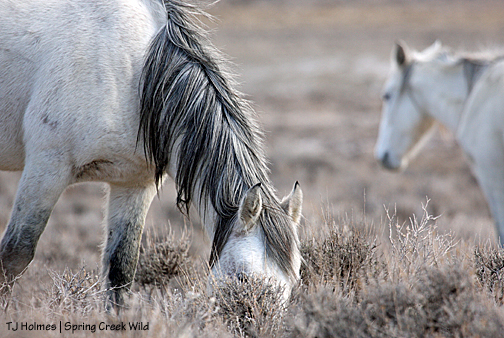
Grey/Traveler and Houdini. I wish his eye was visible, but this is a common view – Grey grazing nearby and Houdini farther away.

This also is common: Daddy with his girls … or … the girls with their daddy!

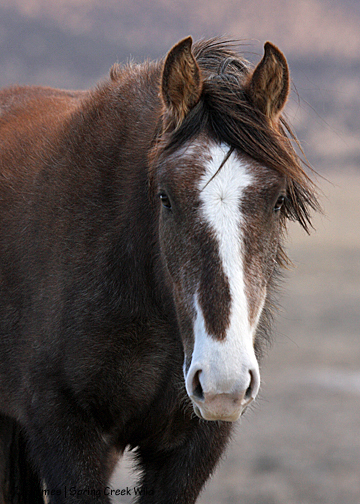
Isn’t he gorgeous? Doesn’t he glow? (Really, he does – I have evidence coming later.)

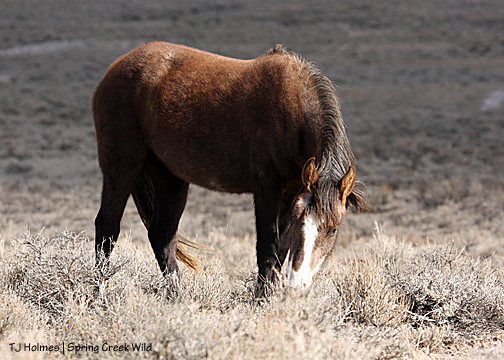
With the broad band of clouds covering the rising sun, the color of the day was fairly dull at this point … but I think you can still see a bit of light illuminating the horses’ coats – and here also, the far background of hills … But it was starting to edge away, that big cloud … revealing brief moments like this:

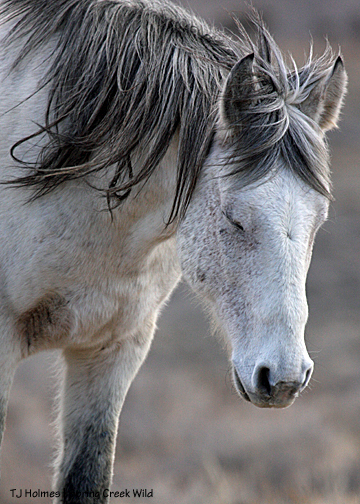
A teaser of light to come …

So many more photos, so little time!

Here’s a shameless plug (which I need to learn to do more of, I’m afraid): I’m speaking at 6 p.m. Thursday at the Wilkinson Public Library in Telluride – scroll down on the right – about the horses, the upcoming roundup and adoption and, very particularly and specifically, about fertility control and the annual program we hope to implement in the basin this fall. The little blurb is, unfortunately, misleading, and that’s not my photo and those are not Spring Creek Basin mustangs. I am in that film, “Mustangs and Renegades” (formerly “Disappointment Valley”), but I have not seen it, and I will not be talking about the film. It was shown there last month, which is the library’s connection.

If any of you are local and can make it, please come and please introduce yourself/ves and let me know about your experiences with the horses!

I mention that, too, because I’m going to try to get more pix up in the next couple of days, but then I’ll be in the basin Wednesday and part of Thursday leading up to my talk in Telluride … visiting with the horses again and collecting more photos and observations. We’re about a month away from the start of our foaling season, and most of the mares are showing definite signs of things to come. Most of our foals should be born in April and May, but our season will go through the summer and into September with at least a few mares.

If you’re praying for a suggestion of what to do, the upcoming scoping letter here will be another chance to do something positive for better management of our mustangs – this scoping letter in particular, for our Spring Creek Basin mustangs. I’ll provide a link to it as soon as I know it’s out (I assume it will be linkable). Public comment helped McCullough Peaks and Pryor Mountain fertility control programs become a reality (and Little Book Cliff’s at the outset – and continuing!); we’ll need them from you here, too.


“BLM to scale back roundups of wild horses”

25 02 2011
BLM link, “BLM acelerates fundamental reforms to wild horse and burro management”: http://www.blm.gov/wo/st/en/info/newsroom/2011/february/NR_0223_2011.html


AP story that moved today on the wire:
By Matthew Daly

Associated Press

WASHINGTON – The government is going to scale back costly roundups of wild horses that some critics contend are inhumane.
The Bureau of Land Management will reduce the number of wild horses removed from the range by about one-quarter – to 7,600 per year. The agency also will expand the use of fertility control and increase the number of animals adopted by individuals or groups. The agency continues to oppose horse slaughter, which some in the West have advocated as a way to thin herds.

The agency’s director, Bob Abbey, said the new plan was intended to ensure that viable herds of wild horses and burros remain on the nation’s public lands for generations to come. To improve the health of both horses and Western lands, officials need the help of private partners and must ensure that management decisions have a scientific foundation, Abbey said.

The changes do not include a proposal that Abbey and Interior Secretary Ken Salazar floated in late 2009 to move thousands of wild horses to preserves in the Midwest and East, where they would graze on land unthreatened by drought and wildfires. The government would have established large horse ranches open to the public for tours and educational visits. The preserves would have cost at least $92 million to buy and build. The plan ran into bipartisan opposition in Congress and among the public.

“It was very evident to us that the public did not like that idea, and so we have dropped that from the strategy we are pursuing now,” Abbey told reporters in a conference call.

The new approach comes a week after the House approved an amendment to cut the agency’s budget by $2 million to protest the roundups. The program’s annual cost has tripled over the last decade to
$66 million. Annual costs are expected to reach at least
$85 million by 2012.

More than 38,000 wild horses and burros roam in Nevada, Colorado, Wyoming and other Western states, the Bureau of Land Management says. An additional 40,000 animals are cared for in corrals and pastures in Kansas, Oklahoma and South Dakota, it says.

The Wild and Free-Roaming Horses and Burros Act was passed by Congress in 1971. It is intended to protect wild horse herds and the rangelands that support them. Under the program, thousands of horses are forced into holding pens, where many are vaccinated or gelded before being placed for adoption or sent to long-term holding facilities in the Midwest.

Animal-rights advocates complain that the roundups – which include the use of helicopters – are inhumane because some animals are traumatized, injured or killed.

Ranchers and other groups say the roundups are needed to protect fragile grazing lands that are used by cattle, bighorn sheep and other wildlife.

Abbey said he knows the changes will not end controversy over the horse management program but said they send an important message: “We will no longer kick the can down the road just because it is challenging.”

Wayne Pacelle, president of the Humane Society of the United States, called the latest plan encouraging but said the Obama administration needs to do more to reduce the number of horses rounded up and removed from public lands.

The current plan “is not economically sustainable, and it is bad policy,” Pacelle said.


BLM budget process

24 02 2011

There has been a lot of talk lately about the upcoming BLM budget process, initiated (I think?) by Rep. Dan Burton’s address in the U.S. House a few weeks ago.

I got this alert this morning (as I’m sure many did) from the American Wild Horse Preservation Campaign: http://org2.democracyinaction.org/o/6931/p/dia/action/public/?action_KEY=5664

It’s a complicated issue, and it’s going to be more complicated when I tell you what it means to Spring Creek Basin. If BLM doesn’t get funding, our roundup this fall won’t happen. Now I don’t quite understand the government budget/funding cycle, and when our roundup was scheduled last year – last budget cycle? – I don’t understand why it’s not funded in this current budget cycle. But our district ranger, acting as herd area manager until one replaces our retired manager, just told me that if Congress does not pass a budget for 2011 and passes only a continuing resolution for the remainder of the year, we would not have the funding for a roundup.

So here it is: Denial of this budget will have a local impact: It will cancel our roundup. Devastating? Maybe not (?). A huge setback? Absolutely.

Why am I so excited about LBC’s roundup this year being canceled and so adamant that ours go on as planned? Because LBC’s was canceled BECAUSE PZP has limited the population growth there. Ours is growing – still growing – and we don’t have a PZP program in place to begin to approach LBC’s success! We’ll end up with about 90-95 horses this year … which would mean ~128 horses next year (based on my knowledge of the horses).

To start, forget the genetic “number.” Whatever it is, it’s moot. Spring Creek Basin is a fenced >22,000 acres. (Most? All? HMAs are fenced or cut off by natural boundaries? We have both.) It’s a finite area with extremely limited resources. The population of 110-120 horses at the 2007 roundup was lean. Some horses/bands were driven outside the boundaries of the herd area to find water and forage – over/through fences. How desperate is that? What would be the condition of 128 horses??? I DON’T WANT TO KNOW – because I can guess. Emotionally, I HATE the mere thought of the roundup this fall. Realistically, I would rather the horses be in good to great condition to withstand the helicopter than in poor to starving condition …

Spring Creek Basin is a drop in the Wild Horse & Burro Program. But consider this: In the proposal I wrote last year asking BLM to implement an annual PZP darting program in Spring Creek Basin, I calculated that horses from Spring Creek Basin NOT sent to long-term holding would save the government (taxpayers) at least $2.25 million over their lifetimes in holding (at $20,000 per horse’s lifetime, according to Tom Gorey; it’s $2,500 per horse per year according to Rep. Burton’s address). We can achieve that with PZP to limit Spring Creek Basin’s herd population growth, to limit roundups to one per decade rather than three per decade.

Yes, we’re a drop in the program – and that’s lifetime, not per year. But what if this was the tale in  multiple herd management areas and wild horse ranges … Little Book Cliffs, Pryor Mountain, McCullough Peaks, Spring Creek Basin and more? How many $millions ($billions over the long term?) would BLM – the government – taxpayers save? How many horses would we save? How many not-born mustangs would NOT go to long-term holding … how many mustangs would live wild on their home ranges?

So how do I/we comment on the budget process? What comment makes the most (realistic) impact? What comment funds our necessary roundup (see the numbers and reasoning above) and implements an annual fertility program in Spring Creek Basin – to start us on the road to the success seen by Little Book Cliffs?

Stopping traumatic roundups is a good goal, but SOMETHING has to be in place to then limit reproduction … leading to what BLM deems “excess.” Wait … what BLM deems? The monsters, right? Re-read what I wrote above: Spring Creek Basin is FENCED. Its resources are LIMITED. In addition to mustangs, it supports – in limited, seasonal quantities – mule deer, elk, pronghorn antelope and cattle (yes, a limited number of cattle, for three months of the year when water – as snow – is (usually) plentiful), as well as coyotes, black bears, mountain lions (rare, I have seen a track), ravens, eagles (golden and bald), owls, kestrels, bluebirds – others – badgers (caught by my wildlife cam!) … What does that have to do with BLM? Monstrosity? No. That’s simply the law of reality … of nature (as fenced by man, which simply ain’t gonna change).

“Let nature take its course …” Who has seen nature in her course? Fortunately (!!), Bones and her half-born foal are the only end-of-nature bodies I’ve seen (equine, that is). Since I’ve been documenting the horses, I don’t know the causes of the foal mortalities (other than Bones’ foal), and the mares other than Bones and one mare that likely died of a catastrophic injury have been elderly girls. Fortunately, I haven’t witnessed Spring Creek Basin horses at the brink of (or past) starvation – but I’ve heard firsthand accounts from people who have. I can’t stand by and watch nature take its course on a fenced range with otherwise healthy horses, and BLM is legally obligated to disallow starvation. Is (lack of) funding going to stop that process?

LBC’s roundup was canceled because growth stopped. Spring Creek Basin’s population is still growing.

On how many other ranges is this the story? I don’t know, I know it only here.

Now what?

I want the bulk of BLM’s Wild Horse & Burro Program budget to go to managing mustangs in the wild. That’s a better goal than “stop the roundups.” In our case, PZP will cost a few hundred dollars a year because of our small population and small number of mares. How much better would it be if the bulk of the budget BLM gets for managing wild horses went to fertility control and a smaller amount – because of fewer necessary? – went to roundups and removals? Will we eliminate mustangs in long-term holding? I don’t know … but as at least a short-term goal, wouldn’t it be better to have more horses wild than in any kind of holding at all – as opposed to the other way around?

To save the majority – here – some horses must be removed. That’s the end result of current management. If we can then start better management, hoorah!

I wish there was a neat way to wrap up this package, this issue, this post. I’ve been trying to get there the last several paragraphs. But it reflects the realities of wild horse management. There’s not a neat way to wrap it up. PZP isn’t perfect. Is it better than the roundup/remove option? Obviously, that’s my stand.

(Not) the end.


Ours, before we were U.S.

24 11 2010

http://www.rgj.com/article/20101123/NEWS20/11210366/1321/NEWS

From the Reno Gazette-Journal

“Best science” gets harder and harder to ignore.


‘We strongly urge …’

31 08 2010

“We strongly urge you to refrain from any further action until a clear plan is in place to sustainably manage and protect our wild herds. Only then can we move forward with a more informed, open and deliberate process, based on input from all who are concerned with the health, well being, and conservation of this animal which embodies the spirit of our American West.”

Is it enough?

Here’s a link to the letter written in 2008 and signed by Rep. Nick Rahall, D-W.Va., chairman of the Committee on Natural Resources, and Rep. Raul Grijalva, D-Ariz., chairman of the Subcommittee on National Parks, Forests, and Public Lands: http://wildhorsepreservation.com/pdf/EuthanasiaBLM_letter.pdf

And here is the link to the July 30, 2010, letter, with the congressmen’s call to other members to sign on (thus far, it has been signed by 54 members of Congress): http://www.wildhorsepreservation.org/news/?p=1456

July 30, 2010

The Honorable Kenneth L. Salazar
Secretary of the Interior
U.S. Department of the Interior
1849 C Street NW, Washington, DC 20240

Dear Secretary Salazar,
Recent media accounts have documented still more deaths of wild horses during Bureau of Land Management (BLM) roundups. Just this month, 12 horses, including three foals, died during the Tuscarora Complex roundup in northeastern Nevada as a result of deeply flawed methods. This tragedy was only the most recent in a string of reports of wild horses dying during BLMroundups this year.

We are concerned by the inability of your agency to acknowledge these disturbing outcomes, change what seems to be deeply flawed policy, and better manage the gathers so as to prevent the unnecessary suffering and death of these federally protected animals.

Specifically, on Saturday, July 10, with temperatures hovering near 100 degrees, the BLM, in a time-span of two and half hours, captured and corralled more than 228 wild horses after running them more than 8 miles. During this time, public observation of BLM activities was prohibited. This ill-advised plan resulted in the deaths of 12 protected American Mustangs, most due to water intoxication; three of the dead were foals less than six months old. By the time the roundup was halted, 17 horses had died.

While we applaud the speed with which you temporarily halted the Tuscarora roundup after these deaths, the roundup has now resumed. Apparently, BLM continues to bar public observers, despite a court order affirming the right to “reasonable access.” So far, 410 more horses have been gathered and, according to BLM’s own account, the death toll has risen to 21.

The BLM is repeating the mistakes made during the deadly round up in the Calico Mountain Complex last winter. That roundup resulted in the deaths of over 105 horses, along with the stress-induced late term abortions of at least 40 mares.

Given this pattern, and the continued threat of death and suffering to these animals, we request that the Tuscarora Complex roundup be suspended, along with any pending gathers, until the agency demonstrates that it has addressed the failings of the current program and can ensure the safety and well-being of the animals you are charged with protecting.

Specifically, the BLM must account for temperature extremes and the impacts of stampeding young, elderly or injured animals across long distances when planning roundups. The BLM needs to ensure transparency by allowing members of the public to observe agency activities. Further, we remain concerned that roundups are conducted at great expense to the taxpayer. As we have pointed out in the past, BLM’s aggressive use of roundups has resulted in unsustainable increases in the number of horses in holding facilities (now at 38,000) and continues to undermine the BLM’s overall budget. Unfortunately, the frequency of roundups has only increased under this administration.

To address these and other flaws, we recommend an independent analysis of the National Wild Horse and Burro program, conducted by the National Academy of Sciences. This analysis will provide a clear determination of the most accurate, science-based methodologies to estimate wild horse and burro populations, provide an assessment of Appropriate Management Levels based on the goal of maintaining sustainable herds and provide an assessment of practical, effective, nonlethal and publicly acceptable management alternatives to current BLM policies.

We strongly urge you to refrain from any further action until a clear plan is in place to sustainably manage and protect our wild herds. Only then can we move forward with a more informed, open and deliberate process, based on input from all who are concerned with the health, well being, and conservation of this animal which embodies the spirit of our American West.
Sincerely,
Member


‘Deeply flawed policy’

31 08 2010

http://www.seattlepi.com/local/6420ap_nv_wild_horses_study.html

BLM seeks independent review of wild horse program

By MARTIN GRIFFITH
ASSOCIATED PRESS WRITER

RENO, Nev. — At the urging of a bipartisan group of House members, the U.S. Bureau of Land Management is asking for an independent review of its wild horse and burro program by the National Academy of Sciences.

BLM officials said the two-year, $1.5 million study would determine whether the agency is using the best science available in managing wild horses and burros on Western rangelands. BLM managers estimate that 38,000 mustangs and burros roam 10 Western states, and half are in Nevada.

The study tentatively set to begin Jan. 1 would focus on population estimation methods, annual herd growth rates and population control measures, agency officials said in a statement released Friday.

The announcement came a month after 54 House members signed onto a letter that Rep. Nick Rahall, D-W.Va., chairman of the House Natural Resources Committee, sent to Interior Secretary Ken Salazar pleading with him to halt a series of wild horse roundups under way in the West.

The letter recommended that the National Academy of Sciences be assigned to review the BLM’s plan to cull about 12,000 of 38,000 mustangs and burros from the range and either send them to long-term holding facilities or put them up for adoption.

Nevada Democratic Reps. Shelley Berkley and Dina Titus were among those who signed the letter that maintains the gathers are based on a “deeply flawed policy.”

“Nevada’s wild horses and burros are a treasured part of our Western heritage, but we continue to struggle with the management of these herds on public lands,” Berkley said Saturday. “My hope is that this study will provide a new blueprint for addressing the many challenges we face in protecting wild horse and burro populations in Nevada and other Western states.”

Titus said she was pleased the BLM acted quickly in response to House members’ request for the study.

“In the meantime, I again urge the BLM to halt roundups until the failings of the current program are addressed,” she said Saturday.

Activists said they support the independent review but only if it’s coupled with an immediate moratorium on all BLM roundups of mustangs from the range. There will be too few genetically viable herds left to study at the present rate of roundups, they said.

Activists said they support the independent review but only if it’s coupled with an immediate moratorium on all BLM roundups of mustangs from the range. There will be too few genetically viable herds left to study at the present rate of roundups, they said.

“I expect the NAS report to be enlightening regarding the lack of science in BLM’s decisions aimed at ridding the West of our wild horse and burro heritage,” said Ginger Kathrens, director of the horse advocacy group Cloud Foundation based in Colorado. “A moratorium right now is essential so that NAS will have a few viable herds left to study.”

The National Academy of Sciences is a nonprofit source of scientific advice that enlists the nation’s top experts to address a wide range of problems.

BLM’s news release:

http://www.blm.gov/wo/st/en/info/newsroom/2010/august/NR_8_27_2010.html

BLM Proposes National Academy of Sciences Study

The Bureau of Land Management has asked the National Academy of Sciences/National Research Council (NAS/NRC) to make an independent technical review of the Wild Horse and Burro Program to ensure that the BLM is using the best science available in managing wild horses and burros on Western public rangelands.

The NAS/NRC has previously reviewed the BLM’s management of the Wild Horse and Burro Program and produced three separate reports; however, these reports are now 20 to 30 years old.  In those reports, the NAS/NRC summarized what was known about wild horses and burros and made recommendations to the BLM for wild horse and burro management, population estimation, and further research.

In the proposed effort, many of the topics discussed in the earlier reports would be included, such as population estimation methods, annual herd growth rates, population control measures, and whether populations will self-limit, as well as other subjects needing new research.

To sort through the many diverse and often conflicting opinions about how wild horses and burros should be managed, the BLM must continue to base its decisions on the best available science and involve the public in its decisionmaking process.  Commissioning the NAS/NRC to review their three earlier reports and the current available information and research about wild horses and burros is a first step.  A second step is to ask the NAS/NRC to make recommendations about future wild horse and burro management and needed research.  A third step is to take the NAS/NRC findings and recommendations and make them available to the public in a variety of ways, perhaps to focus groups or science forums.

Both the BLM and NAS/NRC will negotiate the terms and outline for the research study.  The proposed study would tentatively begin about January 1, 2011, and would cost the BLM approximately $1.5 million and take about two years to complete.

Congress created the NAS/NRC to be a non-Federal, not-for-profit source of scientific advice.  The NAS/NRC enlists the nation’s foremost scientists, engineers, health professionals, and other experts to address the scientific and technical aspects of society’s most pressing problems.  Each year, thousands of these experts are selected to serve, without pay, on hundreds of study committees.
The BLM manages more land – more than 245 million acres – than any other Federal agency. This land, known as the National System of Public Lands, is primarily located in 12 Western states, including Alaska. The Bureau, with a budget of about $1 billion, also administers 700 million acres of sub-surface mineral estate throughout the nation. The BLM’s multiple-use mission is to sustain the health and productivity of the public lands for the use and enjoyment of present and future generations. The Bureau accomplishes this by managing such activities as outdoor recreation, livestock grazing, mineral development, and energy production, and by conserving natural, historical, cultural, and other resources on public lands.

–>The Bureau of Land Management has asked the National Academy of Sciences/National Research Council (NAS/NRC) to make an independent technical review of the Wild Horse and Burro Program to ensure that the BLM is using the best science available in managing wild horses and burros on Western public rangelands.

The NAS/NRC has previously reviewed the BLM’s management of the Wild Horse and Burro Program and produced three separate reports; however, these reports are now 20 to 30 years old.  In those reports, the NAS/NRC summarized what was known about wild horses and burros and made recommendations to the BLM for wild horse and burro management, population estimation, and further research.

In the proposed effort, many of the topics discussed in the earlier reports would be included, such as population estimation methods, annual herd growth rates, population control measures, and whether populations will self-limit, as well as other subjects needing new research.

To sort through the many diverse and often conflicting opinions about how wild horses and burros should be managed, the BLM must continue to base its decisions on the best available science and involve the public in its decisionmaking process.  Commissioning the NAS/NRC to review their three earlier reports and the current available information and research about wild horses and burros is a first step.  A second step is to ask the NAS/NRC to make recommendations about future wild horse and burro management and needed research.  A third step is to take the NAS/NRC findings and recommendations and make them available to the public in a variety of ways, perhaps to focus groups or science forums.

Both the BLM and NAS/NRC will negotiate the terms and outline for the research study.  The proposed study would tentatively begin about January 1, 2011, and would cost the BLM approximately $1.5 million and take about two years to complete.

Congress created the NAS/NRC to be a non-Federal, not-for-profit source of scientific advice.  The NAS/NRC enlists the nation’s foremost scientists, engineers, health professionals, and other experts to address the scientific and technical aspects of society’s most pressing problems.  Each year, thousands of these experts are selected to serve, without pay, on hundreds of study committees.


BLM promises

6 06 2010

Is BLM really starting to listen … ???

*Wild Horses and BLM’s promise of a new day dawning* – LA Equine Policy Examiner

“Animal advocates are a bit saddle sore from past relations with BLM.  Trust is in short supply.  The proclamation of a new day dawning was delivered with mixed messages wrapped in a pretty package.”

“The announcement also says, ‘The euthanasia of healthy excess animals or their sale without limitation to protect the animals from slaughter’ is a topic of discussion and an option that will be off the table.  Dean Bolstad, National Program Division Chief, confirmed interpretation of this wording to mean that the topic will not be included in the Secretary’s initiative.”

BLM’s proclamation by BLM Director Bob Abbey: “Bureau of Land Management Director Bob Abbey today announced that the agency is taking the Federal Wild Horse and Burro Program in an unprecedented new direction, and is seeking in-depth public comment on a Strategy Development Document implementing Secretary of the Interior Ken Salazar’s Wild Horse and Burro Initiative.”

There are links toward the bottom to access the document for comments: “To gather feedback, the Strategy Development Document outlines specific areas where the BLM is seeking public input over a 60-day comment period. To ensure input from the broadest number of stakeholders, the BLM is using ePlanning. To access the document and provide the BLM with feedback, select this link. A PDF version of the document is also available by clicking on this link.”

Both links seem to be broken at the moment …

“Costs for the program, particularly those for animals in holding facilities, have risen dramatically in the last several years. In fiscal year 2009, for example, approximately $29 million, or about 70 percent of the total wild horse and burro program budget of $40.6 million, was spent on animals held in corrals and pastures.”

Hopefully our coming proposal to implement a relatively inexpensive fertility control program in Spring Creek Basin using volunteer labor – with major $$ savings – will be well-received …


Wild horse workshop in Denver

14 05 2010

FYI …

BLM Press Release:  WHB Advisory Board Workshop & Meeting

Bureau of Land Management      Contact: Tom Gorey
For release: Thursday, May 13, 2010     (202-912-7420)

National Wild Horse and Burro Advisory Board Will Conduct Public Workshop and Hold Meeting in June in Denver
The Bureau of Land Management announced today that the National Wild Horse and Burro Advisory Board will conduct a public workshop and hold a regular meeting in June at a two-day event in Denver.  The workshop on Monday, June 14, will provide the public with a unique opportunity to express their views, comments, and suggestions regarding Secretary of the Interior Ken Salazar’s wild horse initiative, which he and BLM Director Bob Abbey announced last October.  The Board will hold a regular meeting on wild horse management issues on Tuesday, June 15.
The public workshop and the Board meeting will take place in Denver, Colorado, at the Magnolia Hotel, 818 17th St., Denver, CO 80202.  The hours of the Monday workshop are 8 a.m. to 4 p.m. local time; the Tuesday Board meeting is set for 8 a.m. to 5 p.m. local time.  The hotel’s phone number for reservations is 303-607-9000.  The business agendas for the public workshop and Board meeting can be found on page 26990 of the Thursday, May 13, Federal Register(http://frwebgate5.access.gpo.gov/cgi-bin/PDFgate.cgi?WAISdocID=762416245134+2+2+0&WAISaction=retrieve).
On Monday, June 14, the public will be able to provide feedback and input concerning Secretary Salazar’s initiative, the details of which can be accessed at the BLM’s website (www.blm.gov); the specific Web address is http://www.blm.gov/wo/st/en/prog/wild_horse_and_burro/national/initiative.html.
On Tuesday, June 15, the public may address the Advisory Board at an appropriate point in the agenda, which is expected to be about 3 p.m., local time.  Individuals who want to make a statement should register with the BLM by noon on the day of the meeting at the meeting site.  Depending on the number of speakers, the Board may limit the length of presentations, set at three minutes for previous meetings.  Speakers, who should address the specific wild horse and burro-related topics listed on the agenda, must submit a written statement of their comments, which may be sent electronically to the BLM by accessing the following Web address:  http://www.blm.gov/wo/st/en/prog/wild_horse_and_burro/wh_b_contact_us/enhanced_feedback_form.html.  Alternatively, comments may be mailed to the National Wild Horse and Burro Program, WO-260, Attention: Ramona DeLorme, 1340 Financial Blvd., Reno, NV 89502-7147.  Written comments pertaining to the Advisory Board meeting should be submitted no later than close of business June 7.
For additional information about the meeting, please contact Ramona DeLorme, Wild Horse and Burro Administrative Assistant, at 775-861-6583.  Individuals who use a telecommunications device for the deaf (TDD) may reach Ms. DeLorme at any time by calling the Federal Information Relay Service at 1-800-877-8339.
The National Wild Horse and Burro Advisory Board provides input and advice to the BLM as it carries out its responsibilities under the 1971 Wild Free-Roaming Horses and Burros Act.  This law mandates the protection, management, and control of these free-roaming animals in a manner that ensures healthy herds at levels consistent with the land’s capacity to support them.  The BLM manages about 37,000 wild horses and burros that roam BLM-managed rangelands in 10 Western states; the agency also feeds and cares for more than 35,000 horses and burros that are maintained in short-term corrals and long-term Midwestern pastures.
The Advisory Board meets at least twice a year and the BLM Director may call additional meetings when necessary.  Members serve without salary, but are reimbursed for travel and per diem expenses according to government travel regulations.
The BLM manages more land – 253 million acres – than any other Federal agency.  This land, known as the National System of Public Lands, is primarily located in 12 Western states, including Alaska.  The Bureau, with a budget of about $1 billion, also administers 700 million acres of sub-surface mineral estate throughout the nation.  The BLM’s multiple-use mission is to sustain the health and productivity of the public lands for the use and enjoyment of present and future generations.  The Bureau accomplishes this by managing such activities as outdoor recreation, livestock grazing, mineral development, and energy production, and by conserving natural, historical, cultural, and other resources on public lands


Washington march highlights

27 03 2010

Photographer Pam Nickoles has amassed a collection of links on her blog that will take you to coverage about the March for Mustangs rally in Washington, D.C. Check back; she said she’ll be adding more!

To those who were there, thank you so much for standing up for our mustangs!


March for Mustangs

24 03 2010

From The Cloud Foundation Web site (will take you to the full site with clickable links):

Title:
March for Mustangs in DC
When:
March 25, 2010 – March 25, 2010  1:00 pm – 3:00 pm
Category:
Protest/Rally

Description

marchformustangsposter240

March for Mustangs

A rally and protest co-sponsored by The Cloud Foundation, The Equine Welfare Alliance , Friends of Animals and many more!

When: Thursday, March 25th

Time: 1:00-3:00pm, Press conference and speakers at 1:30pm (Hope Ryden, author “America’s Last Wild Horses,” Filmmaker Ginger Kathrens, Author RT FItch, Friends of Animals Director Priscilla Feral, In Defense of Animals President Dr. Elliot Katz, Filmmaker James Kleinert and many more- including special guests to be announced)

Where: Lafayette Park located directly across from White House at 16 Street and H Street, NW). Around 3:00pm protesters will march with sign to the BLM office at 1849 ‘C’ Street.

Plus Mustangs on the Hill II: On Friday morning we’ll meet and brief people on meeting with their Represenatives in meetings to save the mustangs. Please schedule an appointment with your Representatives for Thursday morning or Friday. The first Mustangs on the Hill last September made a lot of important impacts for wild horses– please schedule meetings now and make the most of your time in DC.

Plus: Special Screening of the new documentary on our wild horses and burros in the west: Disappointment Valley… A Modern Day Western by James Kleinert on Wednesday evening, March 24th from 6:00-8:00pm at BusBoys and Poets, location 14th & V street


Driving? Check out the Ride Share to connect with other advocates in your area to get to DC –

Why: BLM’s cruel and poor mismanagement is destroying a vital piece of the American west. The American public is sanding up for our horses and burros- please join us in a March for Mustangs, rally and protest.

Roundups increased significantly in 2000 in the Bush years and they haven’t let up under the Obama administration.  12,000 wild horses and burros are scheduled for removal from our public lands this fiscal year alone. These helicopter roundups come at enormous expense to our wild herds and to the American taxpayer.

Recently the roundup of 1900 mustangs took place in the Calico mountains of Northwestern Nevada during the dead of winter, ending early in February when BLM realized the herds were far smaller than estimated. To date 60 horses have died due to this roundup and the death toll continues to climb daily. This does not include the 30 plus mares that have aborted their late-term foals in the feedlot style corrals in Fallon, Nevada where the horses are being held. Two foals had their hooves literally separate from the bone after the helicopters ran their families for miles over rocky and sharp volcanic ground.

Secretary Ken Salazar, who oversees the BLM, has decided there is no room left for our mustangs on their designated lands in the west. The Secretary and has proposed purchasing private land in the East for our Western wild horses. This only adds to the financial and humane train wreck that the Wild Horse and Burro Program has become.

So rather than spending over thirty million dollars this fiscal year to remove our wild horses and burros from the range, let’s protect them on their western lands. The intent of Congress’ 1971 Free-roaming Wild Horses and Burros Act was not to warehouse our allowed to live in freedom in self-sustaining numbers on western rangelands designated primarily for their survival. Drastic change is needed in the management of wild horses and burros if they are to survive, as wild animals, into the future. Wild horses benefit the land as they evolved in North America and they represent our living history in the west.

Annually we lose $123 million running a taxpayer subsidized grazing program is often referred to as “welfare ranching” due to the small fees charged to livestock permittees. The rate is currently the lowest allowed by law—$1.35 per cow/calf pair per month. This rate needs to be raised to over $9.00 in order for the program to break even. If cows were removed and horses allowed to stay, we’d save even more—including our valued mustangs. Holding the 1900 Calico horses alone in a feedlot style facility amounts to a staggering cost of over $10,000 per day!

But change is on the way for our wild horses and burros! Some 25 protests have been mounted from coast-to-coast including Chicago, LA, NYC, Denver, Las Vegas, Reno, and Sacramento since late December. Thousands of people have braved the cold and come out with their families to hold banners and signs demanding that President Obama react to the hideous mistreatment of our spectacular wild horses and respond to the incredible waste of taxpayer dollars on a broken program that only lines the pockets of powerbrokers and cattle barons. Now is the time to say enough is enough. Open the gates and return our wild horses to their rightful ranges.

Please take action for our wild herds.  An immediate moratorium on all roundups is needed! This must be followed by hearings and investigations on BLM mismanagement; accurate and independent assessments of just hwo many wild horses we have left and the real range conditions. Then we need to develop a  sustainable plan for our wild herds on our Western public lands and restore their protections set forth in the 1971 Wild Free-Roaming Horses and Burros Act. Moving our wild horses in non-reproducing, broken families to the East is not the answer.

Join us on Thursday, March 25th for a Mustangs March on Washington and take action today to save these incredible animals who are currently being managed to extinction.

Take Action

–       Call President Obama 202-456-1111

–       Call your Senators 202-224-3121

Also in London (will take you to the full site with clickable links):

Outrage Over Wild Horse and Burro Removals Crosses the Pond

CHICAGO, (EWA) – The outrage over the round-up of America’s wild horses and burros has spread internationally. Groups in the United Kingdom will be holding a rally in front of the American Embassy in London on March 25. On the same day, Americans will be holding a rally across from the White House in Lafayette Park that will conclude in front of the Bureau of Land Management (BLM) offices.

The London Protest was organized by Jane Bravery, Mary Alice Pollard of Cornwall’s Voice for Animals (CVFA), Maria Daines, singer/songwriter and board member of Saving America’s Horses and international actress, Melita Morgan. The rally is cosponsored by the Equine Welfare Alliance (EWA) and The Cloud Foundation (TCF).

Maria Daines commented, “If we do not stand as one on issues that affect all species whose purpose is to live wild and free, we cannot expect our own species to evolve in a compassionate and considerate way towards each other. Wild horses deserve their time and place, they deserve our protection and we must exist peacefully with these glorious creatures or risk losing them forever.

Mary Alice Pollard adds, “Cornwalls Voice for Animals represents seven thousand supporters worldwide and stands united in ending wild horse round-ups and seeing the wild horses being born free and living wild and free.”

The Washington DC rally and press conference is hosted by Friends of Animals and is cosponsored by EWA, TCF, and In Defense of Animals. A screening of James Kleinert’s documentary, Disappointment Valley will be held the night prior to the protest. Celebrities, advocates and organization members from across the country are expected to attend the two day event.

There is a groundswell of support for the preservation of America’s Mustangs. The BLM would like the public to believe this is just a minor uprising but this is a major international movement.” ~Ginger Kathrens, volunteer executive director, TCF.

The recent deadly round-up at the Calico Complex in Nevada has added to the tremendous support for a moratorium on round-ups. To date, 113 wild horses have lost their lives as a result of the round-up. At least two foals literally had their hooves run off.

“Our wild horses don’t have the luxury of time to waste while we grapple with bad policy. We must not allow special interests to methodically eliminate these horses from public land or our future generations will be robbed of their natural heritage.” ~Mariana Tosca, Actor and Social Activist/Animal Activist

CVFA, EWA and TCF urge the public to attend these rallies and ask that President Obama issue an immediate moratorium on round-ups and reject BLM plans to relocate wild horses to the East and Midwest until current range studies and independent population counts are available.

EWA’s John Holland notes, “The United Call for a Moratorium originally sent to President Obama and the Department of Interior in November, remains unanswered.”

The Equine Welfare Alliance is a dues free, umbrella organization with over 100 member organizations. The organization focuses its efforts on the welfare of all equines and the preservation of wild equids.

www.equinewelfarealliance.org

www.cornwallsvoiceforanimals.org