By Martin Kidston
Billings Gazette
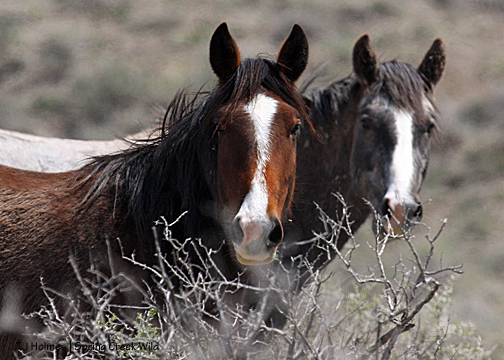
CODY — The Bureau of Land Management will begin darting wild mares in the McCullough Peaks with a contraceptive later this month in a move that the agency says will cost less than past roundups and help stabilize the herd’s population.
Officials with the BLM’s Cody Field Office will dart mares over the age of 1 with the fertility control drug porcine zona pellucida, or PZP, in hopes of establishing a viable population of 70 to 140 wild hores.
Tricia Hatle, the BLM’s wild horse specialist in Cody, said Monday that two trained wildlife darters will administer the vaccine using capture guns. The effort is expected to run through 2015.
“One person will dart the mare, and the other person will be the observer,” she said. “We’ll recover the dart so we know if the vaccine was injected. It’s administered in the hip, in the muscle. It’s about 1 cc, a very small amount of liquid.”
Hatle said targeted mares will receive .5 cc of PZP. The drug would be mixed with .5 cc of an emulsifier known as Freund’s Modified Adjuvant.
Hatle said the vaccine works by blocking sperm from penetrating the mare’s egg. The PZP will be shipped to Cody by the Science and Conservation Center at ZooMontana in Billings, Mont.
In past years, Hatle said, management of wild horses in the McCullough Peaks has largely relied upon gathers and removals to control the population.
But those efforts have been costly. In 2004, when 362 horses were removed from the McCullough Peaks management area, the cost reached $135,000. In 2009, when 94 horses were removed, the cost exceeded $102,000.
“Our goal is to keep the herd at 140 or below,” Hatle said. “As of February, we were at 124 adults, and we’ve had one foal born so far.”
Hatle said the wild horses in the McCullough Peaks generally live 25 to 30 years — a little longer than their wild counterparts roaming Montana’s Pryor Mountains.
As the mares mature, she said, they’ll be permitted to foal. The newborns will ultimately replace older horses that die off.
“What you want to balance out is having foals born in proportion to horses that die of old age, so your population stays at a balanced level,” Hatle said. “You do this by allowing the mares to foal between 3 and 7 years of age.”
Mares that reach the foaling age will no longer be treated with PZP, she said. It may take one or two years after vaccination before the drug wears off.
“This allows the mare to mature fully before they foal,” Hatle said. “It’s easier to let them have a foal at 3 to 6 years. Right now, I have mares foaling at two years.”
Sarah Beckwith, public affairs officer for the BLM’s Wind River/Bighorn Basin District, said the new contraceptive program will cost less than past roundups.
She said Friends of A Legacy-McCullough Peaks Mustangs will pay for the PZP and assist in the field. The only cost associated with the program, she said, is Hatle’s time administering the vaccine.
“FOAL will be donating its time and paying for the PZP, and (Hatle) is doing this within her workday, so there’s no extra cost,” Beckwith said. “It’ll be much cheaper than the roundups.”
Members of FOAL couldn’t be reached Monday for comment, but Beckwith lauded the group for its efforts in addressing the herd’s long-term care.
“It’s such a helpful and wonderful partnership we have there with them,” Beckwith said. “Their goal is the same as ours — to reduce the need of those roundups. With this program, that’s what we’re aiming to do.
Contact Martin Kidston at 307-527-7250 or mkidston@billingsgazette.com