Wild Horse Scientists

6 01 2013

wildhorsecover-300

Behind the scenes and out of the public spotlight – the way they like it – are a number of people – scientists – working to improve wild horse management. A new book by Kay Frydenborg, Wild Horse Scientists, published in November by Houghton Mifflin, looks at a couple of these scientists: Dr. Jay Kirkpatrick and Dr. Ron Keiper.

Dr. Kirkpatrick is director of the Science and Conservation Center in Billings, Mont., where PZP is made and darters are trained. His work has proved especially invaluable with the wild horses managed on Assateague Island National Seashore. Dr. Keiper came up with a system of identifying the Assateague Island horses when research and fertility control started there around 25 years ago.

The book is aimed at children 10 and older, but given the myths and misconceptions I still hear about fertility control and wild horses, it’s likely appropriate for all age levels. Also, the idea that science IS being applied to the management of wild horses – particularly on Assateague, where the population is controlled only by the use of fertility control and a roundup hasn’t been conducted in many years (?) – is important and has applications that readers of all ages can appreciate.

Hoping to get more kids aware of the mustangs of Spring Creek Basin, our National Mustang Association/Colorado chapter and Disappointment Wild Bunch Partners are working with the Telluride Institute to get schoolkids to the basin. This book could become an important part of their unit about good, in-the-wild management of these horses.

For more information, see Kay’s website: http://www.kayfrydenborg.com/

From her website:

“Dr. Ron Keiper and Dr. Jay Kirkpatrick have both, in their own unique way, made the wild horses of Assateague Island, Maryland their lives’ work. Experience Dr. Keiper’s handwritten notes—taken over countless watchful hours in the field—which are both a diary and a scientific log that chart the lives of his equine subjects, some of nature’s greatest survivors. And follow Dr. Kirkpatrick from the lab to the field as he works tirelessly to find a way to manage the horse population with a birth control vaccine, and helps keep the precarious balance of Assateague’s ecosystem intact.

“Descriptive prose meets solid science as author Kay Frydenborg offers a rare glimpse into the wild herds of Assateague, sharing beautiful photos of the Assateague herds in their island home and of both of the scientists at work—some of them never seen before.”

Also visit the website where Houghton Mifflin promotes authors, photographers and conservationists who highlight all kinds of topics to get kids interested in science: http://www.sciencemeetsadventure.com/

Find the book on Amazon. I just ordered mine.


Kids and mustangs

17 09 2012

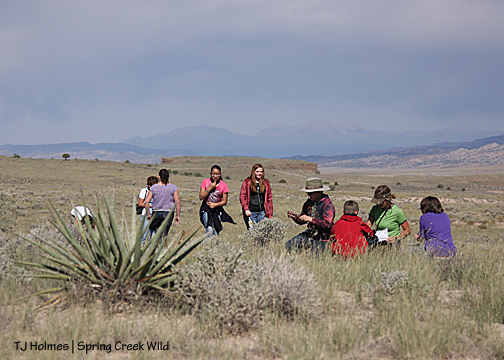
Today, 15 seventh-graders from Naturita came with their science teacher to Spring Creek Basin for a wild horse educational unit set up by Alessandra and Laura of the Telluride Institute.

Kiley Whited, our herd manager based at the Tres Rios Field Office in Dolores, and Kathe Hayes, volunteer program coordinator with San Juan Mountains Association, offered the students a fantastic hands-on activity checking plant inventory along a transect Kiley set up near the water catchment. Students learned about grasses such as blue grama, galleta and Indian ricegrass and shrubs such as shadscale and greasewood, and how those form part of the horses’ diet – and how BLM managers inventory the range to know the appropriate population range – appropriate management level – a given area can support.

The range is looking fantastic now with a lower population level after the roundup and less pressure on the range, despite a significant lack of rain this year. But the little rain we have had has really brought up the vegetation!

Kiley talks about vegetation within the frame along the transect with a Naturita student.

Four groups of students worked along four transects to identify and weigh plant material.

Painted fingernails and a mustang hoof. Kathe Hayes brought this hoof and leg found in the basin several years ago to demonstrate how veterinarians and others are learning about good hoof construction from the hooves of mustangs. The kids thought it was “grody” but kinda cool!

Some “juicy” words the kids used to describe the mustangs: Majestic (love this one!), pretty, field trip!

We had lunch near Seven, Kreacher and Duke, Hayden, Tenaz and Apollo, and also got to see Chrome’s band with little Kwana during our trip.

Thanks all around to everyone who made this trip possible – including the parents who transported the kids! Hopefully we can make this an annual event. The Naturita Colts certainly deserve to learn about the mustangs in their backyard!


What we want to know

6 01 2011

Today, I was so honored to spend some time with three smart, beautiful young ladies at a local elementary school, talking about horses – specifically, wild horses – more specifically, the wild horses of Spring Creek Basin. They wowed me from the start, with the list of things they knew about horses and then a list they had compiled that they wanted to know.

A, M and M, thank you for sharing part of your day with me! I hope I contributed to your excitement about wild horses, and I can’t wait to see you next week!

With permission from K at the school, these are their questions:

WHAT WE WANT TO KNOW:

1. Is there a first aid for horses?

2. Is there a cure for horses that break their leg?

3. Measuring horses by hands.

4. How fast does a wild horse run?

5. What are the symptoms of colic?

6. What is founder?  Do you wild horses get founder?

7. Since wild horses aren’t shoed, does that have an impact on them?

8. Why is it called “Disappointment Valley” where the wild horses live?

9. How do you find the wild horses?

10. How many wild horse herds are in Colorado?

11. What diseases do wild horses get?

12. Are the wild horses affected by car crashes?

13. How long is a horse pregnant?

14. How long before a colt stands?

15. How many breeds of horses are there?  What are they called?

16. How do you transport rescued horses?

17. How do you train a horse that’s been abused?

18. Can you feed a horse chocolate?

Can you believe those fabulous questions?! (I love the last one!) Also next week, the girls will meet a local couple that rescues abused and unwanted horses. They’re getting quite an education!

This is the list they had come up with of things they know:

1. Different horses have different tempers.

2. Horses have no nerves in their manes.

3. Some horses need you to click and say trot if you want them to trot.

4. In order to make a horse canter, you have to slap their rumps – hard.

5. You pull on the reins very softly to make horses slow down.

6. Horses have a muscle in their hooves called a frog that makes them able to trot and canter at amazing speeds.

7. If a horse has a broken leg, you have to kill it.

8. Horses like apples and carrots.

(Note that the second to last thing they “know” in this list becomes the second question they “want to know.”)

Check out how many of their questions have to do with the horses’ health and well-being. Are you as impressed as I am? A and M are in second grade; M is in fourth grade.

Beautiful, beautiful and beautiful.