Must be …

30 10 2010

… hunting season once again. Same tree as the last two years, so I make the not-hard-to-arrive-at assumption that it’s the same responsible person – who is obviously not a responsible human being.

I wonder, does this person wonder who cleans up after him/her (I suppose it could be a her, but really?).

I’d like to highlight this unknown person because by doing so, I really highlight the countless, nameless, *responsible* hunters who do NOT leave behind evidence of their visit to the basin to be photographed. Those folks should get some props for their careful visits.


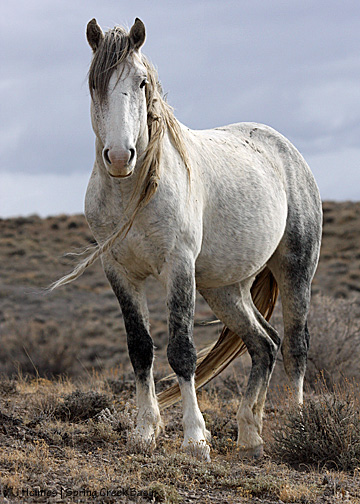
Whisper

4 10 2010

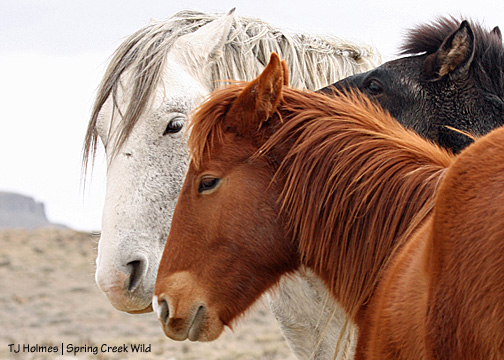
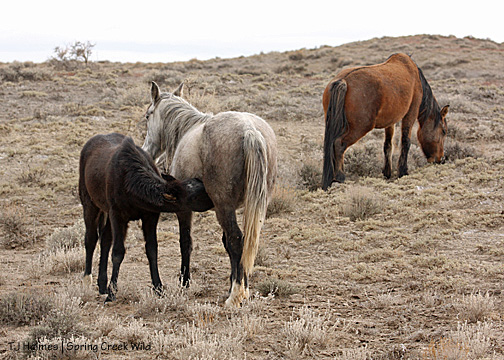
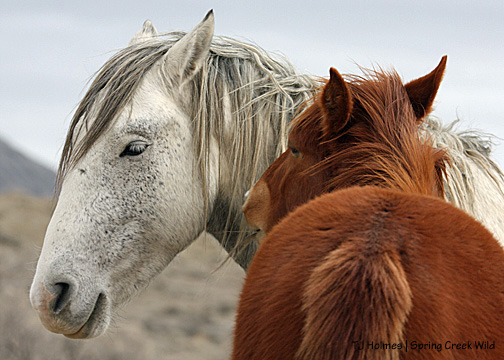
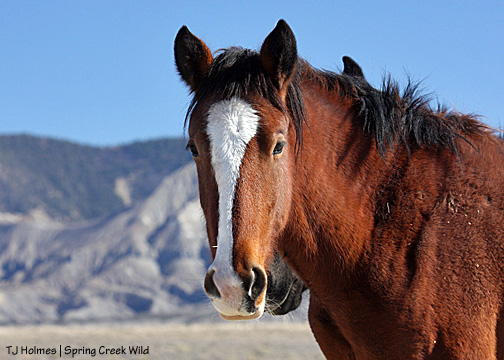
Whisper, watching Steeldust’s band … daddy Bounce in the background.

I attended a workshop recently about horse photography. Before I went, I thought: I want to use this as a way to urge myself out of my box, to see things differently. But as it turned out, I like my “box” – the basin, the wild and wonderful and unique horses within it. I have a *relationship* with each of those horses and with the basin. The horses we photographed were beautiful, and the setting was lovely. The light when we were out was harsh, though, the horse running measured circles in the high-barred roundpen did nothing for me, nor the horse galloping around the arena filled with jumps, who wanted to return to his pals in the pasture across the driveway. No relationship – to me. No connection – with me. The pictures I did take reflected some relationships the horses had with each other – not very outside my photographic box. A photographer recently told me he wasn’t going to photograph wild horses any time but in the spring anymore because otherwise they didn’t do anything but graze. I countered that the typical photos of wild horses galloping and kicking and biting and fighting are NOT what happens all the time (hello, spring). “That’s what sells,” countered the professional photographer.

Yeah.

I admire this photographer very much, and I can’t fault him for knowing what sells – he makes his living by what sells. As do other professional photographers.

Would he be surprised by what I *saw* – what I *see* – when I’m with these horses – little ole amateur me? Aspen and Mouse, Sundance and Aspen, Whisper later with Storm, then Bounce to the “rescue” after they’d had a great round of fun – or maybe he just wanted to play, too; he has played with Storm before. Gaia, whinnying for her little brother to come back up the hill to her and mama and daddy – not willing to intervene but anxious, worried about brother. Mona and her new daughter, covering a wide expanse back to a known territory – to … to show off her daughter to her daughter’s sire, to her “sisters” who made the journey from a place far away – see how my world has changed? Isn’t she gorgeous? Kreacher’s, then, staying nearby, at least overnight and into the next day. Not challenging, just watching. Young Cuatro, learning from young Twister – are they glad for some other, elder, company in Bruiser?

Nothing going on?! Lord help me and my battered Jeep, I keep going back BECAUSE of all that’s always going on! There is my connection! There are my relationships (yes, I’m rather a loner by human terms). There is my “box,” and I learned I really don’t want to be outside. Being inside is the greatest gift I’ve ever been given, and I love, I love, I love them all.

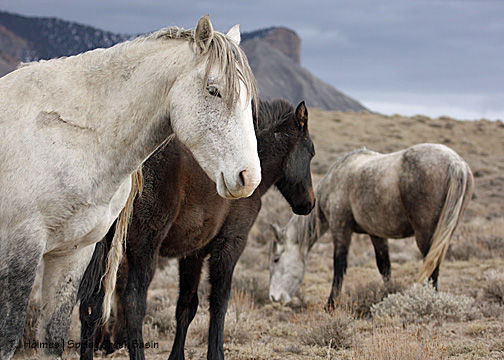
I’m in a unique position of not worrying about what sells – because I don’t. But I am very keen that people who view my photos FEEL a relationship with these horses – that they SEE the relationships these horses have with each other – and with their home. The pic of Comanche and Bruiser – stallions, with a mare and foal nearby – and a very prominent landmark of a very particular place in the background – do you SEE the connection? Do you feel THEIR connection to home?

Some are just pretty pictures. Some are illustrating behavior, interaction. But my goal all along has been to tell a story with these photos, from me, who is there, to you, who are not able to be. I very much also admire the photographer who led the workshop, a fine art photographer. If I try to combine photojournalism (documentation) with as much art as I can muster – if that combines to provide you with a window to something deeper about these horses, I will feel I’ve done my part to return to the world some little piece of the magic I’m filled with every single time I’m with these incredible creatures, these particular wild horses, of Spring Creek Basin.

Whisper and his father, new generation and a generation that came before, near and far, future and present and past. What has Bounce seen in his long life? How many foals has he raised into the world, how many mares has he loved and lost, seen removed? Will Whisper stay home? Will he find mares and sire foals? What is his future? Do you see it? Do you wonder?

If so, I’m grateful. These horses are integral to the world’s connective fabric.

If not, well, I guess I better keep at it … 😉


‘We strongly urge …’

31 08 2010

“We strongly urge you to refrain from any further action until a clear plan is in place to sustainably manage and protect our wild herds. Only then can we move forward with a more informed, open and deliberate process, based on input from all who are concerned with the health, well being, and conservation of this animal which embodies the spirit of our American West.”

Is it enough?

Here’s a link to the letter written in 2008 and signed by Rep. Nick Rahall, D-W.Va., chairman of the Committee on Natural Resources, and Rep. Raul Grijalva, D-Ariz., chairman of the Subcommittee on National Parks, Forests, and Public Lands: http://wildhorsepreservation.com/pdf/EuthanasiaBLM_letter.pdf

And here is the link to the July 30, 2010, letter, with the congressmen’s call to other members to sign on (thus far, it has been signed by 54 members of Congress): http://www.wildhorsepreservation.org/news/?p=1456

July 30, 2010

The Honorable Kenneth L. Salazar
Secretary of the Interior
U.S. Department of the Interior
1849 C Street NW, Washington, DC 20240

Dear Secretary Salazar,
Recent media accounts have documented still more deaths of wild horses during Bureau of Land Management (BLM) roundups. Just this month, 12 horses, including three foals, died during the Tuscarora Complex roundup in northeastern Nevada as a result of deeply flawed methods. This tragedy was only the most recent in a string of reports of wild horses dying during BLMroundups this year.

We are concerned by the inability of your agency to acknowledge these disturbing outcomes, change what seems to be deeply flawed policy, and better manage the gathers so as to prevent the unnecessary suffering and death of these federally protected animals.

Specifically, on Saturday, July 10, with temperatures hovering near 100 degrees, the BLM, in a time-span of two and half hours, captured and corralled more than 228 wild horses after running them more than 8 miles. During this time, public observation of BLM activities was prohibited. This ill-advised plan resulted in the deaths of 12 protected American Mustangs, most due to water intoxication; three of the dead were foals less than six months old. By the time the roundup was halted, 17 horses had died.

While we applaud the speed with which you temporarily halted the Tuscarora roundup after these deaths, the roundup has now resumed. Apparently, BLM continues to bar public observers, despite a court order affirming the right to “reasonable access.” So far, 410 more horses have been gathered and, according to BLM’s own account, the death toll has risen to 21.

The BLM is repeating the mistakes made during the deadly round up in the Calico Mountain Complex last winter. That roundup resulted in the deaths of over 105 horses, along with the stress-induced late term abortions of at least 40 mares.

Given this pattern, and the continued threat of death and suffering to these animals, we request that the Tuscarora Complex roundup be suspended, along with any pending gathers, until the agency demonstrates that it has addressed the failings of the current program and can ensure the safety and well-being of the animals you are charged with protecting.

Specifically, the BLM must account for temperature extremes and the impacts of stampeding young, elderly or injured animals across long distances when planning roundups. The BLM needs to ensure transparency by allowing members of the public to observe agency activities. Further, we remain concerned that roundups are conducted at great expense to the taxpayer. As we have pointed out in the past, BLM’s aggressive use of roundups has resulted in unsustainable increases in the number of horses in holding facilities (now at 38,000) and continues to undermine the BLM’s overall budget. Unfortunately, the frequency of roundups has only increased under this administration.

To address these and other flaws, we recommend an independent analysis of the National Wild Horse and Burro program, conducted by the National Academy of Sciences. This analysis will provide a clear determination of the most accurate, science-based methodologies to estimate wild horse and burro populations, provide an assessment of Appropriate Management Levels based on the goal of maintaining sustainable herds and provide an assessment of practical, effective, nonlethal and publicly acceptable management alternatives to current BLM policies.

We strongly urge you to refrain from any further action until a clear plan is in place to sustainably manage and protect our wild herds. Only then can we move forward with a more informed, open and deliberate process, based on input from all who are concerned with the health, well being, and conservation of this animal which embodies the spirit of our American West.
Sincerely,
Member


‘Deeply flawed policy’

31 08 2010

http://www.seattlepi.com/local/6420ap_nv_wild_horses_study.html

BLM seeks independent review of wild horse program

By MARTIN GRIFFITH
ASSOCIATED PRESS WRITER

RENO, Nev. — At the urging of a bipartisan group of House members, the U.S. Bureau of Land Management is asking for an independent review of its wild horse and burro program by the National Academy of Sciences.

BLM officials said the two-year, $1.5 million study would determine whether the agency is using the best science available in managing wild horses and burros on Western rangelands. BLM managers estimate that 38,000 mustangs and burros roam 10 Western states, and half are in Nevada.

The study tentatively set to begin Jan. 1 would focus on population estimation methods, annual herd growth rates and population control measures, agency officials said in a statement released Friday.

The announcement came a month after 54 House members signed onto a letter that Rep. Nick Rahall, D-W.Va., chairman of the House Natural Resources Committee, sent to Interior Secretary Ken Salazar pleading with him to halt a series of wild horse roundups under way in the West.

The letter recommended that the National Academy of Sciences be assigned to review the BLM’s plan to cull about 12,000 of 38,000 mustangs and burros from the range and either send them to long-term holding facilities or put them up for adoption.

Nevada Democratic Reps. Shelley Berkley and Dina Titus were among those who signed the letter that maintains the gathers are based on a “deeply flawed policy.”

“Nevada’s wild horses and burros are a treasured part of our Western heritage, but we continue to struggle with the management of these herds on public lands,” Berkley said Saturday. “My hope is that this study will provide a new blueprint for addressing the many challenges we face in protecting wild horse and burro populations in Nevada and other Western states.”

Titus said she was pleased the BLM acted quickly in response to House members’ request for the study.

“In the meantime, I again urge the BLM to halt roundups until the failings of the current program are addressed,” she said Saturday.

Activists said they support the independent review but only if it’s coupled with an immediate moratorium on all BLM roundups of mustangs from the range. There will be too few genetically viable herds left to study at the present rate of roundups, they said.

Activists said they support the independent review but only if it’s coupled with an immediate moratorium on all BLM roundups of mustangs from the range. There will be too few genetically viable herds left to study at the present rate of roundups, they said.

“I expect the NAS report to be enlightening regarding the lack of science in BLM’s decisions aimed at ridding the West of our wild horse and burro heritage,” said Ginger Kathrens, director of the horse advocacy group Cloud Foundation based in Colorado. “A moratorium right now is essential so that NAS will have a few viable herds left to study.”

The National Academy of Sciences is a nonprofit source of scientific advice that enlists the nation’s top experts to address a wide range of problems.

BLM’s news release:

http://www.blm.gov/wo/st/en/info/newsroom/2010/august/NR_8_27_2010.html

BLM Proposes National Academy of Sciences Study

The Bureau of Land Management has asked the National Academy of Sciences/National Research Council (NAS/NRC) to make an independent technical review of the Wild Horse and Burro Program to ensure that the BLM is using the best science available in managing wild horses and burros on Western public rangelands.

The NAS/NRC has previously reviewed the BLM’s management of the Wild Horse and Burro Program and produced three separate reports; however, these reports are now 20 to 30 years old.  In those reports, the NAS/NRC summarized what was known about wild horses and burros and made recommendations to the BLM for wild horse and burro management, population estimation, and further research.

In the proposed effort, many of the topics discussed in the earlier reports would be included, such as population estimation methods, annual herd growth rates, population control measures, and whether populations will self-limit, as well as other subjects needing new research.

To sort through the many diverse and often conflicting opinions about how wild horses and burros should be managed, the BLM must continue to base its decisions on the best available science and involve the public in its decisionmaking process.  Commissioning the NAS/NRC to review their three earlier reports and the current available information and research about wild horses and burros is a first step.  A second step is to ask the NAS/NRC to make recommendations about future wild horse and burro management and needed research.  A third step is to take the NAS/NRC findings and recommendations and make them available to the public in a variety of ways, perhaps to focus groups or science forums.

Both the BLM and NAS/NRC will negotiate the terms and outline for the research study.  The proposed study would tentatively begin about January 1, 2011, and would cost the BLM approximately $1.5 million and take about two years to complete.

Congress created the NAS/NRC to be a non-Federal, not-for-profit source of scientific advice.  The NAS/NRC enlists the nation’s foremost scientists, engineers, health professionals, and other experts to address the scientific and technical aspects of society’s most pressing problems.  Each year, thousands of these experts are selected to serve, without pay, on hundreds of study committees.
The BLM manages more land – more than 245 million acres – than any other Federal agency. This land, known as the National System of Public Lands, is primarily located in 12 Western states, including Alaska. The Bureau, with a budget of about $1 billion, also administers 700 million acres of sub-surface mineral estate throughout the nation. The BLM’s multiple-use mission is to sustain the health and productivity of the public lands for the use and enjoyment of present and future generations. The Bureau accomplishes this by managing such activities as outdoor recreation, livestock grazing, mineral development, and energy production, and by conserving natural, historical, cultural, and other resources on public lands.

–>The Bureau of Land Management has asked the National Academy of Sciences/National Research Council (NAS/NRC) to make an independent technical review of the Wild Horse and Burro Program to ensure that the BLM is using the best science available in managing wild horses and burros on Western public rangelands.

The NAS/NRC has previously reviewed the BLM’s management of the Wild Horse and Burro Program and produced three separate reports; however, these reports are now 20 to 30 years old.  In those reports, the NAS/NRC summarized what was known about wild horses and burros and made recommendations to the BLM for wild horse and burro management, population estimation, and further research.

In the proposed effort, many of the topics discussed in the earlier reports would be included, such as population estimation methods, annual herd growth rates, population control measures, and whether populations will self-limit, as well as other subjects needing new research.

To sort through the many diverse and often conflicting opinions about how wild horses and burros should be managed, the BLM must continue to base its decisions on the best available science and involve the public in its decisionmaking process.  Commissioning the NAS/NRC to review their three earlier reports and the current available information and research about wild horses and burros is a first step.  A second step is to ask the NAS/NRC to make recommendations about future wild horse and burro management and needed research.  A third step is to take the NAS/NRC findings and recommendations and make them available to the public in a variety of ways, perhaps to focus groups or science forums.

Both the BLM and NAS/NRC will negotiate the terms and outline for the research study.  The proposed study would tentatively begin about January 1, 2011, and would cost the BLM approximately $1.5 million and take about two years to complete.

Congress created the NAS/NRC to be a non-Federal, not-for-profit source of scientific advice.  The NAS/NRC enlists the nation’s foremost scientists, engineers, health professionals, and other experts to address the scientific and technical aspects of society’s most pressing problems.  Each year, thousands of these experts are selected to serve, without pay, on hundreds of study committees.


Lashing out

8 08 2010

I get so overwhelmed sometimes by the cruelty humans inflict on each other – animals, children, women (in no particular order, of course) – a stone in the road, using a stone from the road.

Worthless – the acts and my rage (how different am I?!) – and nothing happens. Nothing changes. One act begets another, worse, “eye for an eye.”

But what if we all had an eye for beauty and turned a blind eye to conflict – not to its happening but to continuing to fuel it?

When I say, several times a day, “I hate people,” this is what I mean. I love our capacity for compassion … I hate that so many people seem to have willed it out of themselves. I hate that I feel driven to say that.

Cold isn’t a season or a temperature but an emotion – lack thereof? I’d protect everyone in the world from it if I could … if they could be protected from such a hideous, snaking, crawling, ugly thing.

Did you see on the news that 10 people – caregivers, medical people, people overflowing with compassion and a driving need to help people, to bring something good to people who see little of it – were killed by Taliban? Gunned down – “their bodies were found riddled by bullets” by vehicles in a wooded area off a road. This story has a “why” that some – most – of us can’t even conceive – that the “spy missions” of these 10 people – people I probably wouldn’t hate – was to bring Christianity to people just trying to survive the ills the world (in their part of the world, the Taliban) inflicts upon them. Peace paid by bullets. The accurate why (though it was a “Christian aid group”) is that they were trying to bring compassion with their medical skills to people in dire need of both those things.

One of the people was from Durango, we found out today. Spy? Well, we ran a story the other day about how an office building near Durango holds a repository of top-secret U.S. intelligence (the address is in the phone book). He was a dentist.

The people were carrying “spy gadgets.” Well, those sinister-looking things on the sterilized tray are all rather pointy. Said with as much sarcasm as I can muster through tears for that man’s family – for the families of all those people – ALL THOSE PEOPLE – who are dying, injured, mutilated for someONE’s idea of … of what, exactly? All those people I can’t hate, can’t love, can’t know, can’t fathom.

“Unbelievable” has become a word I use frequently. A word I use unfortunately. I word I find unfortunate to use, as a lover of language, of beauty, to have to resort to such an ugly, unfortunate, un-enough word.

I try to keep this blog wrapped in beauty, try to exclude the outside happenings to be found on other blogs, websites, handheld newspapers, etcetera. As this blog, beauty is a small thing, wrapped in this greater world of insanity and cruelty and slaughter of hopes and ideals, literally, of people, horses, homes.

I’ve shared this before; it fits here: http://www.celebratewhatsright.com/

What’s important is that *concept*: “Celebrate what’s right with the world.” Because even as the whole world seems to descend into madness, there IS *right* with the world …  and it’s up to you and I and the other lovers of right to celebrate it.

Here’s an example:

For those who can’t (won’t?), celebrate: beauty, life, people, animals, rocks in the road.

If cruelty makes you angry, celebrate what makes you happy … and share it. Every chance you get. It’s the least – and the *act* of it the most, after all – we can do.


Happy Independence Day

4 07 2010

Freedom is not free, as the saying goes. It means responsibility. It means fences. It means cooperation. It means a greater good. It means my right may not be your right, but it’s as important to me as yours is to you and should be acknowledged as such – and vice versa.

Independence doesn’t mean thrown away. It means pride – and having the courage to look beyond pride and ask for help when it’s needed – it means giving help before it’s asked of you.

Our “free-roaming” wild horses and burros are not. Not really.

Kreacher and his girls can circumnavigate Filly Peak, but they have no access to the pinon-juniper-dotted hillside below the clouds, touching the sky.

Are they less wild? Less free? We all have chains snugging us to the responsibilities and demands of life.

Mustangs are “America’s horses,” more than any other breed in existence. They evolved here. They returned here. They thrive here.

Their freedom depends on us to make their lives as independent as possible.

Let freedom ring. 🙂


Wild Horse Fever

19 06 2010

Time to update links, everyone, and you’ll definitely want to. Tales of the Little Book Cliffs wild horses has moved to this address: http://wildhorsefever.wordpress.com/

Billie’s former blog is still live, so you’ll be able to access all her great photos and write-ups about visits to the range and the goings-on of the horses. She’s one of my original inspirations, both in keeping an Internet record of the horses and sharing them with virtual visitors and in the work done by her and others who are members of the local advocacy group, Friends of the Mustangs, in documenting the horses and working  to ensure their health and well-being.

So here’s just a nudge in that direction to get readers started on the right hoof this morning! Welcome to WordPress, Billie! I look forward to reading your stories and seeing your photos in a whole new format!


BLM promises

6 06 2010

Is BLM really starting to listen … ???

*Wild Horses and BLM’s promise of a new day dawning* – LA Equine Policy Examiner

“Animal advocates are a bit saddle sore from past relations with BLM.  Trust is in short supply.  The proclamation of a new day dawning was delivered with mixed messages wrapped in a pretty package.”

“The announcement also says, ‘The euthanasia of healthy excess animals or their sale without limitation to protect the animals from slaughter’ is a topic of discussion and an option that will be off the table.  Dean Bolstad, National Program Division Chief, confirmed interpretation of this wording to mean that the topic will not be included in the Secretary’s initiative.”

BLM’s proclamation by BLM Director Bob Abbey: “Bureau of Land Management Director Bob Abbey today announced that the agency is taking the Federal Wild Horse and Burro Program in an unprecedented new direction, and is seeking in-depth public comment on a Strategy Development Document implementing Secretary of the Interior Ken Salazar’s Wild Horse and Burro Initiative.”

There are links toward the bottom to access the document for comments: “To gather feedback, the Strategy Development Document outlines specific areas where the BLM is seeking public input over a 60-day comment period. To ensure input from the broadest number of stakeholders, the BLM is using ePlanning. To access the document and provide the BLM with feedback, select this link. A PDF version of the document is also available by clicking on this link.”

Both links seem to be broken at the moment …

“Costs for the program, particularly those for animals in holding facilities, have risen dramatically in the last several years. In fiscal year 2009, for example, approximately $29 million, or about 70 percent of the total wild horse and burro program budget of $40.6 million, was spent on animals held in corrals and pastures.”

Hopefully our coming proposal to implement a relatively inexpensive fertility control program in Spring Creek Basin using volunteer labor – with major $$ savings – will be well-received …


Wild horse workshop in Denver

14 05 2010

FYI …

BLM Press Release:  WHB Advisory Board Workshop & Meeting

Bureau of Land Management      Contact: Tom Gorey
For release: Thursday, May 13, 2010     (202-912-7420)

National Wild Horse and Burro Advisory Board Will Conduct Public Workshop and Hold Meeting in June in Denver
The Bureau of Land Management announced today that the National Wild Horse and Burro Advisory Board will conduct a public workshop and hold a regular meeting in June at a two-day event in Denver.  The workshop on Monday, June 14, will provide the public with a unique opportunity to express their views, comments, and suggestions regarding Secretary of the Interior Ken Salazar’s wild horse initiative, which he and BLM Director Bob Abbey announced last October.  The Board will hold a regular meeting on wild horse management issues on Tuesday, June 15.
The public workshop and the Board meeting will take place in Denver, Colorado, at the Magnolia Hotel, 818 17th St., Denver, CO 80202.  The hours of the Monday workshop are 8 a.m. to 4 p.m. local time; the Tuesday Board meeting is set for 8 a.m. to 5 p.m. local time.  The hotel’s phone number for reservations is 303-607-9000.  The business agendas for the public workshop and Board meeting can be found on page 26990 of the Thursday, May 13, Federal Register(http://frwebgate5.access.gpo.gov/cgi-bin/PDFgate.cgi?WAISdocID=762416245134+2+2+0&WAISaction=retrieve).
On Monday, June 14, the public will be able to provide feedback and input concerning Secretary Salazar’s initiative, the details of which can be accessed at the BLM’s website (www.blm.gov); the specific Web address is http://www.blm.gov/wo/st/en/prog/wild_horse_and_burro/national/initiative.html.
On Tuesday, June 15, the public may address the Advisory Board at an appropriate point in the agenda, which is expected to be about 3 p.m., local time.  Individuals who want to make a statement should register with the BLM by noon on the day of the meeting at the meeting site.  Depending on the number of speakers, the Board may limit the length of presentations, set at three minutes for previous meetings.  Speakers, who should address the specific wild horse and burro-related topics listed on the agenda, must submit a written statement of their comments, which may be sent electronically to the BLM by accessing the following Web address:  http://www.blm.gov/wo/st/en/prog/wild_horse_and_burro/wh_b_contact_us/enhanced_feedback_form.html.  Alternatively, comments may be mailed to the National Wild Horse and Burro Program, WO-260, Attention: Ramona DeLorme, 1340 Financial Blvd., Reno, NV 89502-7147.  Written comments pertaining to the Advisory Board meeting should be submitted no later than close of business June 7.
For additional information about the meeting, please contact Ramona DeLorme, Wild Horse and Burro Administrative Assistant, at 775-861-6583.  Individuals who use a telecommunications device for the deaf (TDD) may reach Ms. DeLorme at any time by calling the Federal Information Relay Service at 1-800-877-8339.
The National Wild Horse and Burro Advisory Board provides input and advice to the BLM as it carries out its responsibilities under the 1971 Wild Free-Roaming Horses and Burros Act.  This law mandates the protection, management, and control of these free-roaming animals in a manner that ensures healthy herds at levels consistent with the land’s capacity to support them.  The BLM manages about 37,000 wild horses and burros that roam BLM-managed rangelands in 10 Western states; the agency also feeds and cares for more than 35,000 horses and burros that are maintained in short-term corrals and long-term Midwestern pastures.
The Advisory Board meets at least twice a year and the BLM Director may call additional meetings when necessary.  Members serve without salary, but are reimbursed for travel and per diem expenses according to government travel regulations.
The BLM manages more land – 253 million acres – than any other Federal agency.  This land, known as the National System of Public Lands, is primarily located in 12 Western states, including Alaska.  The Bureau, with a budget of about $1 billion, also administers 700 million acres of sub-surface mineral estate throughout the nation.  The BLM’s multiple-use mission is to sustain the health and productivity of the public lands for the use and enjoyment of present and future generations.  The Bureau accomplishes this by managing such activities as outdoor recreation, livestock grazing, mineral development, and energy production, and by conserving natural, historical, cultural, and other resources on public lands


Black and blue

25 04 2010

This photo is from a visit a couple of weeks ago … one I’m starting to despair of ever getting any information up about. (I just downloaded the pix from my memory card to my hard drive!) But I want to share it, particularly, and I want to share the message I read just yesterday …

Band stallion Bounce, with the La Sal Mountains of Utah behind him.

“May God bless you with discomfort at easy answers, half-truths and superficial relationships so that you may live deep within your heart;
“May God bless you with anger at injustice, oppression and exploitation of people (and horses and other animals), so that you may work for justice, freedom and peace;
“May God bless you with tears to shed for those who suffer pain, rejection, starvation, war and loss, so that you may reach out your hand to comfort them and turn their pain into joy;
“May God bless you with enough foolishness to believe that you can make a difference in this world, so that you can do what others claim cannot be done;
“May God bless you with God’s comforting presence now and in your journeys through each day.”

~ Franciscan blessing

God  has apparently blessed me with quite a substantial reserve of foolishness, and I am working under the sincere and optimistic belief that I CAN make a difference … even if just in my own little corner of the world. 🙂