
Buckeye.
Bold.
Beauty.
There really don’t seem to be enough words … or the right words … or the words that do justice … sometimes.
Blessed.
Buckeye.
Bold.
Beauty.
There really don’t seem to be enough words … or the right words … or the words that do justice … sometimes.
Blessed.

Kestrels are one of my favorite birds. I love them so much, “Kestrel” became the name of a beautiful buckskin filly back in 2007 when I started documenting the Spring Creek Basin herd.
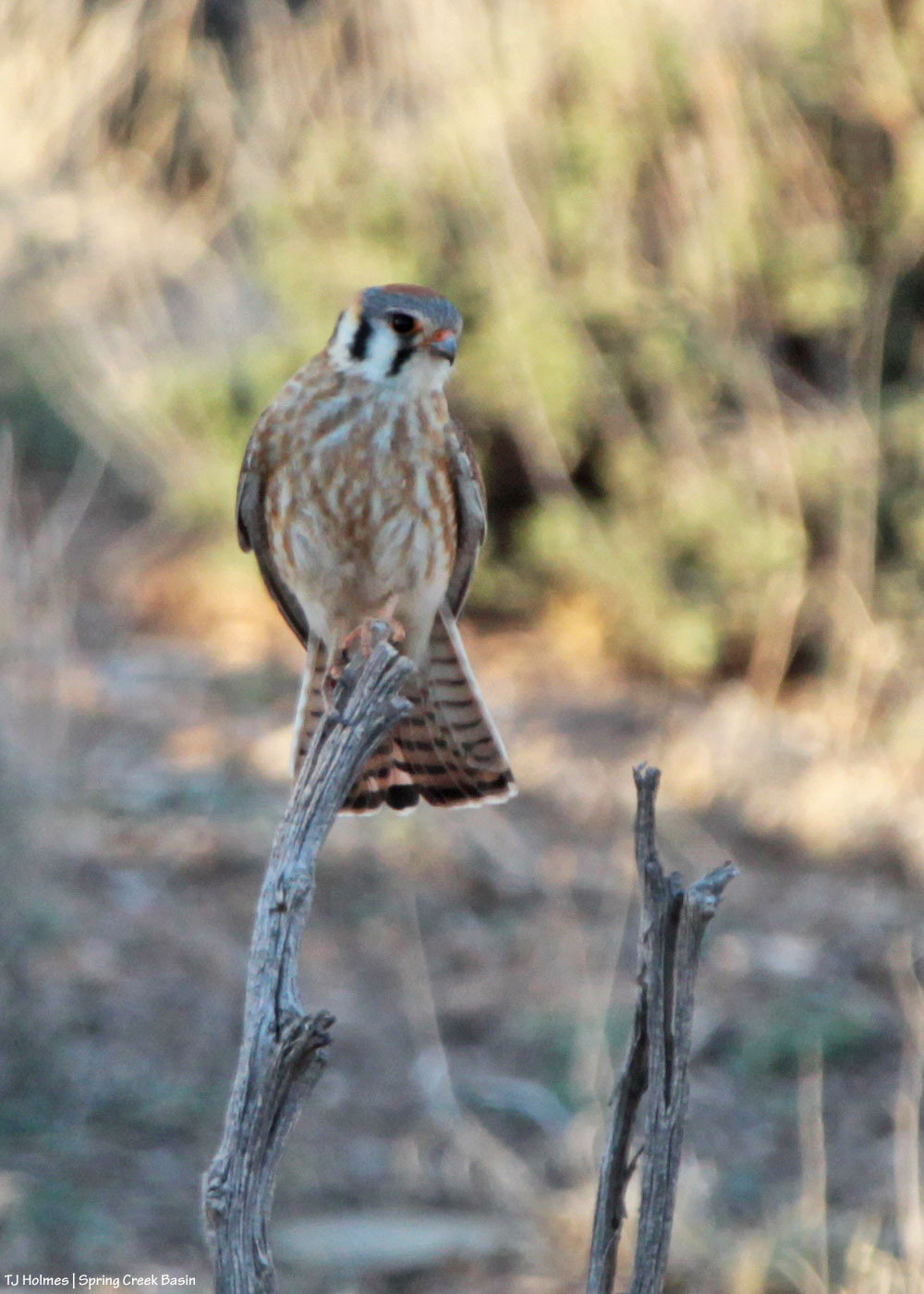
Bird photographers will wince at these blurry images of the gorgeous little (female?) falcon I photographed the other day in the basin, while hanging out with a band, but I’ve been seeing more of them, soaring over the budding greasewood and shadscale and newly growing grasses, that I thought they’d serve my purpose of *celebrating wild* very well, indeed.
“The American kestrel, also called the sparrow hawk, is the smallest and most common falcon in North America,” according to Wikipedia. All About Birds says they’re “North America’s littlest falcon” and “pack a predator’s fierce intensity into its small body. It’s one of the most colorful of all raptors.”

And because no post about kestrels is complete without Kestrel …

… From a wonderful shared visit with a friend a couple of lovely evenings ago. 🙂

From the youngest members of Spring Creek Basin to the oldest: Houdini. 🙂 One more trip around the sun, old girl.
Long-time readers know that I shy away from posting pix of our foals. There’s a personal reason behind that … and for better or otherwise, it’s a greatly-ingrained habit and born out of an abundance of caution and feelings of protection.
Most readers also know that, in cooperative agreement with our BLM herd manager and managing office (Mike Jensen and Tres Rios Field Office, respectively), we dart our mares with immunocontraceptive vaccine PZP in order to keep the growth rate of the herd slow, in bigger/better/more important order to prevent roundups and removals. The number of foals born in Spring Creek Basin each year is small, and we do have mortality of adults (it’s a fact of life in the wild) – and sometimes, in some years, those numbers are equal.
We haven’t had a roundup since 2011, and we have no need for removals in at least the near to middling future as our current appropriate management level (population range, which is 50 to 80 adult horses) is above the current population.
But the two foals* we’ve had so far this year in the basin have some qualities that have me thinking about my “no foals on the blog” policy. The first has passed the 2-month mark (he’s about 2.5 months old), and the second, a month old, shows every sign of continuing good health. Both are protected by mamas and “aunties,” as well as their daddies, and seem to be the darlings of their families.
So I’d like to introduce you all to Odin and Ranger. Odin was born to 20-plus-year-old Hollywood and his long-time mare Shane, and Ranger was born to Buckeye and Dundee.

Odin is a flashy dun colt with ties on both sides of his pedigree to Sand Wash Basin. Hollywood’s presumed dam (I didn’t know her very long) was a grulla mare I named Slate. I know that mare was introduced from Sand Wash Basin in 2001; I am not *certain* that she was Hollywood’s dam, though I once saw a photo of her with a foal and yearling-looking Hollywood. (My visitation to Spring Creek Basin started in 2002, and my documentation of the herd started in 2007.) Shane’s dam, Mona, was introduced from Sand Wash Basin in 2008. The pic above shows Odin the day I found him, when he was already at least a week old.

Ranger is a big dun boy, sired by our Buckeye and out of Dundee, the oldest of the three Sand Wash Basin mares introduced in the fall of 2021 to Spring Creek Basin. As fate would have it, this colt also has top- and bottom-side ties to Sand Wash Basin: Buckeye, through his maternal line, has a genetic tie to Sand Wash Basin (his great-grandmother). Interestingly, Dundee’s sire in Sand Wash Basin is a dun stallion with a blaze and four stockings named Chrome. … OUR Chrome is the colt’s paternal grandsire; he was grey with a blaze and four stockings. That Ranger should be devoid of white is a mystery of equine color genetics (and if he turns grey, I’m gonna cry). Ranger is almost a week old in the pic above.
Because Spring Creek Basin is so small (almost 22,000 acres) and our herd necessarily small (the resources of this high-desert range – forage and water – MUST be able to support the mustangs as well as wildlife such as elk, mule deer and pronghorns), we periodically introduce mares to keep our genetics strong.
We’ve had four introductions to date, presided over by three different BLM herd managers: three stallions in the late 1990s; three mares in 2001; three mares in 2008; three mares in 2021. Sand Wash Basin has been generous with its introductions of genetics, and our small herd is stronger for it. BLM didn’t set out to introduce mustangs only from Sand Wash Basin, though it has happened – at least in 2008 and 2021 – that roundups/removals there coincided with times when our herd was ready to receive new infusions. (It should be noted that these four introductions have been with BLM coordination, during BLM management. Introductions of horses – intended or otherwise – by ranchers in the decades after the settlement of this valley in the mid- to late 1800s are harder to trace.)
So that’s a little bit new info and a little bit history, and I hope it provides a fair understanding of an aspect of partnership that happens here for the benefit of our mustangs: how it’s always evolving … and why it’s best to take the long view in mustang management. 🙂
I hope you also join me in welcoming Odin and Ranger and wishing them long lives, lived wild and free!

Baby Odin and daddy Hollywood.

Dundee, Ranger and daddy Buckeye.
******
As it turned out, I’ve been drafting and crafting and revising and hemming and hawing over this post for a little while, and in that interim, a third foal was born in Spring Creek Basin. 🙂

The newest resident of Spring Creek Basin is a spectacular little filly born to Buckeye and Aiyanna. Aiyanna, who will be 3 this spring, is a much more relaxed first-time mama than Dundee, and her filly already is outgoing and inquisitive. Friend Tif Rodriguez, who went with me to Sand Wash Basin to get Dundee, Aiyanna and Rowan, named the filly Bia, representing Greek goddess Bia, who was known for her strength, force and raw energy. For a variety of reasons, that fits this tough little girl to a T!

Big brother Ranger with “auntie” Aiyanna and his new baby sister, Bia.
This shouldn’t have to be mentioned (and I’m also sure it’s not the readers of this blog who need this warning!), but lots of people are shrugging off the cabin fever of a long winter and visiting Disappointment Valley and Spring Creek Basin this spring: We don’t have any distance rules in Spring Creek Basin such as some other herds/herd management areas have, but please use common sense and exercise great care when visiting, especially these new mama mares and their babies. Long lenses and binoculars are your friends (for reference, I’m using a 150-600 mm lens).
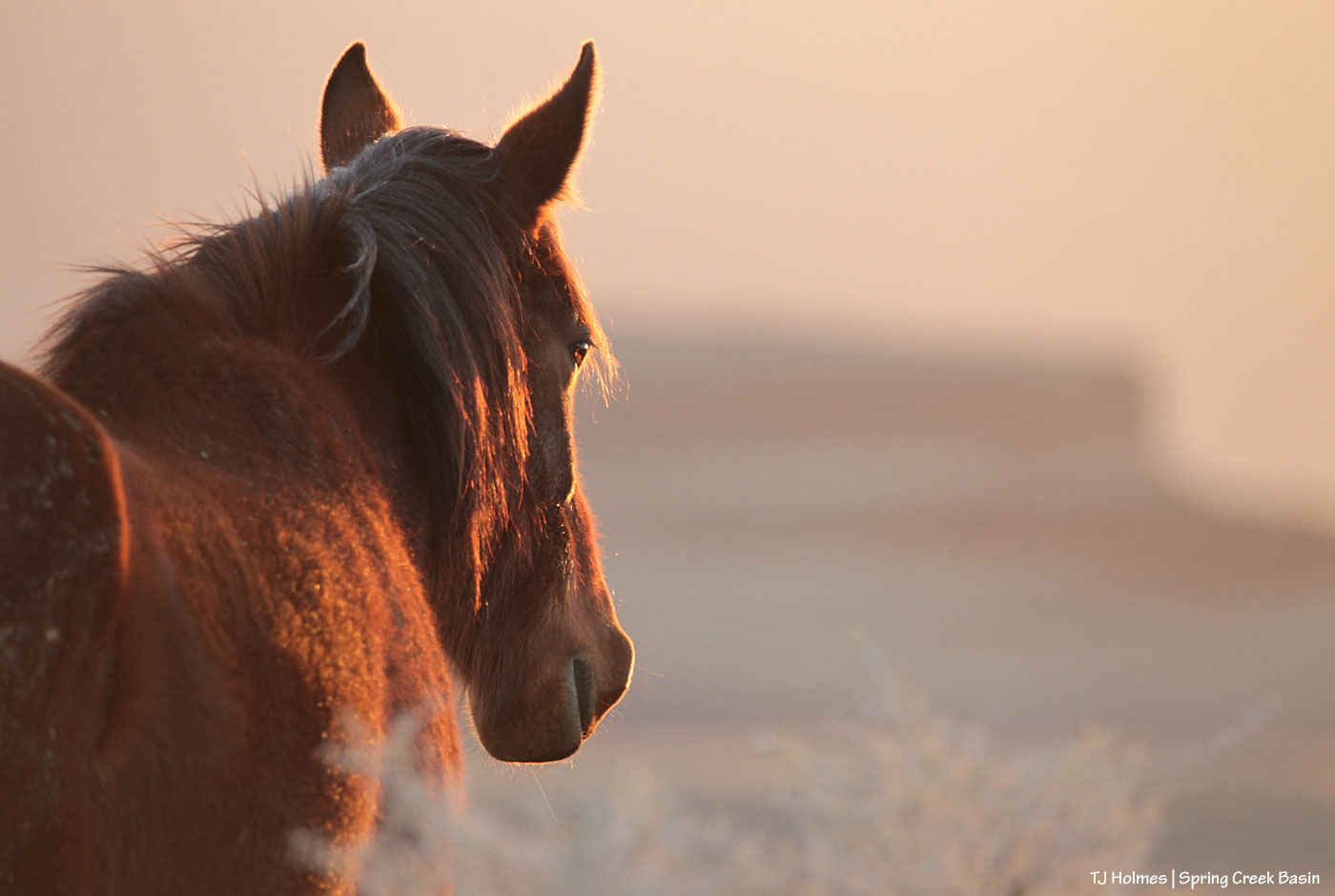
Long live the beautiful, protective, bay mustang mares – in particular, our lovely Madison.
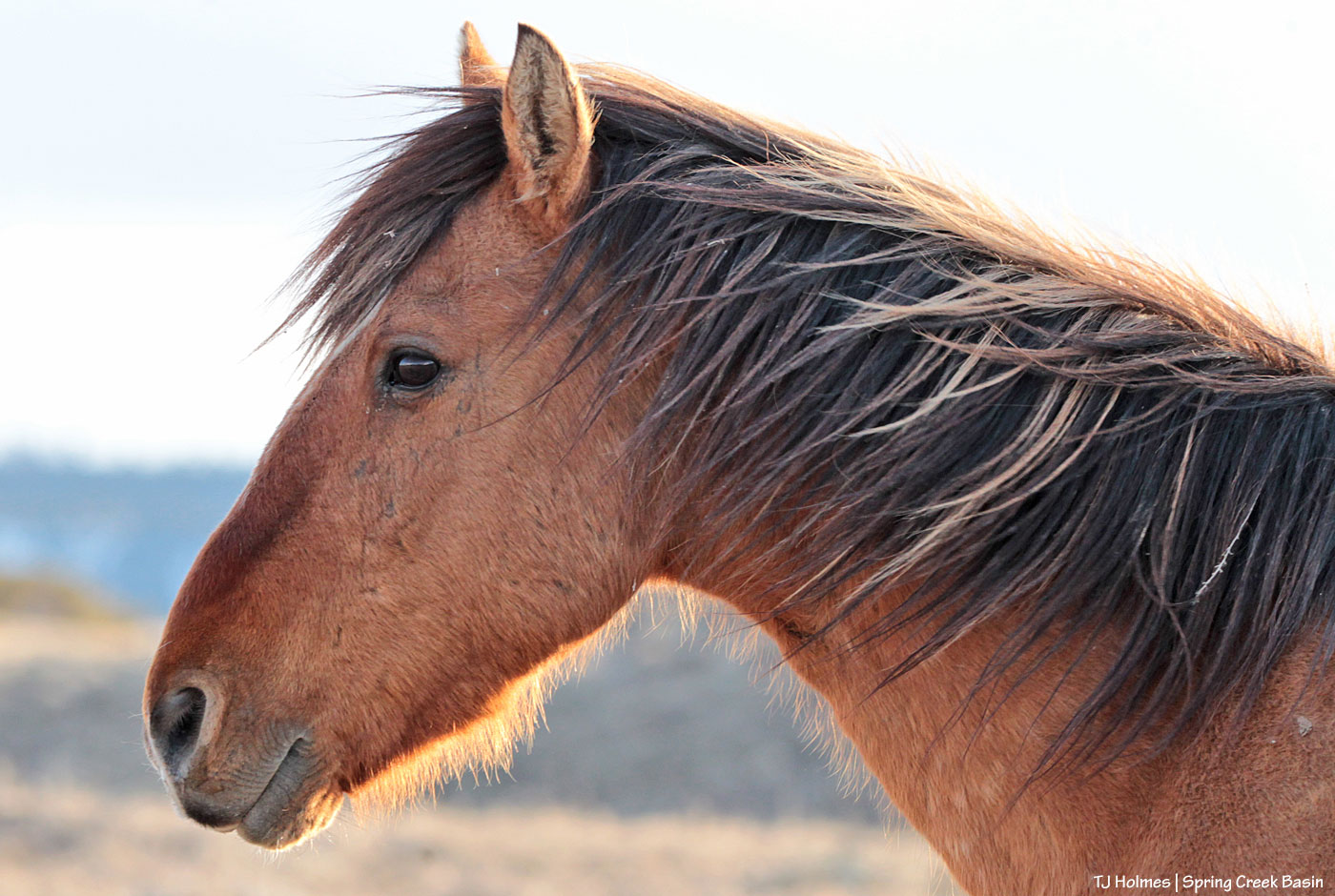
No lady’s hairdresser could do better – or more natural. 🙂
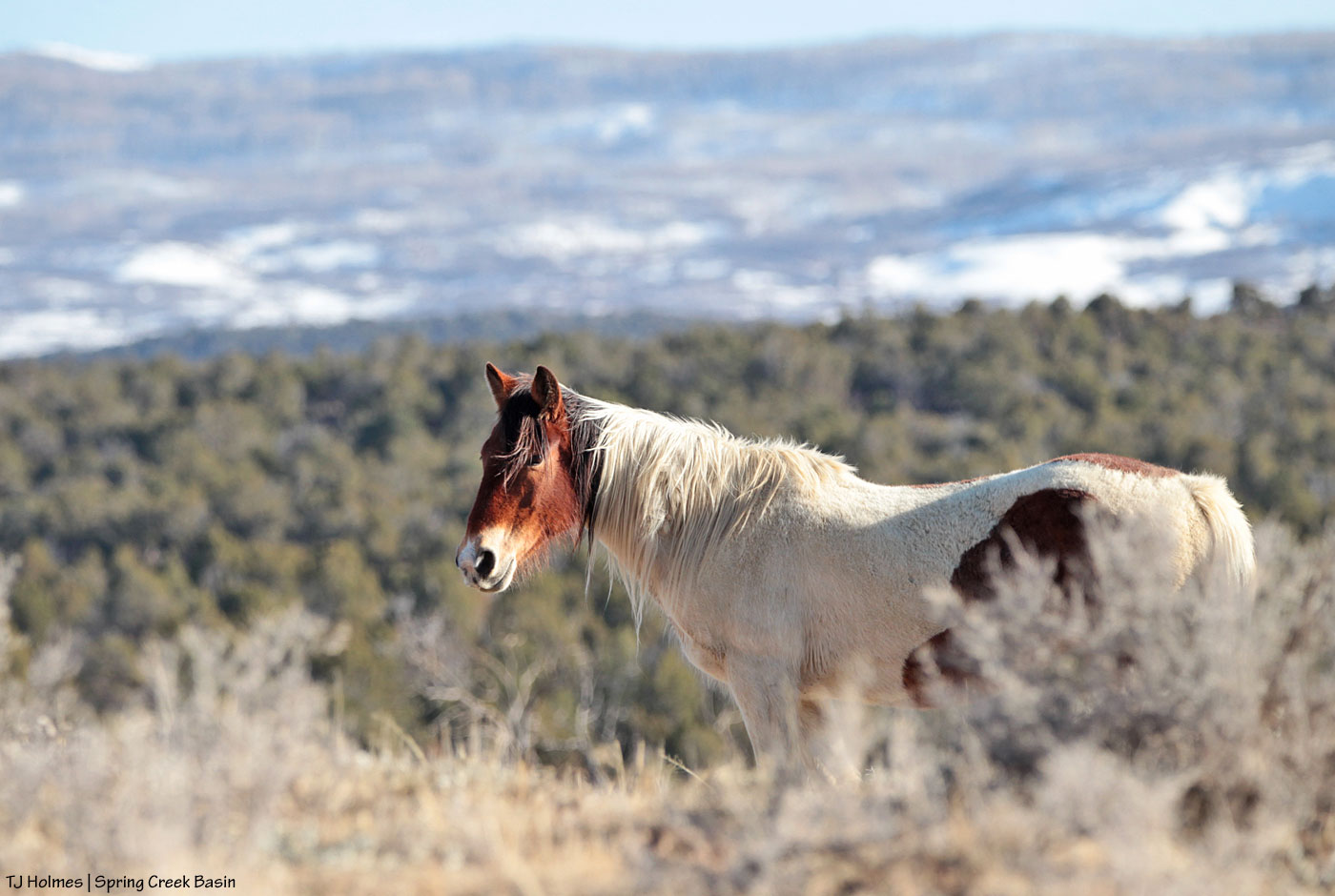
This photo of Chipeta wasn’t taken all that long ago, but that snow in the distance is currently doing a lot of rushing and rolling and flowing as muddy water in area creeks and arroyos. … And that area in the distance isn’t nearly as white as it was.
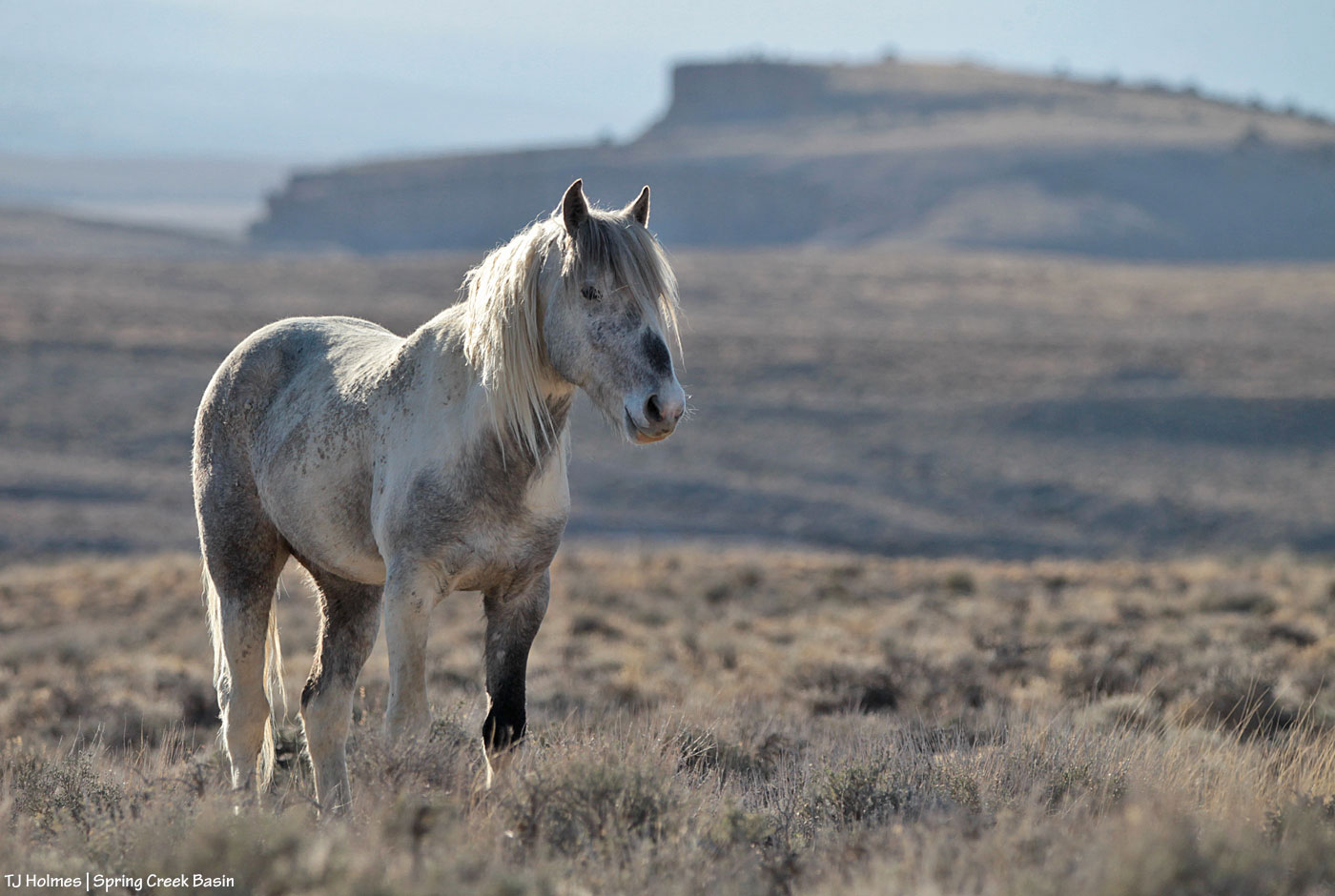
Handsome Flash is getting more grey and – if possible – more handsome.

He and a pal were grazing peacefully, far from chaos.
Dust in the air … we need some rain on the land again (though what it will do to our roaring creeks, I don’t know!).

All of a sudden, it’s spring in Disappointment Valley. How do we know?
The greasewood (above) is budding. We always look forward to this (at least partly) because it provides an early source of protein for the horses coming out of winter.
Grass is rising (sparse, but it’s there).
Cottonwood, silver poplar and apricot (!) leaves (in my neck of the not-so-wooded woods) are budding.
Robins are hopping.
Meadowlarks (how I love them!) are trilling my favorite song(s).
Butterflies are fluttering by.
Disappointment and Dawson creeks are running high and fast (Spring Creek *is* actually trickling), and places that AREN’T even creeks are channeling higher country snowmelt into arroyos rushing muddily to Disappointment Creek.
Mustangs are shedding.
Humans are wearing – *gasp* – short sleeves and baring winter-white skin to sunshine – which means it’s sunscreen season again.
I can ride my bike outside (instead of inside on the stationary trainer), and as a result, I think I have the first slight sunburn of the season.
High temps have gone from 40s to 50s to 60s to 70s (near 80!) in about as many days. (And by Friday, we’ll have a 30-ish-degree temperature drop.)

I initially thought this was phlox, but I think I’ve identified it more correctly as filaree or storksbill/cranesbill. (Remember the post about April’s full “pink” moon? Filaree is part of the geranium family, not phlox, but it IS very pink!)
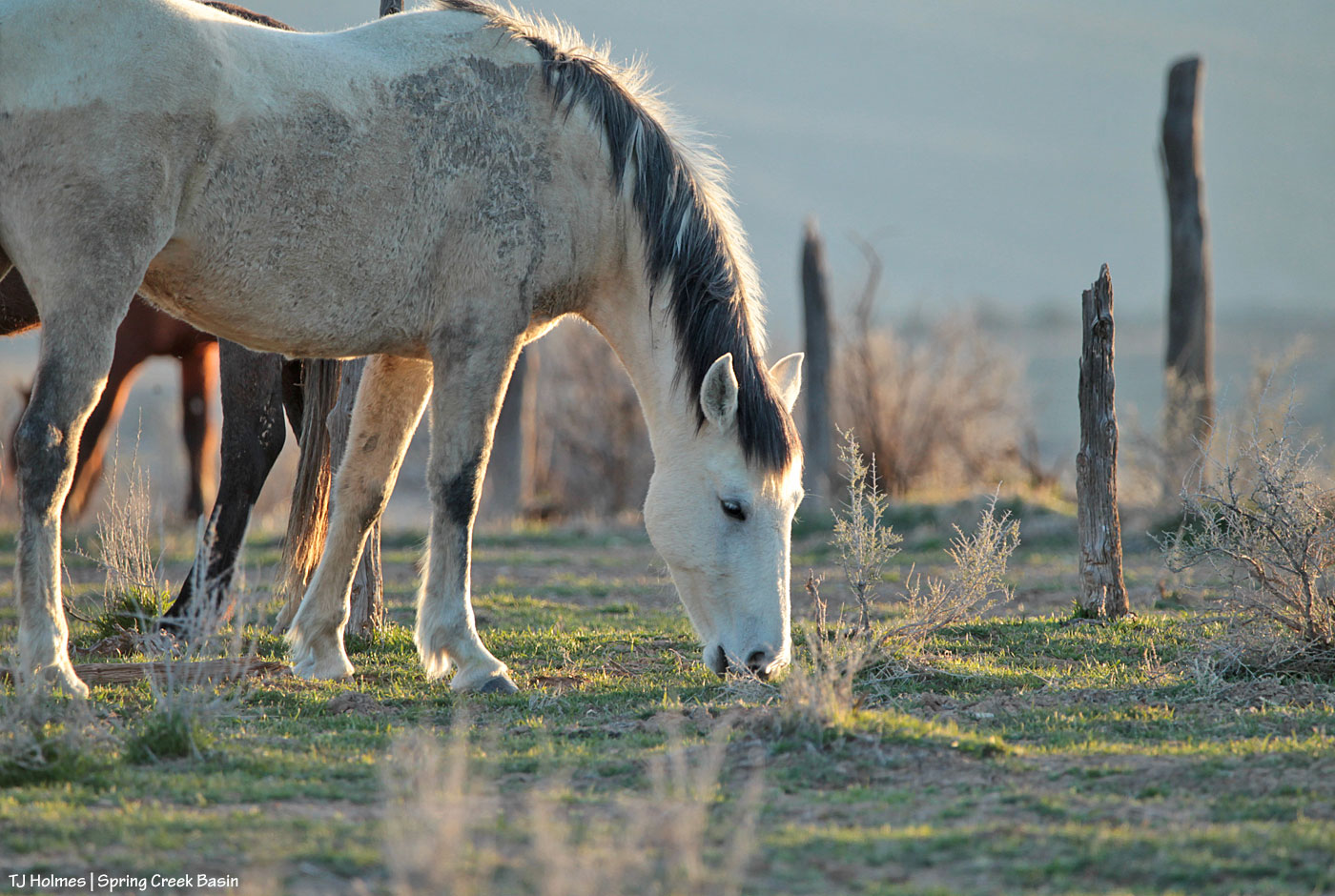
What signs of spring are YOU seeing where you live?

I was sitting in a little stand of trees along a shallow little arroyo when Seneca grazed her way into the perfect spot framed by the branches of the juniper.
It was a lovely evening location – for both of us!
 Spring Creek Basin Mustangs