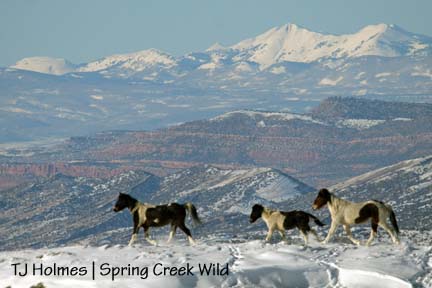
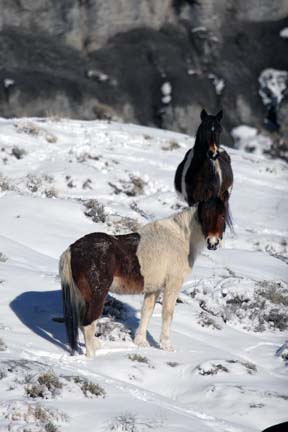
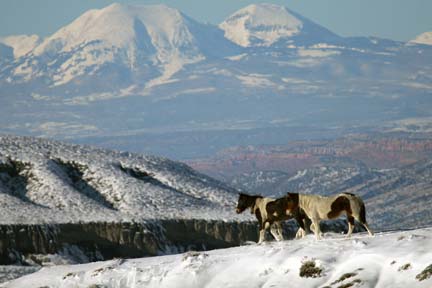
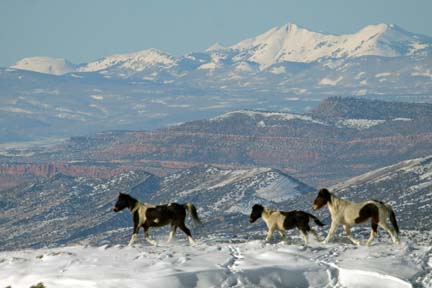
(I call this stallion Grey, but he is more commonly known as Traveler. At least I thought he was commonly known until he was sent to Canon City after we’d been told he’d stay. This photo was taken in April 2007. With 10 horses in his band (including him), his was the second-largest band in the herd area at the time.)
I’m TJ, a devoted fan of the wild horses of Spring Creek Basin, a Bureau of Land Management herd area in Southwest Colorado’s Disappointment Valley. This is in no way intended to be an official site and is not affiliated with the BLM. For official information, call the Dolores Public Lands Office at (970) 882-7296.
Since the August 2007 gather, during which almost 70 horses were penned, I have become more aware of the controversies surrounding wild horses in the West. To date, I have visited the Little Book Cliffs Wild Horse Range near Grand Junction, Colo., the Pryor Mountain Wild Horse Range in southern Montana and near Lovell, Wyo., and the McCullough Peaks Herd Management Area near Cody Wyo. Future visits are planned to the Sand Wash Basin and Piceance Basin herd management areas in northwestern Colorado, as well as to the Jicarilla Wild Horse Territory in northwestern New Mexico. I have found that with more documentation of horses in the particular herds, it is possible to conduct roundups that are more calm and less stressful on the horses and that result in fewer injuries. To that end, I started a documentation project of the Spring Creek Basin wild horses in September 2007, on the day of the release of the wild stallion known as Traveler.
I call the stallion Grey, so my blog will likely use Grey/Traveler interchangeably (when I forget to type “Traveler” and type Grey instead). Grey has his own special story. He had long been a dominant band stallion in the basin and was very popular with visitors. Advocates at a public meeting with a BLM official before the roundup were told he would stay in the herd area. However, he was sent to Canon City, to the wild horse and burro facility the BLM maintains at a prison there. A representative of the Spring Creek Basin chapter of the National Mustang Association, a representative of the San Juan Mountains Association (a partner with the San Juan National Forest) and I went to Canon City to identify him and bring him home. A two-week quarantine turned into three weeks, and it was four weeks and one day (of total captivity) before he was released back into the area. Photos taken in 2005 show that Grey was aged at 10; in 2007, he was aged at 17 (good thing the rest of us don’t age that fast!). He is likely at least 14, and with a number of younger bachelor stallions in the basin now, his chances at having another band are slim; not the kind of glorious homecoming I had envisioned for this wonderful horse. Only one horse from his original band, a grey mare I call Alpha, was released. She has established herself as the alpha mare in Steeldust’s band. She knows how to choose ‘em; Steeldust, also a grey stallion, is currently the dominant stallion in the area with a band of nine (including him).
Ten horses were released immediately after the gather: a black stallion, a dun stallion, a grey stallion and a pinto stallion, two pinto mares and a pinto foal, Alpha, a grulla mare and a muley bay mare. Although advocates were concerned that there were not enough horses in the herd area to meet the minimum “appropriate management level” number of 35, I have documented more than 40 horses. At least eight mares are pregnant. The five released mares all were given the PZP-22 immunocontraceptive. It should not affect their pregnancies, but it should prevent them from becoming pregnant during the next two seasons.
It probably is not my place to do this, but no one else – including the BLM – has documented the horses to the extent I have (to my current knowledge), so I’ve started naming them. It’s easier to talk about Houdini than “that grey mare that was with Junior in the spring that looks like Grey from a distance.” Houdini – and her foal, Two Boots – were in a band with a stallion I called Junior (because of his resemblance to Traveler) in April. Junior’s band was gathered, but Houdini and her foal managed to escape, hence “Houdini.” I’ll refer to the horses by name as I come to them and try to share the reasons behind the names I have given them.
We got a lot of snow in early January, and for various reasons, I haven’t been able to get out to the herd area since Dec. 29. I’ll share some of those December photos – hopefully it will help me figure out the layout of this blog.
My goal for this blog is to enable folks who know about the horses but for whatever reason are not able to get into the herd area to still keep in touch with them. When I first went to the basin in the fall of 2002, I wasn’t real impressed. Now, it’s one of my favorite places on Earth. If you don’t know the horses, I hope this will make you more familiar with them. As you get to know them, I hope you will be moved to do whatever you can to ensure their protection. Like Grey, they each have a story to tell.