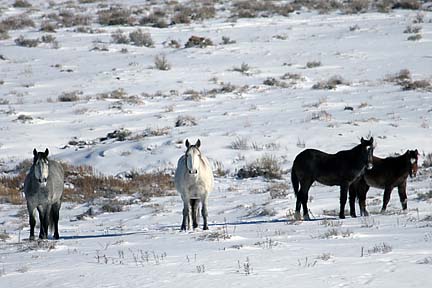
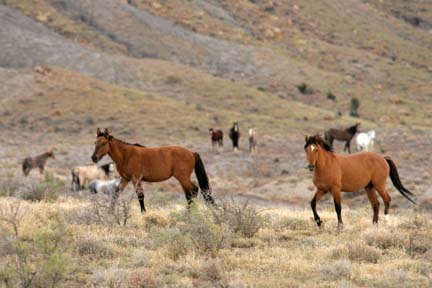
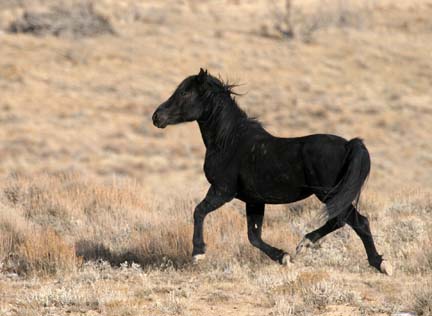
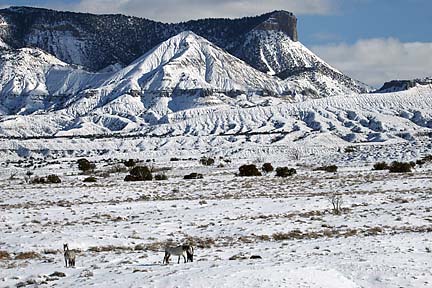
To read about the May 17 count in Spring Creek Basin, follow these links to The Durango Herald online. The first link is to my article about the count itself, and the second link is to an accompanying article by Outdoors Editor Greg Moore about the new group we’re working on. Pat Amthor, a member of the Four Corners Back Country Horsemen and, with her husband, Frank, project leader for the annual counts, and I also are in that group. (The first article should start “Big” …)
Basin as world – Sunday, May 4, 2008
6 05 2008
Yep. Roach.
I specifically climbed up on top of Round Top on Sunday to find some particular horses, but the only ones of those I saw were Poco, Bones and Roach. It made me really happy to find those guys because I hadn’t seen ’em for a while, and someone told me recently that they were all looking in poor condition.

They all look pretty good, don’t they? Bones has filled out some. She’s still thin, but she’s no longer as skinny as she was last fall when I first saw her.

I noticed a strong similarity between Poco and Bounce this weekend. Something to make ya go hmm.
Maybe?

I have to say that Roach is one of my favorites. Maybe it’s his personality – he rarely gets ruffled – maybe it’s long association. One of these days, I’ll post a pic of him from when I first saw him in 2004, with the roached mane that earned him his name.

Bones. Not the prettiest girl in the basin. This photo is meant to illustrate her weird hip, but it’s kinda hard to see, I guess.

This shows it a little better. Any veterinarians care to speculate?
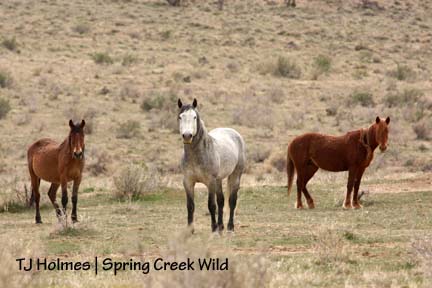
There’s Roja at right. Pregnant?
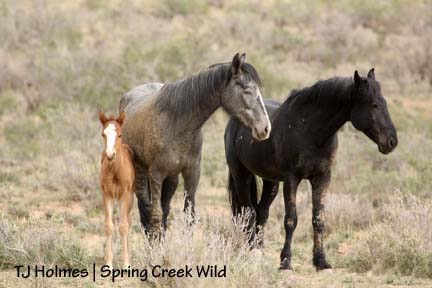
Stunning boy Grey/Traveler with his family. This was taken from the road near the dugout intersection. Seeing him like this – not alone, not with bachelors, but with a family!!! with mares and yearlings and a foal – is a phenomenal thing. I’ve known two exceptional horses in my life; Grey’s one.

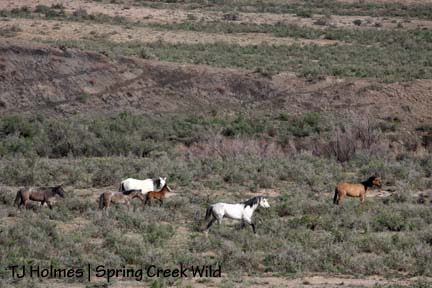
Steeldust’s girls. Luna leads the way down the road followed by Ember, Mahogany, Alpha and Piedra. They’re followed by the rest of the band, and Hollywood, and Mouse and Comanche.

I really like this young guy, Hollywood. I’d like to see bigger things from him than being an eternal lieutenant stallion to Steeldust. But he’s young. His time will come.

Comanche, one of the Bachelor 7. He and Mouse and Piedra are all a weird brownish-grey color, which I think comes from them being born brown or bay. They’ll all eventually turn grey. Comanche is shedding out more greyish this spring.
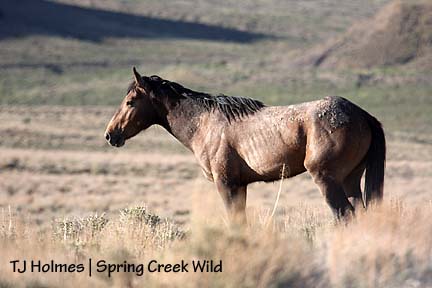
Mouse. Another of my favorites. I really hated to see him limping. I hope it’s something minor that heals quickly. The low sun angle might be a little strange on their colors, but you can see that Mouse is a shade more brownish than Comanche.

I haven’t had time to look this flower up in my book. It’s very tiny and very low to the ground, like most of the other wildflowers in the basin.

Another flower I haven’t taken the time to identify. This photo was taken April 20, the day I found Ember. This flower was growing in the shade, but in following visits to the basin, I found it out in the open in full sunshine.

Indian paintbrush – one of my favorite wildflowers. I particularly love the ones – like this one – that are so bright they look like they’re glowing with their own inner shine.
Comments : 6 Comments »
Categories : Uncategorized
Into the hinterlands – Sunday, May 4, 2008
6 05 2008I was downloading photos from my Sunday trip into the basin when the computer stopped – my 80 GB external hard drive is full! So I’ve been busy with that and a pesky little thing like my day job, and I haven’t tweaked many photos yet. But here are two I did:

From left, Bounce, Gaia and Alegre. They were really close to Seven’s band, up in the north part of the herd area right near the road.

Look who’s pregnant! That’s Molly in the background; she was gathered and released, and I found out recently that the contractors aged her at “older than 20.” Zowie. I do think she’s an older mare, and I really don’t know how long mares in the wild continue to conceive and have foals, but I’m starting to question her actual age?! I’ll try to post a pic of Roja later … I still can’t quite tell with her. She’s not NEARLY as huge as Molly. Isn’t Seven a handsome boy?
I saw almost all the horses Sunday – including the pinto family from a far distance to the south. The two horses I didn’t see have me really curious: David, the bay bachelor with the big blaze, left front fetlock, left hind pastern and right hind sock, and Aspen, the muley bay bachelor with the “upside-down” aspen-leaf star. They’re from two different bachelor bands – normally. Maybe they hooked up? The Bachelor 7 was split, with Duke, Chrome (who has shed out very light grey) and Hook together, and Mouse and Comanche tagging along after Steeldust’s band. Mouse was favoring his right front leg. He didn’t limp too badly when he walked, but when he tried to trot, it looked like he was trying to keep all his weight off that leg. Ugh. I hope it’s just a bad bruise or a sprain. Spring is beautiful, but it’s tough to be a bachelor boy. Kreacher had hooked up with the other bachelors – Corazon, Cinch, the muley bay, Ty and Mesa – but between the time I saw them together and the time I saw them again from the crown of Round Top, Kreacher had split.
Grey/Traveler is just stunning now, all or mostly shed out into his summer silver and framed with his black mane and tail and black legs. I challenge anyone not to be in awe of that horse! Yes, yes, he’s my personal favorite, but WOW, he’s gorgeous! 🙂
I hope to have more photos later this week, including some of the wildflowers that are popping up everywhere. It gets more and more green every time I visit – just remarkable. But I’m a little worried about the water already. Two water holes that I know of are already bone dry, and two others are about half full. There is water in places in some of the arroyos. How could we have had such a monster winter, with all that snow, and the water holes be draining already? There is a water catchment in the area, built with funds from the National Mustang Association, but the water tanks have been dry since at least August before the gather. Time to get those fixed, I’d say. I think that’s my next “project.”
Comments : 2 Comments »
Categories : Uncategorized
“Saving the American Wild Horse” – film screening
1 04 2008Telluride filmmaker James Kleinert has produced a provocative film called “Saving the American Wild Horse” and has been showing it at film festivals and – at least – to San Miguel County commissioners to garner support for our wild horses. The film was screened at the Durango Film Festival about a month ago, and the two showings were absolutely sold out. Four Corners Back Country Horsemen member Rachelle Davis saw the film for the first time that weekend and met James, and she worked to get the film shown again in Durango.
She offered this information in the 4CBCH newsletter this month:
“I was shocked and moved by the information I learned. It brings to light the mistreatment of wild horses, inhumane slaughter and other issues pertaining to wild horses. Sheyrl Crow, Viggo Mortensen and Peter Coyote are featured in this film. Much of the footage used is of the horses in Disappointment Valley that we count each year. I thought it was very well done and worth trying to get screened again so the back country horsemen could have a chance to watch it.”
The film will be screened at 6:30 p.m. Sunday, April 30, at the Abbey Theatre in Durango; doors open at 6 p.m. The cost will be $6 per person, with a portion of the proceeds going toward marketing for additional screenings. A silent auction also will be held.
James attended the roundup last April, and he spent some time last summer – before the roundup – in the basin filming our Spring Creek horses. Footage of them from the summer as well as during the roundup is featured in the film. It’s not an easy film to watch, but it is important to know what’s going on. James’ Web site is movingcloud.com.
Comments : Leave a Comment »
Categories : Uncategorized
The Internet as a resource
21 02 2008This is just a quick post to say I’ve added some additional links to the “blogroll” that may be of interest to wild horse folks. I don’t want to list every possible site known to mankind, just a few of the ones I’ve found helpful or that have led me to additional information about wild horses. The American Wild Horse Preservation Campaign Web site, in particular, has some good information. Check the “links” link on any of the sites for even more information.
Comments : Leave a Comment »
Categories : Uncategorized
Back in the basin
11 02 2008My first trip of the new year to the basin wasn’t exactly what I envisioned. As much snow as I have at my house, within spitting distance of the La Plata Mountains, and as much snow as was in the basin in December, AND as much snow as we’ve had since then, I expected a lot more snow and, well, a lot less mud. It has been warm here the past couple of days (almost 50 degrees yesterday; 42 in the basin today), but it must have been warmer there longer – the snow is just in patches, and the mud is pretty nasty.
There were no new tire tracks coming out of the road to the herd area off the county road, so I parked there and hiked in. I’ve been so anxious about the horses, envisioning them having to paw down through a foot or more of snow, that getting so close and yet, so far away, wouldn’t cut it! It’s about three miles from the county road to the herd area boundary; it took me about an hour and 15 minutes one way, hiking through slushy snow and seriously bad mud. The whole area is just saturated. Yucky, yucky, yucky … but I bet it’s gonna be a good spring for the ponies!
There were some bulls (bovine) about halfway in, close to the road, which goes through private property before it crosses the herd area boundary. They weren’t too worried about me. Close to the boundary, I saw a big herd of elk.

That’s a lot of elk! On the other side of the fence is the herd area.
Once in the herd area, I didn’t have to go too far in to get a vantage point of a huge chunk of the basin. I sat on a rock, ate an apple and got out the binoculars. I saw lots of cows – I counted 45 in several different groups – but it took awhile of slow glassing with the binoculars to find any horses. The good news is that the first group of horses I saw were the Bachelor 7 – including my boy Grey. The ironic part of seeing him for the first time since early November was how far away he was.
I also saw two dark horses even farther away. They were in some trees, so I’m not sure whether there were more than the two I saw. I did take some photos, even though all the horses were so far away I couldn’t see any of them without the binoculars. The photos confirmed that the first group was, indeed, the Bachelor 7, with Grey, and my best guess from the photos of the farther horses is that it was the bachelor stallions Ty, black with a “railroad tie” star and strip, and Mesa, solid bay.
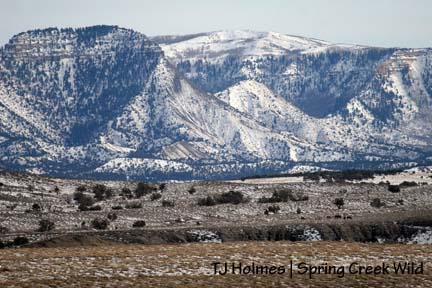
Can you see them? This is a full-frame shot, taken at 400 mm. Look above the words “Spring Creek,” just above the cut that runs the width of the photo. See those dots? Those are the boys.
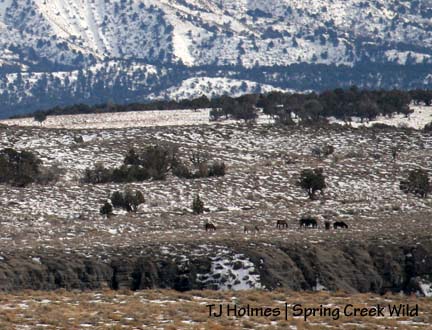
This is a serious crop of the previous photo. From the distance, the only horses I can absolutely identify are Aspen, far left, Grey, to the right of Aspen, and Duke, the dark horse at far right (in another photo, his head is up, and I can see his big star). Grey kinda blends into the background, but you can see his dark mane.
So now I know what conditions are like. The county road is good to the Suckla Ranch turnoff, but past that, it gets dicey. My first plan was to get down to the corral from which the horse folks ride in. But the road got pretty soft, and getting stuck isn’t my idea of fun. Don’t even think about driving off the county road on the road to the herd area! It will be a long time before I get all the mud off my boots.
I hope all this snow and moisture means a good spring and summer for vegetation in the basin – and for the horses!
Comments : Leave a Comment »
Categories : Uncategorized
Upcoming news
8 02 2008I am still waiting anxiously to get out to the herd area (lots and lots of snow in this region), although I finally remembered the cattle that are in the herd area – or were in December. I realized someone must be trucking hay to them – unless they managed to get in, round them up and haul them out – so the road may be passable at least to the entrance of the herd area. I may give it a try this weekend.
In other news, I plan to attend the first Wild Horse & Burro Program national advisory board meeting of 2008, which will be held Feb. 25 in Tucson, Ariz. I haven’t heard about my status on the board, but given that it’s almost mid-February and my application was in by early December, I think I didn’t make it. However, the meeting is open to the public, and the Spring Creek board has encouraged me to go. I hope to report on the events of that meeting when I get back. (If anyone reading plans to attend, please let me know!)
Also, I was recently asked to speak to the Mesa Verde Back Country Horsemen group at their March meeting (which will be held the week after I get back from Tucson) about my documentation project in the basin, as well as the other herds I’ve visited and roundup alternatives. Me, get to talk about my favorite subject?! I have been told there are time limits …! What I am most looking forward to is talking with people who have stories of their own to share about the horses. Relatively speaking, I’m a newcomer to this herd. I strongly believe that collaboration is one key to protection of our wild horse herds, and I’m eager to learn other people’s ideas.
My friend Claude Steelman, a professional wildlife photographer based in Durango, spent time last year visiting and photographing horses in all four of Colorado’s herd management areas (Little Book Cliffs is, of course, a wild horse range). He has a book coming out later this year with a collection of those photos. Visit his Web site at www.wildshots.com for more samples of his work (awesome!). In his new “Wild Horse Gallery,” the black and white photo of the grey horse trotting away from the photographer/viewer is Grey (Traveler)! Isn’t it stunning? What’s more amazing is that it is one of just a couple of photos Claude was able to fire off after the trailer door was opened and Traveler was released (Sept. 19, 2007). That photo is an example of what separates us amateurs from the pros – and it is part of what has me so excited to see the other photos of wild horses he has “captured” with his camera.
Now, speaking of photos, I thought I’d share some of my favorite photos taken in the basin last fall:
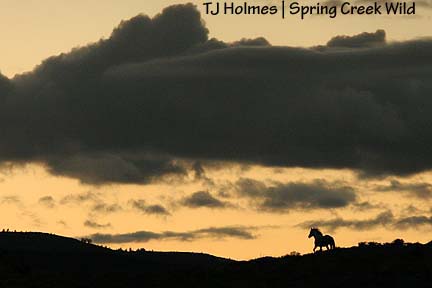
Grey (Traveler) at sunset in the basin on Oct. 14. This was the first time since his release that I had seen him; he was with six other bachelors. He has been alternately with all of them, some of them and alone since that time.
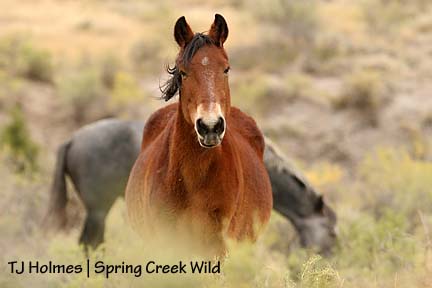
This is Molly, the muley bay released mare, with grey stallion Kreacher in the background. Their family also includes sorrel mare Roja. I think Roja is young, and I’m sure she’s pregnant. I’m unsure about Molly’s pregnancy status at this time. Harry Potter fans will recognize the name “Kreacher.” The day of this photo, Oct. 20, 2007, was the first time I saw this band, and I thought, “What an ugly creature.” Pretty easy to name him after that! Molly doesn’t have the best conformation herself, but she has a sweet face.

That’s Cinch in the lead (you can see the belt-like marking on his side that gave him his name), followed by Corazon and Twister. I had seen these horses – and figured out it was two bachelor stallions with an orphan – earlier in the day (also Oct. 20). I took this photo from my Jeep out on the county road along the edge of the herd area. I couldn’t believe my luck to see them twice. This pic is pretty heavily cropped. The next time I saw Twister, he was with his current family: Seven, Houdini and Two Boots.
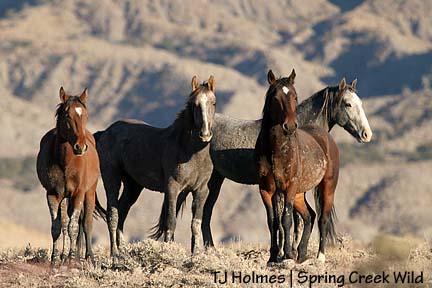
This is one of my favorite pix from all the years I’ve been visiting the horses. These are four of the “Bachelor 7,” from left, Aspen (note his upside-down Aspen-leaf star), Hook (see the “hook” of his snip between his nostrils), Duke (the leader) and Chrome (you can see his big blaze here but not his four stockings). Taken near sunset Nov. 4, 2007.

Another of my favorite pix. That’s Seven at left, just a few minutes after the photo right above this was taken, chasing the bachelor boys away from his mare, Houdini, and their foals, Two Boots and Twister. He looks very determined, doesn’t he? This is a very promising young stallion, I think. There are two young mares in Steeldust’s band, Piedra and Rosa, and I’m unsure if they’re his daughters or if he picked them up after they were kicked out of their sires’ bands. They don’t look pregnant, so I’ve guessed their ages at 3. If they ARE his daughters, he’ll likely kick them out this spring. If that happens, where will they end up? Will one of those bachelor boys get lucky, or might Seven add them to his family?
Comments : 4 Comments »
Categories : Uncategorized
Viewing wild horses …
19 01 2008
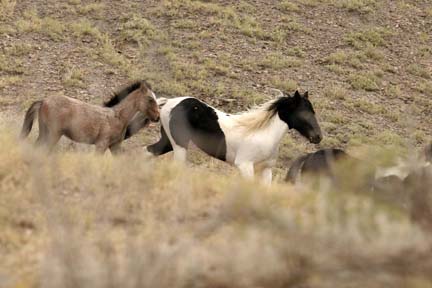
Kiowa and Reya move away from me after I walked up a ridge to look for Ceal and Shadow. This photo was not cropped but was taken with a 100-400 mm lens at close to the 400 mm setting. Taken Dec. 16, 2007.
A good article about wild horses is in the February 2008 issue of Western Horseman magazine. The author, a WH senior editor, attended a photography workshop last year with photographer Lynne Pomeranz, author of Among Wild Horses. Lynne is a fine-art photographer and wild horse advocate who lives in New Mexico. I was fortunate to meet her during a book-signing in Craig last May. The article contains some tips about wild horse viewing that I would like to reiterate and expand upon.
Wild horses are wild. Would you expect to walk up to a bison in Yellowstone National Park with your Kodak point-and-shoot camera? (Please, answer no.) Do not expect to be able to walk up to a wild horse. Horses are a “flight” species and have evolved as prey – for mountain lions, wolves, coyotes … humans. They would rather run away from you than fight you, but keep in mind that a mama with a foal and a stallion with a band of mares and foals are going to do whatever they think is necessary to stay away from you.
Keep this in mind: You can try to get so close that the only photos you get are of horses’ butts as they’re running away from you, or you can respect their space, stay a fair distance away and get photos of them interacting with each other. Some bands will give you some benefit of the doubt and just stand and watch you – as long as you don’t approach too closely. But when they decide to leave, count on them running far and fast away from you.
Vehicles can often be used as a “blind” from which to shoot. Also keep in mind that the road through the herd area is not maintained, and you travel at your own risk. The road is usually fine from late spring through fall, depending on the weather, but four-wheel drive is usually recommended because of the soft sand and creek crossings through some arroyos.
Please do not harass horses, especially pregnant and/or nursing mares. (By the way, harassing wild horses is against the law.)
Do not yell or flap your arms around the horses to get a better expression. I’ve seen horses seemingly napping, hind leg cocked, tail lazily swishing at flies, but do not for a second think that they’re not following your every move. On the other hand, do not act like a silent predator and stalk them, then suddenly spring up out of an arroyo. I do use the arroyos quite a bit to get around, but I try to do it in such a way that the horses never know I’m there.
A bit about equipment: I use a Canon digital SLR camera with a 100-400 mm lens. I don’t HAVE to get right up on them to get a good photo. The crop tool in your photo editing program is a lovely thing. I also use a monopod to steady the camera and lens.

The above photo is a good example of the power of the (long) lens. It was taken at the 100 mm end of my lens’ capability.
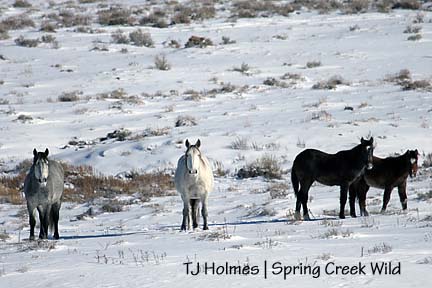
This photo was taken from a little bit closer as I walked parallel to them following a road, closer to the 400 mm end. It also was cropped.
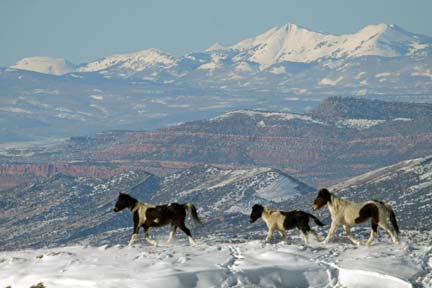
Bottom line, the key word here is respect. If the horses “tell” you you’re too close, back off (or watch as they leave). In the snowy environment that is now the basin, I am particularly careful to stay away from the horses. The only reason I took these photos of Seven’s family was opportunity; I didn’t know they were there until I suddenly saw them below the road – at the same time they saw me. I saw 24 horses that day, but these were the only ones I was close enough to photograph. When they moved on, I did not pursue them.
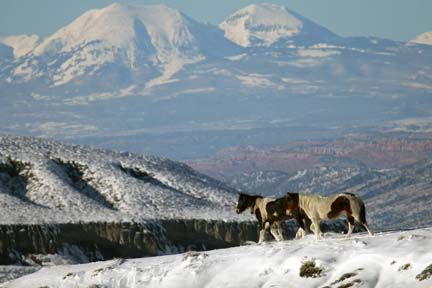
When taking the photos of the pintos, I pushed my lens to its limit and later cropped judiciously. I was farther from the horses than the photos indicate, and when they trotted away through the snow, I let them go. A benefit to that was that if I HAD pursued them, I would have missed the opportunity of seeing them trot across the far ridge against the stunning backdrop of the La Sal Mountains! Only because I was looking for the very thin mare Ceal did I go even as close to them as I did.
Comments : 13 Comments »
Categories : Uncategorized
On snowshoes in the basin
18 01 2008
(Seven, Houdini, Two Boots and, just barely, Twister in Spring Creek Basin.)
Dec. 29 was my last visit to the basin. The conditions were about the same as on Dec. 16: sunny and in the lower 20s. I was able to drive into the herd area, staying in the tracks of other drivers, notably a Division of Wildlife officer I talked with on my way in. I parked past the water catchment and continued on wearing my snowshoes (always listen to your mother!). Alpha and Steeldust, the big grey stallion that is currently the dominant stallion in the area with three mature mares, two young mares, a young stallion and two 2007 foals, were soaking up the sunshine on a hill just northeast of the first main road intersection. I watched them through the binoculars but didn’t go close to them.
My main goal was to find Grey (Traveler), as I had not seen him since a November camping trip. I saw 24 horses that day, but I never did see Grey. A single dark horse, possibly bay, was down to the southwest, on a ridge probably near the corrals off the county road. It could have been any of the bachelors, and although I saw only that one horse, I think it is likely there were others below the ridge out of my sight.
Walking along a road that goes past my favorite water hole, I came upon Seven, the released 7-year-old grey stallion, and his family: Houdini, Two Boots and Twister:
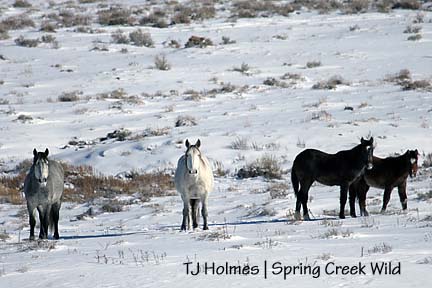
(From left, Seven, Houdini, Two Boots and Twister. You can see in this photo that Two Boots is much bigger than Twister. Seven is just gorgeous in his winter-silver coat. I am sure Seven is a son of Grey’s.)
They saw me as I saw them, as they were down low on the north side of the road. We all stopped, but they weren’t too bothered by me. I took photos and walked along the road, stopping now and then to take more photos. As long as I was walking parallel to them, they didn’t seem to mind (maybe by now they’re used to my two-legged presence in the basin), but when the road curved and took me slightly toward them, Seven decided enough was enough, and he led his family away to the northeast.
This group has an interesting story – a couple of interesting stories, I guess. I named Seven “Seven” because I got tired of referring to him as “the 7-year-old grey released stallion”; also, I’m a lurking Star Trek fan. Yes, I know he won’t be “7” forever, but his 7-year-old year had to be a memorable one. He was captured – and released – and he found himself a family.
Houdini became “Houdini” after I realized who she was. She had been with a band of horses in April led by a Grey look-like I called Junior (although I no longer believe him to be a son of Grey’s). Junior’s band was captured (some thought Junior was Traveler because the “strawberry roan” mare was with his group) – obviously, Houdini escaped, hence her name. She is one of the first I named post-gather. I still have not been able to determine the gender of her foal (I’m starting to think filly), but I named her Two Boots, both for her two hind socks and in honor of a Pryor Mountain stallion named Two Boots, which I saw while visiting in September 2007.

(Houdini with baby Two Boots in April 2007.)
And then there’s Twister, the orphan.
I first saw Twister in mid-October, with two pintos. Although my first thought was “stallion, mare, foal,” there was the nagging question of how two dark bay pintos had produced a rose grey foal. Then I recognized one pinto as a stallion I had seen with a bachelor group in April: Corazon, for the top part of a “heart” on his left side. Then I realized the other pinto also was a stallion! Whoa! What’s the story here?
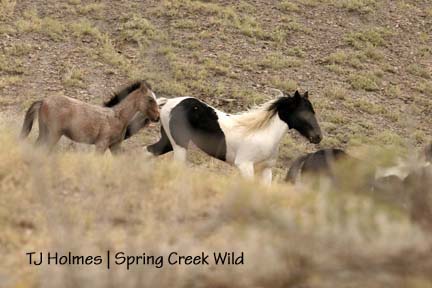
(Twister, left, with Corazon and Cinch, who is almost out of the frame at right.)
My theory is that Twister’s dam was gathered, and he was somehow missed. He’s rather small (especially compared with Two Boots), so he may have been born late in the season and just couldn’t keep up. With his coloring, he would have blended in with the ground as viewed from a helicopter. Kudos to these two stallions (I named the darker one Cinch for the belt-like markings on his right side and neck) for taking this youngster in, although I’m sure he’ll always be small from lack of nutrition. Then, in early November, I found Twister (for the orphan Oliver Twist) with Houdini’s family! Now that’s a good match. Twister adores Two Boots and follows her everywhere, sticking closer to her than even Houdini or Seven.
It should be noted that, from a distance, it’s easy to confuse Traveler and Houdini, as they are both light grey with dark manes and tails (although Traveler’s mane and tail are darker). And some of the bachelor boys Traveler has been with match Seven and the foals. Again, this is from a distance, like looking through binoculars, because it’s hard to judge the size of the foals from that far away.
Two Boots is very dark right now, almost black, but s/he has shown some lightening of her coat from her baby pictures. In addition to her socks, she has a large star and “coon tail” markings or “white ticking” at the top of her tail in the form of horizontal bars – quite distinctive.
The duns – Hollywood (released stallion) and his mare, Jif – were east of Alpha’s band.

(This photo does double duty: That’s Hollywood at right and Jif at left with Alpha and Steeldust’s band in the background. Alpha is at far right – “white,” for sake of identification – and Steeldust is the grey by Jif’s right front knee. This photo was taken in mid-October 2007.)
I’ve been doing some research on “dun” vs. “buckskin,” and I found that duns can, indeed, have black points. Hollywood is a classic dun, with a multi-colored mane that many women would die for – and pay for at beauty salons! – awesome zebra stripes on his legs and a dorsal stripe. I named him Hollywood after the Quarter Horse stallion Hollywood Dun It and because he’s so flashy with his half-star and hind sock and fetlock – and those zebra stripes! During my color research, I came across the term “peanut butter dun” (no kidding), which matches Jif exactly – hence her name! (I hope some of these names give you a chuckle; as I have said, the names are not official.) She also has zebra striping on her legs and a dorsal stripe, and her face exhibits a “sooty” coloration (which I’ve read buckskins do NOT have). She and Hollywood were seen hanging out with three of the “Bachelor 7” in November, but they seem to have returned to their solitary ways.
I don’t know the name of the low hill west of Round Top – or if it has a name – but I skirted it on the north side, then climbed a shoulder where I could look down on the saddle between it and Round Top. My goal was to get high and try to spot horses, which are commonly seen in the area north of there. It looked more climbable, given the snow and my snowshoes, but I’d be lying if I said I didn’t stop a time or four on my way up. From about halfway up, I spotted Seven’s band moving north into an open area … with another band coming from the north, toward them. After some long moments staring through the binocs, I identified them: Bounce, the released black stallion, Slate, the released grulla mare, and Alegre, the very pretty dark grey mare I think is a daughter of Grey and Alpha. I was happy to see them because they were among the last horses I documented. I’ve seen them a few times now, but they’re among my favorites. Grey and Alpha had a grey daughter a few years ago I called Flash for her flash-lightning style face marking. Alegre looks almost identical to her. Slate got the PZP along with the other released mares, but her brand – on the top of her left hip – is the only one I’ve been able to actually see and photograph. Slate may be an obvious name. She was aged at 5. I think, based on how dark Alegre is, that this may be her first foal. I do not know if Bounce had these mares before the gather, so the sire of their foals is unknown. (Feb. 15: Updated information: Claude Steelman, who was at the gather every day, has a photo of Bounce and Slate coming to the trap together, so they were together at least immediately before the roundup, and he may be the sire of her foal.)

(Bounce shows off the suspension that earned him his name. Photo taken in November 2007.)
When you see Bounce for yourself, you’ll know exactly the reason behind his name! This boy was aged at 20 at the August gather. All the horses were lean then, and I would have believed he was older. He seems to be a different “type” than most of the other horses, and I’ve never seen another that had as much bounce to his step. If he IS 20, the years have been kind to him.
Seven and Bounce eventually came together out the open, and their squeals carried to me, far away on the hillside, where I sat on a pricky sage bush to avoid the snow. There was some striking, but although I watched the entire encounter through the binoculars, I didn’t see any real violence. After a few minutes, they moseyed on – Seven and family continuing to the northeast, and Bounce and girls continuing on to the southwest.
When I was up on top of the hill, two reddish-colored coyotes came up from the south side, saw me and went back down, but otherwise, I didn’t see any more horses from the top of the hill. However, there were some snowed-over horse tracks and an old manure pile up there, which kind of surprised me.
I could see the corral along the county road from the top of the hill, and it was easy to distinguish the larger horse tracks from the smaller deer and/or elk tracks, but I didn’t see any more horses until I was on the road past the water hole again.
Five horses were working their way up the hill where Alpha’s band had previously been. I could not identify them for sure because of distance, but I believe it was four of the Bachelor 7. That group consists of Grey/Traveler; a mahogany bay stallion with a large star and left hind sock named Duke (I believe he is the dominant one of that group); a bright bay stallion with an upside-down aspen-leaf star named, appropriately, Aspen; a medium grey stallion with a blaze and four stockings named Chrome; a rose grey stallion with star, strip and a snip that hooks between his nostrils named Hook; a brownish-grey stallion I named Mouse (I saw him with Corazon in April); and another brownish-grey I named Comanche. Comanche and Mouse are the same shade of brownish grey – likely born bay and turning grey. A young mare in Steeldust’s band I call Piedra (named after the local river and because she has a gem-shaped star) has the same coloring. This color is not to be confused with roan or grulla, as these horses will become more and more grey, eventually “white” like Alpha and Houdini (and Grey). Comanche differs from Mouse by being stouter and with a lighter face. Mouse has a curious “smoke spot” on the left side of his nasal bone, about where a caveson would go.
Speaking of roan, I heard someone at the gather say of the grey horses, “Oh, I just call them all roans.” I have seen greys, bays, blacks, sorrels, duns, buckskins, pintos, a seal brown mare and a grulla in Spring Creek Basin, but I have not seen a single roan horse in the area.
As a side note, the cattle are on the range; I don’t know how many. There seemed to be a lot, and when I saw them, they were all in the northwest, around the area where the trap site was last August. They’ll be there through February, I think.
Comments : Leave a Comment »
Categories : Uncategorized
Snowbound basin
18 01 2008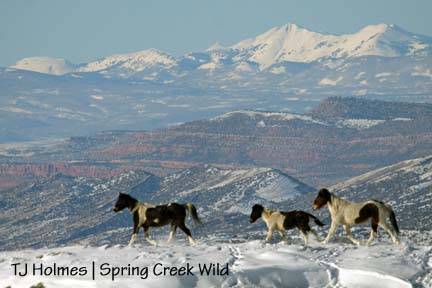
Dec. 16 was sunny and fairly mild, with temperatures in the lower 20s. I did not expect to encounter so much snow, so I left my snowshoes in the Jeep. Far enough in to decide not to turn back, I wished I had them!
I knew the pintos prefer the southern area of the herd area, and I had not seen them my previous few visits, so I chose to hike in to that area. Also, the far southern end is an area with which I am not as familiar as other parts of the basin. I had previously seen the pintos – stallion Bruiser, mare Kiowa and her foal, Reya, and mare Chipeta – with a seal brown mare I call Ceal. The first time I saw Ceal was in May 2004 up in the northeastern part of the herd area; I also saw her in April 2007 when two bands of pintos merged briefly in the very southern end.
Ceal and her 2007 black filly, Shadow, were with Bruiser’s band in October, but when I first saw the pintos through the binoculars on this trip, I didn’t see Ceal, so I decided to go closer in case she was hidden behind a hill nearby.

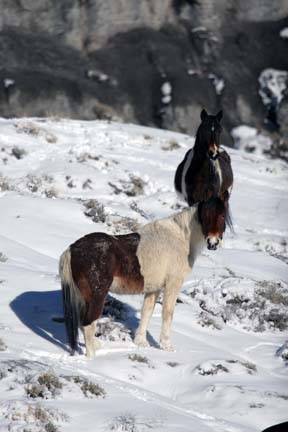
(Chipeta, foreground with the big snip, was named after Chief Ouray’s wife. I saw her in April with a mature horse I now think may have been her dam. I think she’ll probably be 3 this spring, and I do not think she is pregnant. Kiowa, in the background, was named after an Indian tribe known for their horsemanship. She had a foal when I saw her in April, has a foal now – Reya – and looks pregnant.)

(Chipeta follows Kiowa and Reya along a snow-covered ridge in the southern end of the herd area. The stallion is not far behind. The mountains in the far distance are the La Sal Mountains in Utah.)
Ceal was not with the pintos, but when they moved off across a ridge in the photos, I discovered Ceal and Shadow below that ridge against a small hill. Ceal is extremely thin, and I am worried about her ability to make it through the winter. If she does not make it, I hope the pintos adopt Shadow.
During my time in the snow, I also saw horses way up to the north, on the northeastern side of the hill called Round Top. They may have been Houdini and her family, but I couldn’t tell because of the distance and light glare.
I did realize that the southern end probably gets much more snow than the northern portion of the herd area – there are more trees and the topography features more hills – so I doubt the area is much used by the horses during the winter.
Comments : Leave a Comment »
Categories : Uncategorized
 Spring Creek Basin Mustangs