What we want to know

6 01 2011

Today, I was so honored to spend some time with three smart, beautiful young ladies at a local elementary school, talking about horses – specifically, wild horses – more specifically, the wild horses of Spring Creek Basin. They wowed me from the start, with the list of things they knew about horses and then a list they had compiled that they wanted to know.

A, M and M, thank you for sharing part of your day with me! I hope I contributed to your excitement about wild horses, and I can’t wait to see you next week!

With permission from K at the school, these are their questions:

WHAT WE WANT TO KNOW:

1. Is there a first aid for horses?

2. Is there a cure for horses that break their leg?

3. Measuring horses by hands.

4. How fast does a wild horse run?

5. What are the symptoms of colic?

6. What is founder?  Do you wild horses get founder?

7. Since wild horses aren’t shoed, does that have an impact on them?

8. Why is it called “Disappointment Valley” where the wild horses live?

9. How do you find the wild horses?

10. How many wild horse herds are in Colorado?

11. What diseases do wild horses get?

12. Are the wild horses affected by car crashes?

13. How long is a horse pregnant?

14. How long before a colt stands?

15. How many breeds of horses are there?  What are they called?

16. How do you transport rescued horses?

17. How do you train a horse that’s been abused?

18. Can you feed a horse chocolate?

Can you believe those fabulous questions?! (I love the last one!) Also next week, the girls will meet a local couple that rescues abused and unwanted horses. They’re getting quite an education!

This is the list they had come up with of things they know:

1. Different horses have different tempers.

2. Horses have no nerves in their manes.

3. Some horses need you to click and say trot if you want them to trot.

4. In order to make a horse canter, you have to slap their rumps – hard.

5. You pull on the reins very softly to make horses slow down.

6. Horses have a muscle in their hooves called a frog that makes them able to trot and canter at amazing speeds.

7. If a horse has a broken leg, you have to kill it.

8. Horses like apples and carrots.

(Note that the second to last thing they “know” in this list becomes the second question they “want to know.”)

Check out how many of their questions have to do with the horses’ health and well-being. Are you as impressed as I am? A and M are in second grade; M is in fourth grade.

Beautiful, beautiful and beautiful.


What about the numbers?

3 01 2011

Please take the time to listen to this documentary by Amy Hadden Marsh about how BLM conducts census reports of wild horses and burros in the West: http://www.kdnk.org/article.cfm?mode=detail&id=1293643372755. Follow that link, then click the arrow under “Documentary; Wild horses caught in the crossfire” to the right to play. It’s not too long, and it’s very informative.

One of the best things I’ve done since starting my mustang advocacy was to grab onto the idea of documenting each horse in my herd, which I learned in short order after witnessing the first day of the Little Book Cliffs roundup in September 2007 (and later meeting documenters and darters for that herd, including Marty Felix and Billie Hutchings) and then meeting Matt Dillon, director of the Pryor Mountain Wild Mustang Center and writer and photographer of the Pryor Wild blog, later that same month. I knew a good thing when I saw it! In 22,000-acre Spring Creek Basin, it took me about 2.5-3 months of weekend visits to document the 43 horses left after the 2007 roundup and be sure I had seen them all.

Amy is a master’s degree candidate in wild horse management (where do I sign up??), and she has put together this oral documentary that touches on a lot of interesting points, including how BLM counts and estimates populations. The documentation of Spring Creek Basin’s and Little Book Cliffs’ herds are mentioned, as well as counting flights over Piceance Basin.

Follow Amy’s blog at From Western Colorado.


Gearing up for 2011

2 01 2011

With the holidays fast approaching and my Christmas trip to Texas, I never stood a chance of posting some more pix from my last visit to the horses last year. Although it was a cloudy, grey day, I spent quite a bit of time with Chrome’s, Hollywood’s and Comanche’s bands – heaven. So I’m going to try to get some more photos up of various horses before I hopefully head out again this week for my first visit of 2011!

Something I’m tremendously excited about is a two-part visit, starting this week and ending next week, to a local elementary school to talk to three students for a project they’re doing about horses! I’m talking about wild horses – of course! They’ll learn more about horses from other people involved in different aspects, including a local equine rescue group, throughout the month. I’ve been speculating about ways to get local kids involved with our mustangs for a couple of years now, so I hope this is the start of something we can continue annually. Later in the spring, I’ll take the students out to Spring Creek Basin for an up-close look at OUR mustangs in the wild. I can’t wait to learn about the students and find out what they’re most interested in regarding horses. I bet they have some super questions!

I’m also excited about being a tour leader for the third year (stymied last year because of rain) to the Spring Creek Basin mustangs during the Ute Mountain Mesa Verde Birding Festival. The link is to last year’s information, but they should be updating it soon. My tour will be Thursday, May 12. If you’re local, sign up! I think the cost is about $60, and it includes travel, some birding along the way to the basin and back, and lunch. Hopefully the weather will cooperate this year! About a dozen people on the tour meet in Cortez and drive out to the basin, where I meet them, and we drive in to look for horses, talking about all kinds of things related to the horses along the way. The Forest Service, a partner in the festival, always has a couple of people along to answer questions about San Juan Public Lands. The year before rain put a damper (sorry) on our plans, we saw almost all the horses.

Our NMA/CO group also plans to do some educational presentations around the region this year. I’ll have more information as we make those plans.

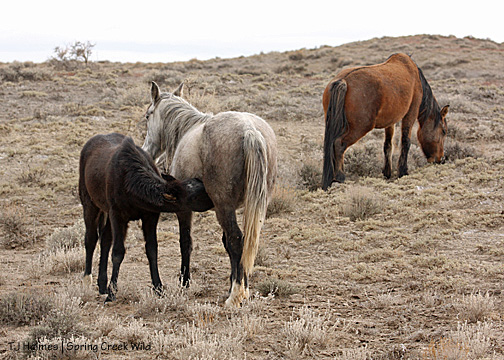
Chrome and Hayden

Now for some heavy stuff. This year, Spring Creek Basin will see another roundup. It’s on the BLM schedule for Sept. 17-21. It hasn’t taken that long in the past, but I plan to be there for every day of it this year, and my fervent hope is that BLM will give the go-ahead for a fertility control program using native (annual) PZP and volunteer darters. We (NMA/CO) have been encouraging fertility control since the last roundup, and we made a formal proposal last year to use PZP (not PZP-22) and volunteer darters. In light of that, with my growing feeling of responsibility to provide as much information as I can as I learn and observe, I will be writing some posts this year that I hope are, in fact, educational and informative. My opinion (and it is an opinion) varies a bit from some of the “mainstream advocacy groups.” I do HATE roundups, but I DO support fertility control, and I do NOT support “let nature take its course,” aka starvation, and even with fertility control, I foresee roundups (we hope for bait trapping over helicopters) in the future, hopefully lessened.

Chrome and Rio

The horses are in great shape. Five water holes have been dug out in the last two years. We got rain last summer (a lot of rain).

Do I want to stop the roundup? No.

Yes, we will say goodbye to many horses this fall. Will it break my heart? It has been breaking  a little every day for the last few years in anticipation.

Does this seem contradictory?

The basin is fenced. It is finite. It cannot support an infinite number of horses. I would rather see fewer horses removed WHILE THEY ARE HEALTHY than many, many horses removed in the very lean condition they were in during the 2007 roundup and before the basin’s grazing and water resources are so taxed. And I want to see fertility control started as soon as possible … so that the next roundup may be years and years and years away. And it is also my hope that by saving such an incredible amount of money by reducing the frequency of roundups, as well as fewer Spring Creek Basin horses going to interminably long-term holding, we might set BLM’s sights on bait trapping – rather than helicopter-driven roundups – in the future.

Could we stop roundups altogether? I’m sure we could. Assateague Island did it. But I’m not sure we’re ready to go there just yet. That is a very intensive program – of necessity.
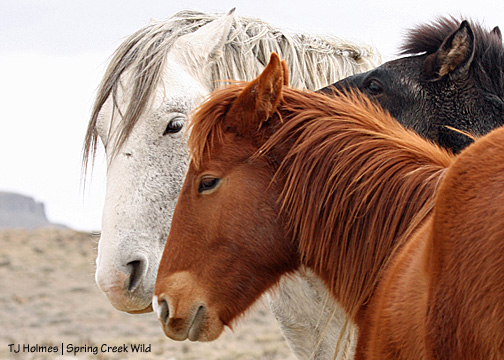
Chrome and Hayden and Rio

Linda on her Beautiful Mustang blog asked me a great series of questions about PZP, and has posted some of my answers, along with photos. Linda adopted a beautiful filly born in 2007 from Beatty’s Butte, Ore., and named her Beautiful Girl. And is she beautiful! (Really, she’s gorgeous!) More answers and photos to come. I’m really grateful to her for giving me another venue. My disclaimer: I am certified to handle and mix PZP and to dart, but I do NOT consider myself an expert. So I continue to read all I can and talk to people who ARE experts.

It was never my intention to use this blog as a political platform, rather I want it to be about the HORSES. Mustangs are an incredibly emotionally charged subject – and rightly so. I still don’t intend this blog to be political. Rather, I’d like it to be educational – both about the horses themselves and what they do for us – emotionally and otherwise – and what we can do for them. I want to encourage discussion and questions and come up with answers. As stated above, I don’t have all the answers, and lots of people have been working on this longer than I have! But after all this time – this year will be the 40th anniversary of the Wild and Free-Roaming Horses and Burros Act – we have enough information *to* CHANGE.
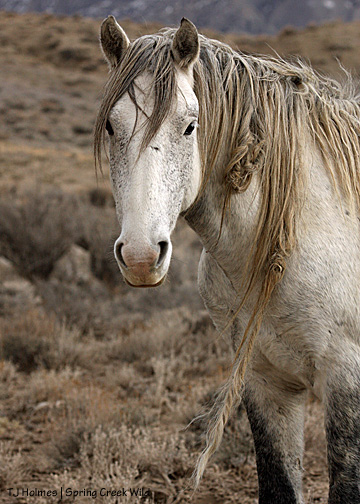
Chrome

I highly recommend at least these books:

Wild Horse Annie and the Last of the Mustangs by David Cruise and Alison Griffiths

Mustang: The Saga of the Wild Horse in the American West by Deanne Stillman

America’s Last Wild Horses by Hope Ryden

Please recommend others, if you like, but I found these books to tell an amazing and not always happy history of horses and humankind. I read Mustang first, about two years ago; it was published in 2008 . Last winter, I read America’s Last Wild Horses for the first time, first published in 1970, and I was struck by one major thought: Nothing has changed. I read Wild Horse Annie right after Christmas, and I thought again: Why has nothing changed? It’s not for lack of letters. Not for lack of schoolchildren – and adults – writing and writing and writing, talking and cajoling and pleading and demanding and insisting that wild horses be protected and managed in the wild.

Why has nothing changed?!
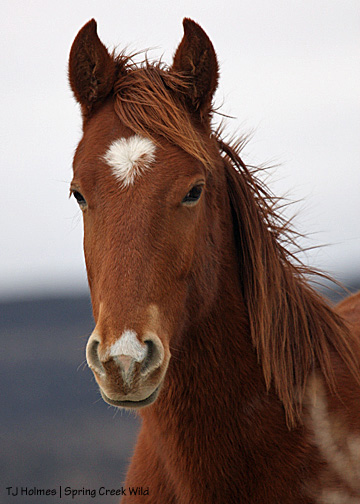
Hayden

I don’t know, but I share the conviction of many, many people that it has to and will.

I joined this fight – and it obviously is one – just a few years ago. I know people who have been fighting for 30 years. Best science is available, and many people are willing to carry it out for the benefit of our mustangs.
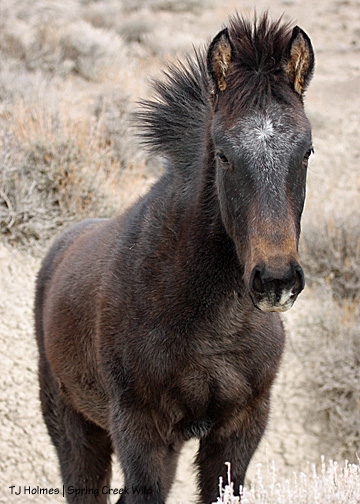
Rio

On my little blog, I’ll put out my opinion (what a scary proposition) and try to be a little more detailed about what we’re trying to do in our little corner of the wild horse world. And I’ll always – always – keep it about the horses.
Rio, Two Boots and Jif


Happy New Year!

1 01 2011

Timely information:

The Rose Bowl Parade will feature Madeleine Pickens’ mustang float. Text “FLOAT 83” to cast your vote on your mobile phone to “50649.” Vote up to 5 times.

The parade is scheduled to start at 8 a.m. PST. That’s 9 a.m. for folks on Mountain time. Almost time!

How cool would it be if the voting lines were jammed with people showing their appreciation of our mustangs?! I’ll vote wild! (A side note, I believe the palominos ridden by the Marine honor guard are mustangs.)

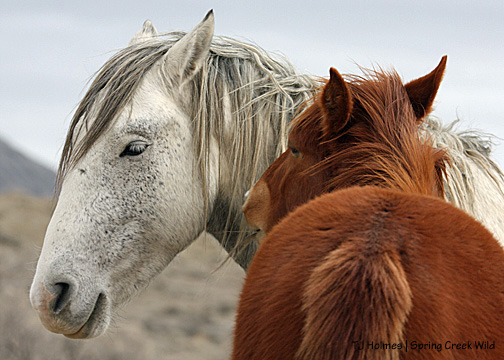
These pix of Chrome and Rio and Two Boots were taken last year (Dec. 15).

I hope everyone had a wonderful Christmas, and I wish you peace and happiness in 2011. For our mustangs to know peaceful (mostly!) wild lives is my greatest wish.


Beautiful Girl(s)

19 12 2010

Through this blog, I’ve been blessed to come into contact with mustang lovers all across the country and the world. That has been as gratifying to me as my journey with the horses themselves – and I’ve probably learned just as much!

I’ve known about Linda’s “Beautiful Mustang” blog for a while now (it’s linked to the right under my blog roll), but the calendar posts brought us in closer contact – particularly when she mentioned she was going to do a post about PZP. Linda adopted her mustang Beautiful Girl as a yearling after she was rounded up with her mother from Beatty’s Butte, Oregon, and her blog relates her journey with this feisty, beautiful girl and other paths along the way – such as her cool Irish wolfhound and the other horses and goats and family she shares her life with!

There’s a lot of information out about PZP (sometimes confused with PZP-22) – and about fertility control in general. I’ve been sitting on a draft post about fertility control and some misconceptions I’ve read for about two months now. It’s a big issue, and the post, while longer than most I write, doesn’t begin to cover it all. I worry about what I’ve left out as much as I wonder how people will take what I’ve written – knocking down misconceptions and outright untruths about PZP and fertility control that some have come to see as irrefutable fact.

So I got pretty excited when Linda proposed a Q&A on her blog about PZP and fertility control (native PZP is not the same as PZP-22). She emailed me six questions, and it took me a long, full day to answer them (lucky I got snowed out of the basin that day!). She has Part I up on her blog now along with some pictures that help illustrate it. These are the questions she asked:

1.) Can you tell us how you became interested in Mustangs and a little about the herd you document?
2.) You’ve said that  you’d advocate the use of PZP to control the growth of Mustang herds, can you tell us why you’ve come to that decision?
3.) From your observations and knowledge, does PZP change the behaviors of wild horses?
4.) Your organization has submitted a plan to the BLM, can you give us the highlights of that plan?
5.) What are the down sides, if any, to using PZP—in your personal assessment?
6.) Do you have any unanswered questions about it?

Like I told Linda, I am not a scientifically “knighted” expert about PZP or fertility control. I don’t have letters before or after my name. But with a specific herd that I advocate for, I decided it was in their best interests for me to learn as much as I could – just like the decision I made to document them. Lots of people have put up information about PZP that seems reasonable and logical and workable … and is perfectly NOT suited to reality. I can’t tell you that *I* know what I’m talking about (I can – you don’t have to believe me). I have cited scientific information researched by people who DO have lots of letters before and after their names.

But I have not yet used PZP, and although PZP-22 was given to eight mares in or brought to Spring Creek Basin, that’s a pretty small “research pool.” (And of the five SCB mares that got the PZP-22 at the end of the 2007 roundup, three are surviving.) I can tell you only what I know (from training and my own reading/research and observations of “my” wild horses) and what other people have taught me. I believe it to be reasonable. I believe myself to be reasonable. I am incredibly emotionally invested in these mustangs (possibly the understatement of the year), but I am also realistic. We’ll have a roundup next fall. I will HATE it, but I recognize the necessity of it.

I absolutely encourage everyone who reads this to READ, RESEARCH, DISCOVER, ASK QUESTIONS! Of me, of actual experts – and make your opinions accordingly. The more that’s asked, the more that’s learned. You may not agree with me, but you’ll have the information to make an informed decision.

And thank you, to a mustang angel in Washington, for giving me another forum to add to the discussion. 🙂


Ours, before we were U.S.

24 11 2010

http://www.rgj.com/article/20101123/NEWS20/11210366/1321/NEWS

From the Reno Gazette-Journal

“Best science” gets harder and harder to ignore.


Hannah, our Hannah

15 11 2010

This post is to give a shout out to a remarkable young woman who has supported our Colorado chapter of the National Mustang Association for the last couple of years, Hannah. Last year, Hannah sent $100 of her babysitting money to NMA/CO to be used in our efforts to advocate for the wild horses of Spring Creek Basin. This fall, she sent $100 again. Hannah, we so appreciate your interest in the horses!

I don’t very often (OK, maybe never) talk about our group, but I think it’s time to start “tooting our horn,” so to speak, and this may be a good time to start.

NMA/CO is a nonprofit chapter of the original organization, based in Utah, that oversees a wild horse sanctuary in Nevada. Members of that original organization had a hand in promoting the Pryor Mountain Wild Horse Range before the 1971 Wild and Free-Roaming Horses and Burro Act went into effect, an interesting fact I learned when I read Hope Ryden’s America’s Last Wild Horses. Locally, members have been staunch advocates of the Spring Creek Basin herd for more than a decade (approaching 15 years now, I believe). Our group focuses solely on the wild horses of Spring Creek Basin, and, interestingly, it was originally started at the request of a former BLM manager of the herd.

I got involved around the time of the 2007 roundup and now am president of the chapter. NMA/CO has done numerous projects in the basin, including removing old fences, building new fences and maintaining boundary fences; building the current water catchment, which provides the only source of fresh water to the horses in the basin (the other sources being extremely alkaline); providing boots to inmates in the inmate training program at Canon City; cutting and spraying tamarisk, also known as salt cedar; helping subsidize trips each spring for “alternative spring break” students from the University of Missouri who do projects on San Juan public lands in Southwest Colorado, including in the basin; trash pickup; and, perhaps the biggest project of all, buying and permanently retiring $40,000 worth of cattle AUMs in the basin several years ago, leaving only one grazing-rights holder, who runs cattle in the basin from Dec. 1 to Feb. 28. These are all projects Hannah and other members contribute to making happen for our wild horses.

Last year, I named the first filly born in Spring Creek Basin after young Hannah. The suggestion was put forward by a member of our board and unanimously – and enthusiastically! – approved by all.

Hannah-filly, now a yearling and thriving.

Hannah with her best friend, year-mate and half-sister, Sable.

Hannah-girl, thank you so much for your generous contributions to our Spring Creek Basin mustangs! You are thought of often, in fact, every time I see Hannah-filly!

From Hannah-filly and the rest of us, thank you!

NMA-news-10-fall

I hope this works … The above is a link to our current (Fall/Winter 2010) NMA/CO newsletter. As you can see (if it works!), we have a lot going on. I think it’s also time to start talking about management strategies we are encouraging in Spring Creek basin, which includes the use of fertility control. It’s about to be roundup year in the basin, and the more facts I can disseminate, the better informed people will be about our realities.

The first fact: Because of the herd population and the limited resources in the basin, a roundup is necessary. Second: With the future use of fertility control, we hope to slow (not stop) population growth and push roundups to as few and far between as possible. Local BLM is considering our proposal, and we hope that will have a favorable outcome.

More to come on this issue.


Must be …

30 10 2010

… hunting season once again. Same tree as the last two years, so I make the not-hard-to-arrive-at assumption that it’s the same responsible person – who is obviously not a responsible human being.

I wonder, does this person wonder who cleans up after him/her (I suppose it could be a her, but really?).

I’d like to highlight this unknown person because by doing so, I really highlight the countless, nameless, *responsible* hunters who do NOT leave behind evidence of their visit to the basin to be photographed. Those folks should get some props for their careful visits.


Whisper

4 10 2010

Whisper, watching Steeldust’s band … daddy Bounce in the background.

I attended a workshop recently about horse photography. Before I went, I thought: I want to use this as a way to urge myself out of my box, to see things differently. But as it turned out, I like my “box” – the basin, the wild and wonderful and unique horses within it. I have a *relationship* with each of those horses and with the basin. The horses we photographed were beautiful, and the setting was lovely. The light when we were out was harsh, though, the horse running measured circles in the high-barred roundpen did nothing for me, nor the horse galloping around the arena filled with jumps, who wanted to return to his pals in the pasture across the driveway. No relationship – to me. No connection – with me. The pictures I did take reflected some relationships the horses had with each other – not very outside my photographic box. A photographer recently told me he wasn’t going to photograph wild horses any time but in the spring anymore because otherwise they didn’t do anything but graze. I countered that the typical photos of wild horses galloping and kicking and biting and fighting are NOT what happens all the time (hello, spring). “That’s what sells,” countered the professional photographer.

Yeah.

I admire this photographer very much, and I can’t fault him for knowing what sells – he makes his living by what sells. As do other professional photographers.

Would he be surprised by what I *saw* – what I *see* – when I’m with these horses – little ole amateur me? Aspen and Mouse, Sundance and Aspen, Whisper later with Storm, then Bounce to the “rescue” after they’d had a great round of fun – or maybe he just wanted to play, too; he has played with Storm before. Gaia, whinnying for her little brother to come back up the hill to her and mama and daddy – not willing to intervene but anxious, worried about brother. Mona and her new daughter, covering a wide expanse back to a known territory – to … to show off her daughter to her daughter’s sire, to her “sisters” who made the journey from a place far away – see how my world has changed? Isn’t she gorgeous? Kreacher’s, then, staying nearby, at least overnight and into the next day. Not challenging, just watching. Young Cuatro, learning from young Twister – are they glad for some other, elder, company in Bruiser?

Nothing going on?! Lord help me and my battered Jeep, I keep going back BECAUSE of all that’s always going on! There is my connection! There are my relationships (yes, I’m rather a loner by human terms). There is my “box,” and I learned I really don’t want to be outside. Being inside is the greatest gift I’ve ever been given, and I love, I love, I love them all.

I’m in a unique position of not worrying about what sells – because I don’t. But I am very keen that people who view my photos FEEL a relationship with these horses – that they SEE the relationships these horses have with each other – and with their home. The pic of Comanche and Bruiser – stallions, with a mare and foal nearby – and a very prominent landmark of a very particular place in the background – do you SEE the connection? Do you feel THEIR connection to home?

Some are just pretty pictures. Some are illustrating behavior, interaction. But my goal all along has been to tell a story with these photos, from me, who is there, to you, who are not able to be. I very much also admire the photographer who led the workshop, a fine art photographer. If I try to combine photojournalism (documentation) with as much art as I can muster – if that combines to provide you with a window to something deeper about these horses, I will feel I’ve done my part to return to the world some little piece of the magic I’m filled with every single time I’m with these incredible creatures, these particular wild horses, of Spring Creek Basin.

Whisper and his father, new generation and a generation that came before, near and far, future and present and past. What has Bounce seen in his long life? How many foals has he raised into the world, how many mares has he loved and lost, seen removed? Will Whisper stay home? Will he find mares and sire foals? What is his future? Do you see it? Do you wonder?

If so, I’m grateful. These horses are integral to the world’s connective fabric.

If not, well, I guess I better keep at it … 😉


‘We strongly urge …’

31 08 2010

“We strongly urge you to refrain from any further action until a clear plan is in place to sustainably manage and protect our wild herds. Only then can we move forward with a more informed, open and deliberate process, based on input from all who are concerned with the health, well being, and conservation of this animal which embodies the spirit of our American West.”

Is it enough?

Here’s a link to the letter written in 2008 and signed by Rep. Nick Rahall, D-W.Va., chairman of the Committee on Natural Resources, and Rep. Raul Grijalva, D-Ariz., chairman of the Subcommittee on National Parks, Forests, and Public Lands: http://wildhorsepreservation.com/pdf/EuthanasiaBLM_letter.pdf

And here is the link to the July 30, 2010, letter, with the congressmen’s call to other members to sign on (thus far, it has been signed by 54 members of Congress): http://www.wildhorsepreservation.org/news/?p=1456

July 30, 2010

The Honorable Kenneth L. Salazar
Secretary of the Interior
U.S. Department of the Interior
1849 C Street NW, Washington, DC 20240

Dear Secretary Salazar,
Recent media accounts have documented still more deaths of wild horses during Bureau of Land Management (BLM) roundups. Just this month, 12 horses, including three foals, died during the Tuscarora Complex roundup in northeastern Nevada as a result of deeply flawed methods. This tragedy was only the most recent in a string of reports of wild horses dying during BLMroundups this year.

We are concerned by the inability of your agency to acknowledge these disturbing outcomes, change what seems to be deeply flawed policy, and better manage the gathers so as to prevent the unnecessary suffering and death of these federally protected animals.

Specifically, on Saturday, July 10, with temperatures hovering near 100 degrees, the BLM, in a time-span of two and half hours, captured and corralled more than 228 wild horses after running them more than 8 miles. During this time, public observation of BLM activities was prohibited. This ill-advised plan resulted in the deaths of 12 protected American Mustangs, most due to water intoxication; three of the dead were foals less than six months old. By the time the roundup was halted, 17 horses had died.

While we applaud the speed with which you temporarily halted the Tuscarora roundup after these deaths, the roundup has now resumed. Apparently, BLM continues to bar public observers, despite a court order affirming the right to “reasonable access.” So far, 410 more horses have been gathered and, according to BLM’s own account, the death toll has risen to 21.

The BLM is repeating the mistakes made during the deadly round up in the Calico Mountain Complex last winter. That roundup resulted in the deaths of over 105 horses, along with the stress-induced late term abortions of at least 40 mares.

Given this pattern, and the continued threat of death and suffering to these animals, we request that the Tuscarora Complex roundup be suspended, along with any pending gathers, until the agency demonstrates that it has addressed the failings of the current program and can ensure the safety and well-being of the animals you are charged with protecting.

Specifically, the BLM must account for temperature extremes and the impacts of stampeding young, elderly or injured animals across long distances when planning roundups. The BLM needs to ensure transparency by allowing members of the public to observe agency activities. Further, we remain concerned that roundups are conducted at great expense to the taxpayer. As we have pointed out in the past, BLM’s aggressive use of roundups has resulted in unsustainable increases in the number of horses in holding facilities (now at 38,000) and continues to undermine the BLM’s overall budget. Unfortunately, the frequency of roundups has only increased under this administration.

To address these and other flaws, we recommend an independent analysis of the National Wild Horse and Burro program, conducted by the National Academy of Sciences. This analysis will provide a clear determination of the most accurate, science-based methodologies to estimate wild horse and burro populations, provide an assessment of Appropriate Management Levels based on the goal of maintaining sustainable herds and provide an assessment of practical, effective, nonlethal and publicly acceptable management alternatives to current BLM policies.

We strongly urge you to refrain from any further action until a clear plan is in place to sustainably manage and protect our wild herds. Only then can we move forward with a more informed, open and deliberate process, based on input from all who are concerned with the health, well being, and conservation of this animal which embodies the spirit of our American West.
Sincerely,
Member