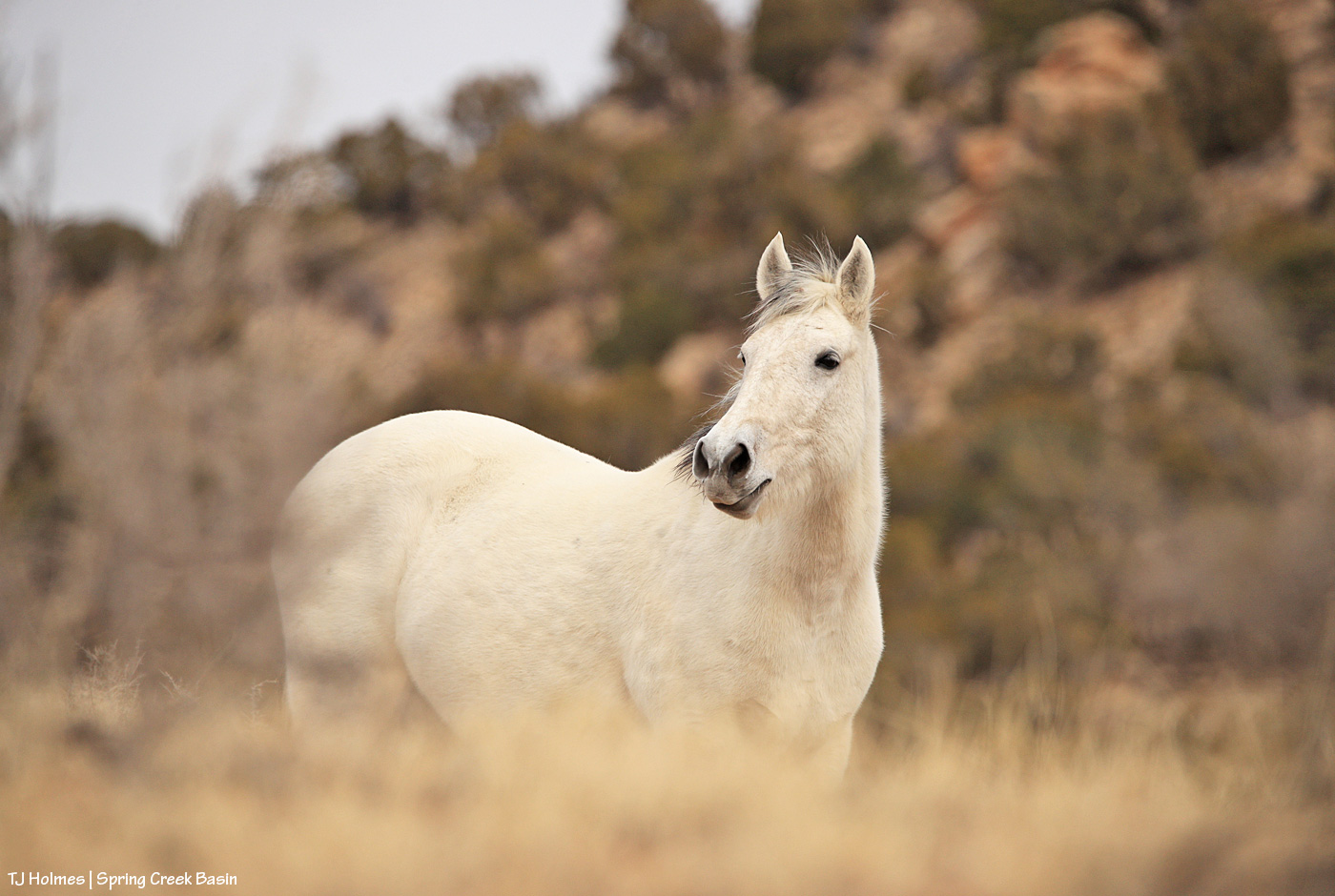
The horses of a band rarely get far enough away from each other to be out of sight, so you’ll rarely hear them whinnying for each other.
But it so happened the other day that while Madison and her band were grazing, about half the band meandered away from the other half in search of water, and they ended up not only fairly far away from each other but out of sight of each other. As it turned out, the bachelor with them was upset about the separation, so he stood between them, where *he* could see each group, and started whinnying.
Eventually, Temple seemed to realize that she and two others were cut off from the others, and she couldn’t see them!
After a few calls back and forth (I’d love to be able to translate, but I imagine the conversation went something like this: “Where are you?” “We’re here!” “I don’t see you!” “I don’t see you, either!” “Come here!” “You come here!”), Temple and her pals (which included the band stallion) joined their lieutenant and followed him to the rest of the band, where I later found them (after I visited with another nearby band), all together and content. 🙂


 Spring Creek Basin Mustangs
This is just so cool – the way mustang band members make an effort to stay in touch. And it’s interesting that those lieutenants really do have important “duties!” They’re not just a bunch of pretty faces. 🙂
Oh, yes, they are almost always aware of each other’s location(s). So I was surprised when, from the road, I saw about four of the band going to water … and not the others anywhere (because of trees and an arroyo)! It was an interesting dynamic, for sure! And ha! Yes, the lieutenants are very devoted to their families … as much as the band stallions, really! 🙂
It’s their behavior that I find most interesting and would like to understand better…
From the stud piles to band governance.
How and why do they do what they do?
Clearly we can learn from them.
Thanks!
P.S.-Yeah, the osprey are sitting on eggs.
Oh, I find their behavior *fascinating*! Always have. 🙂
The stud-pile ritual is quite interesting, and I love to have fun explaining it – and acting it out! – for visitors! It’s much funnier when I “act like a horse” than when the stallions do it, of course; they take it VERY seriously. Stud piles are not territory markings, as many people think (like with coyotes or wolves or other species); they’re an “I was here” signal that the other stallions read and recognize as easily as we read words on a page. I also see mares take an interest in manure piles (especially when isolated … maybe they already know who contributed to the piles?), and I see all the horses “track” with their noses. Did you know horses can be trained as scent-trackers? I find that amazing!
We can learn so very much from them, and I know you’re also a student of horses and other animals and all of nature. 🙂
So cool about the osprey on their nests! Exciting!!
I love your interpretation. I can hear it in my head just like that!😄
🙂 I try (really, I do!) to NOT anthropomorphize … but sometimes, you (I) really can’t help it. 🙂