The time has come (it’s past time, really) to go ahead and publish this post, which has been in draft form for a few months now.
The misinformation out there about fertility control – including PZP-22 and native PZP, often used interchangeably (though the base vaccine is the same) – is staggering and, given its potential value as an effective tool in the management of wild horses, horribly disturbing. I read something the other day that said PZP causes stallions to fight all the time over mares that are always in heat. I’ve also heard that because the mares continue to come into heat each month (that, in fact, is true – every 18 to 23 days with some seasonal irregularities), they are “continually raped” by stallions.
***Rape is a wholly human construct. Stallions do not rape mares.***
A mare’s “heat cycle” is her body’s indication that she is fertile and ready to be bred.
Rape is a terrible, terrible thing that is about domination. Please do not confuse the awfulness of a man overpowering a woman against her will with the natural cycle of procreation in a wildlife species.
This year, I witnessed an early-foaling (April) mare being bred in June. That means she missed (conceiving on) her foaling heat and the next month’s heat cycle and was bred (again, I assume) two months after she foaled. She has never been treated with fertility control. The stallion did chase her, and she did stand for him.
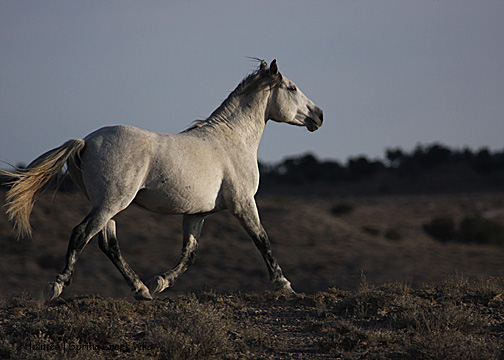
Alpha still apparently has not conceived, though she received a dose of PZP-22 in August 2007, and it had no effect on the other three surviving mares that received it then (and no, PZP-22 was NOT responsible for the two mares’ deaths). You might remember that Alpha foaled in late July 2008 – an event not connected to fertility control (neither PZP nor PZP-22 affects the fetus a mare may be carrying when she receives the vaccine). Why so late? Trouble conceiving? She is an older mare, though I’m unsure of her exact age. The fact that Storm was still nursing as of last fall means one of two things: She’s either not pregnant or she’s not enough pregnant to be ready to wean her big boy.
An older mare getting an extended break from the demands of carrying and caring for a foal is not a bad thing.
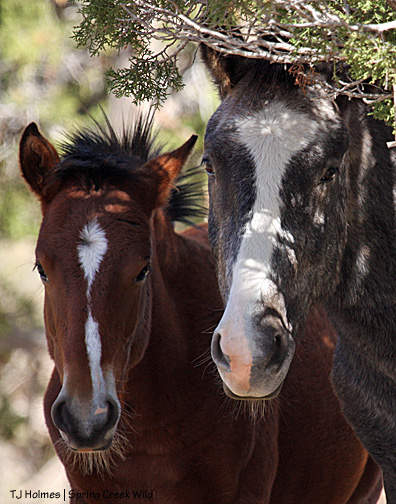
Mahogany, who lost her foal this spring, also is an older mare. She’s an older mare being courted by three young-ish bachelors, the youngest (I think) of which seems to have the highest “rank” and has claimed her. But that doesn’t stop them all from enjoying quiet moments together.

Mouse at left, Mahogany facing and Sundance behind her. Aspen, the third stallion, is definitely the low-rank stallion; he was just up the hill.
Mahogany is likely pregnant again – not cycling, to be blunt – but that doesn’t stop these bachelors from sticking close to her – watching her and each other for an opening. (Jan. 20 update – these four horses have finally apparently split from Steeldust’s band.) This is likely rank-related because Mahogany is, as I said, likely pregnant. Every now and then, there’s a scrap, quickly resolved, and sometimes, there are moments the stallions share like this:

… from a visit in September. Mouse, left, and Sundance. It’s just as sweet as it looks – no seconds-later sparring after this picture was taken.
So Mahogany, never treated with fertility control, has three boys vying for her “affection.” She lost a foal but was likely bred on her foaling heat and is most likely pregnant now with a foal due this spring – but healthy and doing well without a foal in the last year. Alpha, treated once with PZP-22 – and apparently not yet pregnant, so cycling every month, though she’s doing it so quietly I haven’t witnessed it – has one extremely devoted stallion, is in fantastic condition and has a big, ultra-stout colt who has gotten double the nutrition and attention from his alpha-mare dam.
Late births? Sure, we’ve had a few – treated AND UNtreated mares:
* Chipeta received PZP-22 in August 2007. She did not foal in 2008, likely because she was young and had not been bred or had not conceived in 2007. She has foaled July 26, 2009, and Sept. 1, 2010 (and why that difference?). Her 2009 foal, Joven, died at about 2 weeks.
*Kiowa received PZP-22 in August 2007, has foaled May 1, 2008; July 1, 2009; and June 28, 2010.
* Alpha received PZP-22 in August 2007, foaled July 25, 2008 (again, not influenced by fertility control). No foals since.
* Mona, treated with PZP-22 in October 2008, foaled in mid-September 2010.
* Raven, treated in October 2008 with PZP-22, foaled in April 2009, not in 2010 and looks pregnant for a foal this spring (though only she knows exact timing).
*Kootenai, treated in October 2008 with PZP-22, has not had a foal.
* Jif foaled Sept. 22, 2009 (never treated with fertility control), likely her first foal; she was not rounded up and had no foal with her post-roundup and no foal (or indication of pregnancy) in 2008. Jif lost her foal immediately or soon after birth in 2010, which would have been in August or September, as did three other mares in 2010 never treated with fertility control.
To continue something I can’t explain, three 2-year-olds have foaled (one lost the foal at birth), and two 3-year-olds (they’ll be 4 this year … I haven’t seen Reya for a while now, but Baylee still looks girlish slim) have not yet foaled. I wonder about it, but I can’t explain it. I wonder also about the overall health of the young mares and their foals vs. that of the mares foaling when they’re older, more mature, stronger.
Nature vs. fertility control? Neither PZP nor PZP-22 cause late births, though I do believe the timing of the application has much to do with it, whether caused by timing of roundups or delay because of legal action. Late births do occur naturally. Something I consider a very positive “pro” of native PZP over PZP-22 is that the remote field darting can coincide with the mares’ biology and is not dependent on human-timed roundups.
We have proposed a fertility control program here as is done in Little Book Cliffs, near Grand Junction, Colorado: With trained volunteer darters, using native (annual) PZP.
The benefits to the horses (individually and as a herd) are indisputable: Fewer births = slower herd population growth = less frequent roundups/disruptions of natural bonds. Mares are healthier, and apparently more attention is given to the foals they do have, which results in healthy(ier?) horses with a high(er?) level of herd knowledge.
The benefits to BLM are – true to form – in numbers: Huge cost savings because of fewer roundups. We think a fertility control program can reduce roundups from three per decade (2000, 2005, 2007 in the last decade) to one. Fewer horses in the adoption pipeline … fewer horses in long-term holding = major cost savings (truly, a benefit to American taxpayers). Overall, this savings numbers in the millions of dollars: Numbers I’ve seen (attributed to a BLM spokesman) are $100,000/day cost to care for horses in long-term holding and an average cost of $20,000 per horse over its lifetime in long-term holding.
Benefits to us who love these horses – to the horses themselves: Dare I say it, priceless.
Several factors make Spring Creek Basin perfect for this type of annual fertility control darting by volunteers: The herd is small (AML=35-65 horses). The herd management area is small (~22,000 acres). The horses are documented by yours truly, the benefits of which I realized shortly after our roundup when I witnessed the Little Book Cliffs roundup and soon after that met the director of the Pryor Mountain Wild Mustang Center (documentation in both herds has been ongoing for years). Our mares are approachable. Contrary to what some (BLM) folks say, visitors do not particularly enjoy the sight of mustangs running away in a cloud of dust a quarter of a mile away. We like to SEE our horses, being horses, grazing, napping, playing, sparring, grooming. This does not make them any less wild?! I don’t understand that argument. But to address it, another benefit to remote darting is that it eliminates the need to round up horses or trap horses or handle horses in order to treat them – hands-off management, which BLM espouses.
Do the horses start to realize what you – the darter – are up to? Of course they do – they’re wily wild! But here’s another misconception debunked: Annual darting of mares on Assateague Island (National Seashore, National Park Service) has been ongoing for 24 years now. Is it hard to dart those mares? They come right up to the tourists, right? In fact, only about 5 percent of the horses are in tourist areas; those horses are the second hardest to dart – second to Little Book Cliffs horses (I have these facts from someone personally involved in the programs of both places). Thought those mustangs were “tame,” too, did you?
Do they become impossible to dart? Twenty-four years (this year) of successful annual darting on Assateague and close to a decade at Little Book Cliffs would seem to prove otherwise, eh?
I am not in any way advocating sterilization. In fact, I am absolutely against sterilization – gelding or otherwise. And I’ll note here that – according to the more than two decades of research on this issue – six or seven consecutive years of PZP application has been found to render mares permanently infertile. Look at that in practical terms. I do not advocate sterility of healthy, mature mares in the prime of life … But neither would I have minded mares like Ceal and Molly NOT leaving orphans because they had foals right up to the years they died. And I would not have minded seeing a mare like Bones, with her healed fractured pelvis, not able to have foals (which killed her – and her foal) but quite able to enjoy wild life with her stallions as long as possible.
What I am FOR is mustangs, wild, on their home ranges, without disruption, longer. I hate roundups – I had a very physical reaction at our roundup in 2007, and to say I am not looking forward to the roundup this fall is the understatement of the eon. BUT – I would rather see healthy horses, able to withstand the helicopter’s assault, brought in than horses in lesser condition. Our horses in 2007 were not quite skinny … but where’s the line? They were definitely lean, on the edge. The population was way over AML, probably between 110 and 120. The basin is fenced or cut off by insurmountable natural boundaries. The amount of forage is limited; the amount of water, even more so. The quality of water is terrible – alkaline with a higher salt content than is considered acceptable for livestock. Cattle graze on the area only from December through February – only when there’s snow – fresh water in frozen form. Coincidence? I doubt it.
I would rather healthy horses be rounded up than horses in less-than-good condition – because I know the future. I will never advocate that “nature take its course” within the confines of human management: fences. “Free-roaming” isn’t, quite.
Here, our group(s) – Colorado chapter of the National Mustang Association, and as representatives to Disappointment Wild Bunch Partners, which also includes representatives of Four Corners Back Country Horsemen, Mesa Verde Back Country Horsemen and San Juan Mountains Association (though SJMA is not an advocate organization) – advocates for BLM’s spoken goals – protecting and managing wild horses in balance with their range – and we are working to provide local BLM with the information to achieve those goals.

This is a big, complex issue, and I can’t possibly cover it all in this post. I hope I’ve given it a broad enough brush to spur thought. We don’t want people protesting our roundup. This year – every year – we want smart management choices to be made on behalf of our mustangs. Sixty of 90 horses to be rounded up are slated for removal. If not next year, 90 of 120 to be removed? Healthy horses or not-so-healthy horses?
I am speaking strictly for Spring Creek Basin, where I know the horses and I know the range. Horses on other ranges – their numbers, conditions, range and water conditions – are not my expertise.
One thing readers should know about me if you haven’t learned it by now: The mustangs of Spring Creek Basin are my No. 1 priority. Period. I will do all I can, as long as I can, for their continued well-being and natural, long, wild lives – and I expect that to be a very long time indeed. And I hope what we do here, following precedent set in a handful of other herd areas, will become, in turn, part of that model for more herd areas to follow. Time, data, experience, success. BLM cannot continue on its current unsustainable course.
Another post I read recently has it right: These horses belong to US, not to BLM. But BLM is charged with management of wild horse herds on BLM lands, in addition to other charges regarding other resources. We have the opportunity to advise BLM in the horses’ best management (another benefit of this herd management area, where I know the horses best), but it has to be smart. BLM must be willing to take responsibility and completely overhaul its management practices. I believe that includes fertility control – not starvation – and not continued reaction to “excess” horses instead of managing from the front end – mares get pregnant, have foals, population grows, population outgrows finite resources.
If this post starts the wheels turning, it has accomplished my goal. I cannot recommend highly enough or often enough that you read this series, put together by Matt Dillon, director of the Pryor Mountain Wild Mustang Center: http://pryorwild.wordpress.com/category/pzp/
I didn’t intend to get so heavy with this post, thinking “love triangle” was a cute way to illustrate the picture of Mahogany with her boys and bring up – and debunk – misconceptions about PZP at the same time. But we’re all locked in a love-hate triangle: wild horses, advocates, BLM. Wild life is messy, not all advocates agree with all other advocates, BLM itself is a dysfunctional agency, I believe, but I also believe there are some good people within its ranks. One cannot paint all herd areas with the same broad strokes, nor all herds, nor all advocates, nor all BLM employees.

In principle, I can agree with this, from the American Wild Horse Preservation Campaign:
The AWHPC Coalition is calling on Congress to reform the government’s wild horse management program and organizing a grassroots campaign in support of:
- A suspension of roundups in all but verifiable emergency situations while the entire BLM wild horse program undergoes objective and scientific review;
- Higher Appropriate Management Levels (AML) for wild horses on those rangelands designated for them;
- Implementation of in-the-wild management, which would keep wild horses on the range and save taxpayers millions annually by avoiding the mass removal and stockpiling wild horses in government holding facilities.
In actual practice, however, stopping or postponing a roundup here could hasten a likely emergency situation in the future. No roundup now, when horses are healthy and not overburdening their food and water resources, also would have the effect of delaying the “legalities” of implementing a fertility control program in Spring Creek Basin as soon as possible (completing a five-year environmental assessment in accordance with the National Environmental Policy Act).
Also, I would substitute “accurate” appropriate management levels where it says “higher” appropriate management levels, using best science and giving wild horses priority on their designated ranges, herd areas and herd management areas, hoping that, in many of these very large areas, higher AMLs would, indeed, be accurate and appropriate.
I wholly support the third premise.
*****
Education may not be part of BLM’s mission. It is part of mine. As someone who spends part of almost every week of the year with these horses, I feel pretty strongly that my opinion and long-term, on-the-ground, in-the-wild observations count for something that can and should be of benefit to the eternal preservation of our wild horses. “In wildness is the preservation of the world” … and our mustangs.

Some PZP resources:
* Excellent series about fertility control: http://pryorwild.wordpress.com/category/pzp/ (click through “Older Entries” to get to the beginning)
* Q&A: http://pryorwild.files.wordpress.com/2010/08/pzp-qa-third-edition-june-1-2010.pdf
Video with Dr. Jay Kirkpatrick, director of the Science and Conservation Center: http://www.mywyoming.org/video/1y8d9ofce8 (it’s long but well worth the information)

I want to leave you with some things to consider:
People hate roundups because they cause such trauma and social upheaval, yet when it comes to fertility control, they seem to completely forget and/or overlook roundups/removals as a cause of any “social unrest” or that fertility control can provide a much better alternative. WHY?? (Predation is a major “if” that has a lot to do with culture and politics, and starvation makes me sick.)
When you ask for facts about PZP/PZP-22 – as well you should! – don’t forget to ask the same questions of the alternative! The alternative to fertility control is, of course, roundups and removals. Consider these factors:
Genetic: Removals are more damaging to the genetic pool of a herd than anything else. The horses most likely to be removed are the younger horses, those considered most “adoptable.” Those horses will NEVER have the opportunity to contribute their genetics. PZP/PZP-22 is reversible. Every horse gets the chance to contribute to the genetic resources of the herd. Now, I expect that rounds and removals will continue to happen, though hopefully the interval will be greater. Unless BLM takes the intense approach Assateague has (and I don’t really see that), some roundups (though we hope bait trapping rather than helicopters will become the norm) and removals will need to happen. Fertility control is not a perfect panacea … but in a fenced pasture – no matter how large – allowing constant breeding makes BLM the most irresponsible horse breeder in the country, even as it is the country’s largest landowner.
Social: Removals, it should go without saying, also are devastating to this intensely familial-bonded species. Slower population growth, effected by fertility control, prevents frequent widespread removals and severing of social/familial bonds. Is witnessed “social unrest” after roundups due to PZP/PZP-22??? Or is it due to removals of sires, dams, siblings, band stallions, mares …???
Economic: I just heard that 40 percent of BLM’s budget goes to the Wild Horse & Burro Program. I’ve read that 75 percent of the Wild Horse & Burro Program’s budget is for roundups and holding. Someone help me with an actual dollar figure per year? Millions. The cost of native PZP is $25 per dose, $1 per dose of adjuvant, $2.15 for the dart = less than $30 per mare per year. Volunteer darters provide intimate knowledge of their horses and free labor. If we can dart 10 mares per year here, that’s $300. ‘Nuff said?
Doing this post has worried me more because of what I’m afraid I’ve inadvertently left out in my explanation or details I’ve been obliged to leave out because of length rather than what I’ve included. Please do ask questions! Please do consult experts! My constant disclaimer is that I am NOT an expert, though I feel beyond fortunate to have mentors such as Dr. Jay Kirkpatrick who IS probably the world’s foremost expert on PZP.
Again, much information is here: http://pryorwild.wordpress.com/category/pzp/
More is coming in this vein …


 Spring Creek Basin Mustangs
Outstanding post TJ. Very nicely done and you know that I totally agree with you . Keep up the good work
Because you strive to know these horses and have been out there now a few years, your opinion is invaluable. Thanks for your Continuing effort to inform and draw in the public and advocates to understanding the peculiarities of the Spring Creek Basin horses. Every herd has to be understood and getting people to become the guardians and admirers on remote HMAs is a challenge. There are hopes that of groups formed people will be able to do this. Keeping wild horses on their own lands would be best and many of us will keep working to that end… as well as saving genetic diversity from removed herds. This is a huge undertaking and one day improvements may be the new norm…. I sure hope so. This is a lifetime of work and beyond, generational. We need to keep those growing up interested in what is wild so
we will always have guardians and admirers watching. mar
That’s a lot of information, TJ–it’s something you’ve studied and know a lot about, and I agree with you. I don’t know of better answers anywhere. I would love to see all Mustangs left on the range–never separated from families–able to sustain themselves and never rounded up. The only way that can ever happen is if the PZP program works. I wish everyone who loves Mustangs would get behind it and help it work.
Thank you all for your support. I can’t tell you how much I appreciate it on behalf of the horses …
Pryor Mountain now has a good fertility control EA, and McCullough Peaks’ fertility control EA (http://www.blm.gov/pgdata/etc/medialib/blm/wy/information/NEPA/cyfodocs/mcculloughpeakhma.Par.0515.File.dat/2011_ea_fonsi.pdf) needs comments. I’ll be doing a post to encourage people to comment – positively! – next. I’ve also created a “brochure” with some information about PZP. My plan is to print it for distribution at our educational programs around the region this year, and I need to tweak it a little for publication here on the blog. But I’ll do that soon, too.
TJ, thanks as always for your photos of these special horses. I get a knot in my stomach knowing 60 will be removed in September!
And I appreciate the PZP info and your perspective. It’ll take time to go through all the links, but I agree that, short of returning acreage “where wild horses and burros were known to roam”, fertility control is the best method going forward. I hate to ask, but have you approximated a mortality rate?
Sure would like to see detailed maps of the original “known to roam” areas. From looking at the current HMA/HA maps, when they were divied, the best acres were given to Homo sapiens, while the wild equids got the acres with the worst forage, water, and the most difficult terrain. Yet they adapted and thrived!
Now Homo sapiens have identified lucrative assets (more so than grazing!) on most of the HMAs, and are contriving ways to remove all but the bare minimum of “inconvenient” animals (to satisfy the BLM mandated to “manage and protect”) in favor of extraction.
BTW, if you didn’t see the recent Denver Post article, Disappontment Valley is targeted for Selenium exploration and extraction. I don’t know if this will impact the Spring Creek area.
http://www.denverpost.com/news/ci_17109238
This is some info about Selenium deposits in Colorado and A FEW of it’s uses:
“Soils that formed primarily on Mancos shale are found in the areas northwest of Rangley, east of Meeker, in the Grand Valley, in Dry Creek Basin and Disappointment Valley southwest of the Uncompahgre Plateau, and in southwest Colorado near the Mancos River. The Mancos shale basins have the potential for high selenium levels, a particular problem in areas with irrigated agriculture. ” (It’s somewhat radioactive and pollutes water.)
Among its uses: “Selenium exhibits both photovoltaic action, where light is converted directly into electricity, and photoconductive action, where the electrical resistance decreases with increased illumination. These properties make selenium useful in the production of photocells and exposure meters for photographic use, as well as solar cells. Selenium is also able to convert a.c. electricity to d.c., and is extensively used in rectifiers. Below its melting point, selenium is a p-type semiconductor and has many uses in electronic and solid-state applications.”
I often ask myself if there’s anywhere the wild ones can be truly safe. I don’t like the answer.
Linda – You have knots … I can’t even come up with a name for what I have … One reason for our educational programs this year will be to drum up support for the adoption … As for mortality, I have exact numbers on mortality since September 2007. We’ve lost three mares (two elders, one from foaling complications) and seven foals, from birth to about 2 months old (except for Bones’ foal, causes all unknown). Thanks for that link – I will check it out, too. I haven’t heard about selenium, but uranium claim stakes were placed (by people illegally driving off-road on ATVs) in spring 2008. I don’t know what’s happened with that. There’s also and/or has been natural gas exploration, which hasn’t proved very successful, from what I’ve heard. Also tend to agree with your assessment of wild horses being relegated to “unproductive” lands … the parallels with the U.S. government’s treatment of Native American tribes is uncanny …
TJ, I know my feelings are infinitesimal compared to yours. But from the first time read your blog and saw photos of these beautiful wild horses, each with its unique personality, I became invested in their welfare and futures.
Please let me know if there’s anything I can do to help spread the word in the Farmington area.
No, no, I didn’t mean that in an negative way … just that … well, I keep trying to focus on things I can change/help/better … It’s gonna be really tough. 😦
We are planning to include Farmington in our series. I’ll get with you about venues/group meetings or other details. And thank you!
Thank you for the detailed information and your personal grasp on what is happening with this herd. I am glad you spend so much time with them and that has translated into such valuable field research. I enjoyed the brief time I spent with them last summer. Please let me know if I can help.
What I’ve learned would not be possible without the research previously done and the in-the-field darting and documentation by people who have been an inspiration to me, including Billie Hutchings and Marty Felix (Little Book Cliffs), Matt Dillon (Pryor Mountain), Dr. Jay Kirkpatrick and Dr. Patricia Fazio, as well as local folks who have been advocating on behalf of the Spring Creek Basin mustangs for nearly 15 years. I do hope to contribute to the knowledge available, as they’ve made it so available to me. Thank you for your continuing support!
I just finished reading most of the whole post, skimming over the parts that are just links. It was very informative, even though I didn’t completely understand all of it. Thanks for showing us all of that, and including a few photos too! From reading this, and other posts and websites I do agree with you. I think that PZP could be very useful and helpful, so long as the BLM uses it the right way.
My question: How long does PZP last for? PZP-22?
I agree, and I think “the right way” should be determined by the horses, with modifications made depending on their reactions and behavior and the vaccine’s efficacy here. Native PZP is given first as a primer dose, then as a booster, and it lasts one year – given annually. (If BLM implements the program here, mares will get the primer this fall, then the booster in the spring of 2012, before they start foaling, with the expectation that about 90 percent of the mares given the booster will NOT foal in 2013.) PZP-22 is supposed to last 22 months – two gestation periods (a mare’s gestation is about 11 months). I can’t really comment from personal experience on that because in our seven mares (including Molly, who died in the fall of 2009), we’ve had widely varying results, which include not working at all to preventing a foal from one mare given PZP-22 in August 2007 (elder Alpha, who had Storm in July 2008, not affected by PZP-22).
[…] So, if this is the case, it seems to me that the least invasive and more humane management program is field darting. If successful, (dare we dream) helicopter roundups may eventually become unnecessary for this HMA. And should the horse population exceed the AML at some point, bait trapping for adoptable candidates could be employed. To me, this is a much better alternative to the ripping apart of family bands as they try to escape a helicopter and the indiscriminate removal of unadoptable, long-term holding bound, sale authority aged horses – the leaders and teachers of the young. Just some food for thought. I encourage everyone to do their own research into the issue. Here is a link to another post about PZP that offers even more information: https://springcreekwild.wordpress.com/2011/01/30/love-triangle/ […]
Well, TJ, you know how we feel about your work and we will continue to support you for years and years into the future! This is a GREAT post and will go far to help educate folks about the realities facing Spring Creek. We’ve been to SC enough and have seen enough to know the situation. The PZP program you’ve developed for use there is absolutely necessary to avoid a population that will outstrip available resources faster than most folks might think. You’re to be admired for spending, literally, nearly every waking moment of your life for the last several years to helping the horses of Spring Creek Basin!! Let us know what we can do and it will be done!! Again, GREAT JOB!!!!!!
I disagree with you TJ on your herd size by keeping the numbers down below what has been noted in several peer reviewed scientific papers. One most noted study by Gus Cothrans, makes note: Dr. Cothran suggests that managing wild horses at low population levels leaves them vulnerable to a long range loss of genetic diversity. This is the same sort of problem which plagues endangered species around the world. But, just how small is too small? At what point do wild horse populations suffer the risk of irreparable genetic damage?
Based on his DNA analysis, Dr. Cothran now believes that the minimum wild horse and burro herd size is 150-200 animals. Within a herd this large, about 100 animals will be of breeding age. Of those 100, approximately 50 horses would comprise the genetic effective population size. These are the animals actually contributing their genes to the next generation. Dr. Cothran has stated that 50 is a minimum number. A higher number would decrease the chances for inbreeding.
As well, my personal opinion is that PZP is an option……. but not the answer either. To improve water sources places around the HMA to expand the range, and at least some range improvements or just “plain ole work from the BLM employees!!? Roundups isn’t a mangagement plan to include using PZP.
Yes, in the literature there is strong evidence of “social disruption” does exist but one needs to read the studies and ask the questions.
As noted in what is known as a code of conduct with the BLM, and are obligated by a Federal mandate to comply.
In an e-mail context word for word; Interior Secretary Gale A. Norton had announced the development of a scientific code of conduct for the Interior Department including the BLM, 2003. All of the scientific activities conducted or funded by the Department are covered by this definition. These involve inventory, monitoring, study, research, adaptive management or assessments that are conducted in a manner specified by standard protocols and procedures.
“It is vitally important that any organization that does as much scientific research and analysis as the Interior Department have a well-founded code of scientific conduct that governs the full range of scientific activities,”
Under the new federal policy, scientific misconduct includes both professional misconduct and research misconduct. Research misconduct is defined as fabrication, falsification, or plagiarism in proposing, performing, or reviewing research, or in reporting research results.
Fabrication is making up data or results and recording or reporting them. Falsification is manipulating research materials, equipment, or processes, or changing or omitting data or results such that the research is not accurately represented in the research record.
Spring Creek Basin, by its size and resources within that finite space, CANNOT support an unlimited number of – or even 150-200 – horses, which renders the rest of your complaint moot. At 150-200 or some other arbitrary number, sure, there would, in fact, be greater genetic diversity because of greater numbers of animals contributing to the gene pool – but at what cost? Dead because there’s not enough water and/or forage to support all those 150-200-??? horses that are now starving? Just spreading around water sources doesn’t equal more horses.
You may not be aware of the introductions of horses to Spring Creek Basin from Sand Wash Basin to aid genetics here. That will continue to happen. It will need to continue to happen because of the above-mentioned constraints.
The reality here is that, at 22,000 acres of desert scrub and not only limited but extremely poor quality water, Spring Creek Basin CANNOT SUPPORT a purely “genetically viable” population of animals. I will never advocate “let nature take its course” – aka starvation – on FENCED range the horses have no choice but to live on when we have within reasonable and realistic reach a good management tool in fertility control – PZP.
Yes, more widespread water sources would help – for increased quantity and availability of water, let alone dispersing the horses in their grazing patterns – and we’ve been preaching that for years – on mostly deaf ears. We continue anyway. We did get five ponds dug out in the last two years – BLM listened. We’d like to get another catchment (for which there is actually a signed (12 years ago) agreement) and some guzzlers. No luck there. We’re continuing to push it anyway.
What I see so much is people quoting theory and seeking pipe-dream “what ifs.” Reality is different, and it’s been hard as hell to get accomplished what we HAVE accomplished here (much before I ever came along). People who live elsewhere can get away with touting theory to other people who live elsewhere and don’t know any better. I live here. HERE where the horses are. I know better.
Disagree with me on herd size all you want from the Front Range. Then come here and let me show you reality – on the ground, here. I don’t disagree with Dr. Cothran (we’re both Aggies, after all). But that’s a perfect world. Spring Creek Basin ain’t perfect, but it’s beautiful, and our horses – at the current population – are thriving. Never since the last roundup (110-120 horses) have they been in such poor condition as they were before/during that roundup. And at various times before the 2007 roundup, they’ve apparently been in much, much worse condition – also with many, many more horses.
In a perfect world, theory might be fine. I live in the real world. And sometimes it sucks. We are trying to effect change within the realm of reality.
Mr. Golembeski – Sir, you know NOTHING until you’ve actually SEEN what the conditions are like in Spring Creek Basin, Colorado. I’ll be more than happy to pay your way out there so you can see for yourself. The real world is the most scientific teacher, real observations of specific places is the way to determine what is best for a specific herd. Even Dr. Cothran knows this. Let me know when you’d like to come out – we’ll figure out how to pay your way. I’d like to be there when you see it but, I know TJ will be happy to show you around.
Just as a P.S. Gale Norton is no longer the head of the Department of Interior. Perhaps we should consider dealing with those who are CURRENTLY in charge of this of the Department, as well as the BLM? Things are not necessarily as they were in 2003…
what a great valentine……………thank you
🙂