With the holidays fast approaching and my Christmas trip to Texas, I never stood a chance of posting some more pix from my last visit to the horses last year. Although it was a cloudy, grey day, I spent quite a bit of time with Chrome’s, Hollywood’s and Comanche’s bands – heaven. So I’m going to try to get some more photos up of various horses before I hopefully head out again this week for my first visit of 2011!
Something I’m tremendously excited about is a two-part visit, starting this week and ending next week, to a local elementary school to talk to three students for a project they’re doing about horses! I’m talking about wild horses – of course! They’ll learn more about horses from other people involved in different aspects, including a local equine rescue group, throughout the month. I’ve been speculating about ways to get local kids involved with our mustangs for a couple of years now, so I hope this is the start of something we can continue annually. Later in the spring, I’ll take the students out to Spring Creek Basin for an up-close look at OUR mustangs in the wild. I can’t wait to learn about the students and find out what they’re most interested in regarding horses. I bet they have some super questions!
I’m also excited about being a tour leader for the third year (stymied last year because of rain) to the Spring Creek Basin mustangs during the Ute Mountain Mesa Verde Birding Festival. The link is to last year’s information, but they should be updating it soon. My tour will be Thursday, May 12. If you’re local, sign up! I think the cost is about $60, and it includes travel, some birding along the way to the basin and back, and lunch. Hopefully the weather will cooperate this year! About a dozen people on the tour meet in Cortez and drive out to the basin, where I meet them, and we drive in to look for horses, talking about all kinds of things related to the horses along the way. The Forest Service, a partner in the festival, always has a couple of people along to answer questions about San Juan Public Lands. The year before rain put a damper (sorry) on our plans, we saw almost all the horses.
Our NMA/CO group also plans to do some educational presentations around the region this year. I’ll have more information as we make those plans.
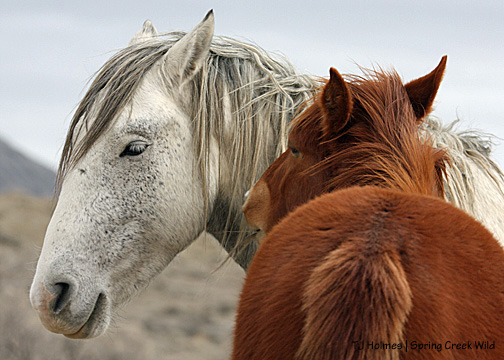
Chrome and Hayden
Now for some heavy stuff. This year, Spring Creek Basin will see another roundup. It’s on the BLM schedule for Sept. 17-21. It hasn’t taken that long in the past, but I plan to be there for every day of it this year, and my fervent hope is that BLM will give the go-ahead for a fertility control program using native (annual) PZP and volunteer darters. We (NMA/CO) have been encouraging fertility control since the last roundup, and we made a formal proposal last year to use PZP (not PZP-22) and volunteer darters. In light of that, with my growing feeling of responsibility to provide as much information as I can as I learn and observe, I will be writing some posts this year that I hope are, in fact, educational and informative. My opinion (and it is an opinion) varies a bit from some of the “mainstream advocacy groups.” I do HATE roundups, but I DO support fertility control, and I do NOT support “let nature take its course,” aka starvation, and even with fertility control, I foresee roundups (we hope for bait trapping over helicopters) in the future, hopefully lessened.

Chrome and Rio
The horses are in great shape. Five water holes have been dug out in the last two years. We got rain last summer (a lot of rain).
Do I want to stop the roundup? No.
Yes, we will say goodbye to many horses this fall. Will it break my heart? It has been breaking a little every day for the last few years in anticipation.
Does this seem contradictory?
The basin is fenced. It is finite. It cannot support an infinite number of horses. I would rather see fewer horses removed WHILE THEY ARE HEALTHY than many, many horses removed in the very lean condition they were in during the 2007 roundup and before the basin’s grazing and water resources are so taxed. And I want to see fertility control started as soon as possible … so that the next roundup may be years and years and years away. And it is also my hope that by saving such an incredible amount of money by reducing the frequency of roundups, as well as fewer Spring Creek Basin horses going to interminably long-term holding, we might set BLM’s sights on bait trapping – rather than helicopter-driven roundups – in the future.
Could we stop roundups altogether? I’m sure we could. Assateague Island did it. But I’m not sure we’re ready to go there just yet. That is a very intensive program – of necessity.

Chrome and Hayden and Rio
Linda on her Beautiful Mustang blog asked me a great series of questions about PZP, and has posted some of my answers, along with photos. Linda adopted a beautiful filly born in 2007 from Beatty’s Butte, Ore., and named her Beautiful Girl. And is she beautiful! (Really, she’s gorgeous!) More answers and photos to come. I’m really grateful to her for giving me another venue. My disclaimer: I am certified to handle and mix PZP and to dart, but I do NOT consider myself an expert. So I continue to read all I can and talk to people who ARE experts.
It was never my intention to use this blog as a political platform, rather I want it to be about the HORSES. Mustangs are an incredibly emotionally charged subject – and rightly so. I still don’t intend this blog to be political. Rather, I’d like it to be educational – both about the horses themselves and what they do for us – emotionally and otherwise – and what we can do for them. I want to encourage discussion and questions and come up with answers. As stated above, I don’t have all the answers, and lots of people have been working on this longer than I have! But after all this time – this year will be the 40th anniversary of the Wild and Free-Roaming Horses and Burros Act – we have enough information *to* CHANGE.

Chrome
I highly recommend at least these books:
Wild Horse Annie and the Last of the Mustangs by David Cruise and Alison Griffiths
Mustang: The Saga of the Wild Horse in the American West by Deanne Stillman
America’s Last Wild Horses by Hope Ryden
Please recommend others, if you like, but I found these books to tell an amazing and not always happy history of horses and humankind. I read Mustang first, about two years ago; it was published in 2008 . Last winter, I read America’s Last Wild Horses for the first time, first published in 1970, and I was struck by one major thought: Nothing has changed. I read Wild Horse Annie right after Christmas, and I thought again: Why has nothing changed? It’s not for lack of letters. Not for lack of schoolchildren – and adults – writing and writing and writing, talking and cajoling and pleading and demanding and insisting that wild horses be protected and managed in the wild.
Why has nothing changed?!

Hayden
I don’t know, but I share the conviction of many, many people that it has to and will.
I joined this fight – and it obviously is one – just a few years ago. I know people who have been fighting for 30 years. Best science is available, and many people are willing to carry it out for the benefit of our mustangs.

Rio
On my little blog, I’ll put out my opinion (what a scary proposition) and try to be a little more detailed about what we’re trying to do in our little corner of the wild horse world. And I’ll always – always – keep it about the horses.

Rio, Two Boots and Jif


 Spring Creek Basin Mustangs
TJ, You are doing a fine job of educating many and drawing people to wild these horses. You have my deepest respect. What you have proposed is reasonable and Should be acceptable. Why has nothing changed?? Those in control are the same in background and experience and they look at all of ‘us’ as if we were from the moon. But we are their friends and family and neighbors and they have never stopped all this removal and stockpiling of wild ones long enough to realize this and to see we all want to help. We are willing to do so much and make change. This comes from a reasonable stance. We are not from the moon… mar
Why not ask that PZP be administered by dart–circumvent roundups in the future? Also, no PZP to mares younger than 3 years old. When young ones are darted, they are more prone to permanent sterilization, and it encourages more social unrest among the bands when darted mares cycle continuously. Work to get removed horses adopted there–instead of transporting them to CC. If you need help in promoting adoption if BLM is willing to do it there, many of us are out here that will help with promotion.
Mar – I agree … We have tools at our disposal, and we have the willingness to put forth our time and expertise.
Linda – I’m not sure there’s any proof of young mares being permanently sterilized by PZP. The only track to sterilization I’ve come across is long-term consecutive use of PZP (administered 6 or 7 years or more in a row). I’ll look into that closer because I want to start darting in the fall of fillies’ 2-year-old years to enable the fillies to grow up themselves before they start having babies (most of them will likely be pregnant already to have foals as 3-year-olds, but the alternative is to start them as long yearlings, and I don’t really want to do that). I don’t like seeing 2-year-olds having foals. They’re healthier, and so are their foals, when they’re older and bigger and stronger. Also, we have a few mares that have been given the PZP-22, and I just haven’t seen any atypical “social unrest,” even among the mares it has worked on (that are coming into heat every month). Another benefit I hope to see with reduced frequency of roundups is a higher demand locally for the horses that ARE removed, as you mentioned. Believe me, I’d love to see them adopted here and never go to Canon City or beyond! That’s part of what our regional education will address this year – would love to have you involved!
Ginger Kathrens has been monitoring the Pryor Herd since they began PZP-ing and she has documented several mares who have never foaled since being treated at less than 3 years. There is a study on the banks horses that suggests more social unrest–I’ll check on who did that.
I’ll definitely be happy to help as I’m sure more will that are around the state. I’ve already talked to Fran Ackley about not moving these CO horses, when we can promote and adopt them regionally. It seemed so senseless at the E. Douglas Roundup in the fall–we even had some folks lined up to take the lame foals.
I think there are some other things at work there (PM), but I’m not involved and don’t know the actual details. I think it would be better to ask that question of the people doing the darting or administering PZP or PZP-22 (both have been used on Pryor horses). And I’d rather see some increased band movement than whole bands removed. Would definitely like to work to increase the local adoption rate!
Many people who have been to roundups have felt compelled when they attended or were influenced by photos posted during the action to adopt horses being removed. This herd can likely find adopters quickly by putting photos up of horses to be removed or being removed. mar
There should be no roundups and/or PZP given until the herds of wild horses that are genetically viable and sustainable. This is not the case at present. Over 100 HMA’s have been zeroed out and most all AML’s are way too low. If the roundups with removals continue along with PZP and PZP-22 being given to returned mares soon most all herds will be extinct. I am surprised you do not realize this and suggest you visit http://www.americanherds.blogspot.com/and http://www.wildhorsepreservation.org . Also see the 2011 roundup schedule that is already in effect.
TJ,
This blog post shows why I so admire you. I feel the same way that you do, but I do not have the gift of writing as well as you do. So, just keep it up. I am behind you all the way!
TJ –
From ALL the many hours spent researching everything I could find on the subject of PZP, i.e. types, where and how used, results, etc., I believe exactly as you do. You have our complete support! I’m most especially interested in anything I can do to help with your efforts to assist youngsters in understanding THEIR world which should, hopefully, always include the wild ones.
After some 3 years of reading your posts, meeting you and the horses of SC, we’re completely confident in your professionalism and desire to “get this right.” If you need anything, you know how to find us!
L and K
Barbara – You may have noticed both those sites are listed under my blogroll. I’d like to point out that I am dealing with a specific herd and specific circumstances. What works for my herd may not work for all.
I am surprised by many things, not least that people continue to be confused about “genetic viability” and the realities of finite herd areas. What number indicates genetic viability? Based on the actual number, the Spring Creek Basin herd is only barely viable at the middle of the AML. Based on the number thrown out by some, it will never be viable – BUT THE SIZE OF SPRING CREEK BASIN HMA IS NOT LIKELY TO CHANGE. SCB simply cannot support the 150 or 200 or whatever number some people throw out as “genetically viable” (which is incorrect).
“Over 100 HMA’s have been zeroed out and most all AML’s are way too low.” The latter part of this statement may or may not be true (I think the AML is pretty close in Spring Creek Basin), but it’s moot to discuss that based on current reality.
To expand on my earlier comment, people who care about the horses ask about downsides of PZP and cite things like out-of-season births and “rape” and social unrest as deterrents … but what about the downsides of the current situation? What about the extreme social unrest caused by massive removals? Massive removals of genetic material? If you’re worried about genetic viability (and we all are), fertility control is a much better alternative than mass removal.
Is fertility control the perfect solution? Of course not. Neither are fenced (they are not free-roaming) herds. Free-roaming will never be, ever again. And so I absolutely will advocate fertility control in FENCED herd management areas. I would rather see mares coming into heat every month than those mares and their offspring and siblings and other horses removed every couple of years and subject frequently to that trauma!
You are correct that viability and a sustainable management plan are necessary. Fertility control reduces roundups and removals, gives more horses more opportunity to contribute their genetics (rather than young horses never contributing – and I’ll expand on this more in a later post), and a stable population on ranges is better for the forage and water resources than the yo-yo effect on what is often poor range in the first place.
Stopping roundups is not the answer in Spring Creek Basin (my area of observation, if not expertise). If we wait for perfect circumstances, I think we’ll continue to see no change. Neither PZP nor PZP-22 is a sterilization vaccine, though if given more than seven years in a row, PZP can cause sterility. That’s not the objective. It is given to slow population growth, not stop it.
Thanks, Billie! I’m where I am because of you and Marty and others! Keep up your great work – I’m following in your footsteps!
Lynn & Kathy – Thank you two (three, really), too. Your support is awesome! 🙂
I’m sorry I got to this discussion so late. For anyone who dislikes PZP, I would direct them to the Summit of the Horse being held this week in Las Vegas. Guess what is back on the table? Slaughter. Some are proposing to open up slaughter houses on tribal lands. The problem with overpopulation is a serious one. They are going to keep doing roundups and putting horses in long-term holding unless there’s a solution on the front-end–like contraception.
Personally, I think anyone who loves America’s wild horses should be looking for a humane compromise to what is quickly heating up into a major heart-breaker. PZP is the absolute BEST solution I have read about. If anyone knows of another, PLEASE speak up. Doing nothing, however, will not appease the growing chorus of citizens unhappy with the overpopulation.
Please check out this link to the summit.
http://www.united-horsemen.org/summit-of-the-horse/
Thanks, TJ, for giving us your first-hand input and for attempting to get the word out about PZP.
Please remember that PZP-22 is an experimental drug that is being used on our wild horses- experimentally. Native annual PZP has a strong history of success. This is the drug to use… but BLM has not got the field personnel to do surveys or to dart horses every year… they have admitted this in a report. The herds all need dedicated people like TJ to come forward and volunteer to administer PZP by dart each year and to begin a selection process that will allow individuals to contribute to the gene pool while keeping the population in check. mar
There is no research completed yet on PZP22. HSUS is working on that now in a 3-herd study. So the jury is still out.
What’s the third herd? I know about Sand Wash Basin and Cedar Mountains.
I agree–it appears from what I’ve read and heard so far, until we get a better long-term contraceptive, PZP will have to be administered annually and it is not cost-effective for the BLM to do it, especially on these vast western rangelands. It will take volunteers–but maybe this is just the thing to get people to step up and help. A lot of people want to help, but don’t know where to start.
True … I get asked a lot “How do I help?” I’m never sure about the right answer – or most complete – answer. I’d like some help with that question as well!
Linda – Well said and timely. For more information about who’s behind that “Summit of the Horse,” check out this link, too: http://www.animallawcoalition.com/horse-slaughter/article/1486. And thanks, Linda, for helping with that word! 🙂
Mar – Also well said, but keep in mind, too, that PZP is classified “experimental” by FDA … and that hundreds of thousands of people take “experimental” drugs every day (just pointing out something that is often used negatively in reference to PZP). As effective and safe and cost-effective as native PZP is, BLM continues to look for multi-year applications, and researchers continue to work toward that end – to address those very things you mentioned – and the HSUS PZP-22 studies are helping with that knowledge. At this point, we need BLM to listen to the dedicated volunteers as well as we need the volunteers. 🙂 It’s happening some places … Something to keep in mind about the selection process – it needs to be random, and it needs to include all – at different times. Color, pretty faces, etc., are human selections, not necessary for survival. Bottom line, all the horses need to be allowed to make their genetic contribution – that’s what contributes to viability. The roundup/removal option currently in use is the single worst thing to do for a wild herd because some horses – the young ones – never get that chance.
Well, discussions are good for all of us. I just wonderif all know our spring Creek Herd and the parameters we have to deal with to keep This herd healthy, fed and watered year to year. TJ, have certainly worked hard to study, learn, support this herd for now and the future. It has not been easy but the work continues. I am looking forward to 2011 as the year the Wild Bunch Partners can make progress for the better of the herd. I do not, by any means, feel we have failed to support the horses but that we are known and heard on levels we may not always understand. We must “keep the faith” and continue to do the work, I think. TJ, your work keeps me interested and going to work for the future of the horses.
Also, BLM has been repeatedly accused of giving PZP-22 to yearling fillies. These have been unable to reproduce… I do not have documentation. BLM has also been accused of giving larger than recommended doses of PZP-22. This is from people present at roundups who have heard what was being said about applications. Because of their track record I do not think this is untrue. mar
Yes, BLM was very proud of their PZP darting at the Pryor roundup. When my husband and I went to the pens before the Pryor adoption, the BLM person there bragged to us that they shot enough PZP into the young fillies that they would never reproduce. So you see why I have concern. The Pryor herd is not technically in the HSUS study, but they administered PZP-22 at the last roundup and it is being documented carefully. So technically, the SWB and CM I would encourage you to call Ginger and talk to her about this. She would welcome your call, I’m sure.
I realize that there are few alternatives on the table, but I don’t know that PZP is the end-all either.
Mar – I also have suspicions about the PZP-22 given at our last roundup … I’m going to check into the PZP-young fillies question.
Pat – It has been a long road, hasn’t it? I do think we’ve made an impact and look forward to continuing our work. You and Frank have been advocates of the Spring Creek Basin herd for a long time! I hope the annual wild horse counts by the Four Corners Back Country Horsemen continue long into the future!
Is it possible for Chrome’s, Hollywood’s, etc’s band or band members to b removed? That would be awful!
Linda – One thing I’m trying to be very careful of is distinguishing between PZP and PZP-22. They are not interchangeable terms and are not the same vaccine. Right now, as far as I know, PZP-22 must be administered by hand, not remote darting. I do see your concern from that comment (I was also at the Pryor Mountain adoption). Horses there were darted with native PZP last spring, and that’s what’s being proposed currently. As I keep saying, PZP is not perfect, but as I see it, it’s the best of the alternatives: roundup/remove or “let nature take its course.” And in current reality, I see it as a significant benefit.
VC – Yes, it’s possible for probably any horse to be removed except the mares (and Corona) introduced from Sand Wash Basin. I hope it’s not too wishful thinking to say I hope BLM honors its previous statements that I will be able to give input in that area … Something I’m not looking forward to but would rather do than leave to BLM only.
Very nice blog with great photos, particularly of the red horse, Hayden. I would like to invite you to visit my blog, From Western Colorado (http://amyhm.wordpress.com). I examined wild horse management as my graduate thesis project (still finishing it up) and there are many posts about WHB. A recent guest post by Scott Thompson is about the Spring Creek herd. I also posted a short video of two horses we saw out there last summer., upon which his story is based. Perhaps one was Chrome?
I also just finished a documentary about census that is the most recent post. I hope you will take some time to read and listen. Thanks. Amy Hadden Marsh
I went to a presentation in Denver last summer by Heidi Hopkins, from HSUS where she spent the evening discussing PZP-12 & 22. There were lots of questions afterwards, and I took lots of notes. She admitted that one down side is that there are out season births when it is administered at the wrong time. I have since talked to her about some lingering questions that I had. 12 month and 22 month are the same infertility agent. The 22 month contains the 12 month agent and also a large pellet that encases the second year treatment. The 12 month quickly dissolves and works the same for the first year, but the second dose for the subsequent year is the larger pellet and dissolves more slowly–thus lasting the second year. HSUS is experimenting on darting PZP-22 now–they had to find a different vehicle (gun) to handle the larger pellet. And I believe that Nancy said they used that at Sand Wash this fall. I checked with Makendra, and she agreed with my memory that they administered PZP 22 to the mares at the Pryor roundup. They treated the mares that escaped the 2009 roundup this past year with PZP-12 so they’ll be on the same schedule in 2011. Several of us from northern CO met with USGS in Ft. Collins last spring to understand this in more depth, as they did the original PZP research for BLM at PM, McP, and LBC. I’ve learned more about equine reproduction in the past year than I would ever have imagined (especially having been an English major). But I love this chance to discuss and explore all the possibilities with everyone: the positives, and the negatives. That is what is needed for all management of all the horses. Yes, check out Amy’s documentary–extremely well-done.
Linda – Heidi was in my training class at the Science and Conservation Center last summer. Thank you for the clarification on PZP-22. I knew they wanted to make a pellet that could be fired remotely, but I wasn’t sure they were using it yet. Apparently, that window of efficacy is very narrow. “Out-of-season births” also occur naturally – we’ve had a couple in Spring Creek Basin. It’s a myth that PZP *causes* out-of-season births, though I do believe timing is crucial and is another reason why I favor native PZP over PZP-22 – no roundups necessary, so it can be given when best for the mares, not humans. Also, legal action in the past has delayed some past treatment of PM horses. I don’t believe native PZP was administered last spring simply “to be on the same schedule in 2011.” What I’ve heard from Heidi is that best efficacy for PZP-22 comes from winter applications; the PZP-22 given to SWB mares in October 2008 was apparently not as effective as PZP-22 given to Cedar Mtns mares in December 2008. … As far as young fillies being unable to conceive after being treated with PZP, I found my notes from Dr. Jay Kirkpatrick, “The contention that mares not producing foals at a younger age will have more trouble conceiving at a later age (after receiving PZP) has absolutely no empirical data to support it.” I’m unclear about exact “younger age.” But another advantage of PZP (and PZP-22): It is reversible. I’m also very glad for these discussions. It helps me organize my thoughts better (OK, maybe not so much?!), and we need informed input to effect change!
Amy – Your census documentary is fantastic! It raises lots of good points. Interesting to hear Fran Ackley acknowledge my documentation of the horses along with Little Book Cliffs – which is one of my major inspirations, along with Pryor Mountain. 🙂 I’ve talked to him a couple of times and have found him reasonable. It was great to read the guest post about your visit with friends to the horses last summer. I think the horses in your video clip are Seven and his yearling (2 this spring) colt, Ze. I’ll add your blog to my blog roll so people can read more about your insights into wild horse management, and I’d like to refer to it in a separate post so people don’t miss it – thanks so much for posting!
Bravo TJ! I feel exactly as you do and believe that a similar plan would work well for managing “my” ponies also!
I concur that out of season births do occur naturally. In 2009 we had a mare that foaled the last week of September at Grayson Highlands. It’s unfortunate, but it does happen and without the presence of PZP or other forms of birth control.
WELL DONE, WELL DONE!!!
L, K and M
i am really sad to hear that it has to happen this year but we all know it has to. i will for surley be there for it as well. i wish i could take one home and complete my dream but i know i cant. i dont have a place other than the fairgrouds to keep one and i would never stall a wild horse that would be very unfair. this is going to be really hard to see because i have became so attached but we willl be strong together. and on a happy note we will finally get to meet face to face