
Grey against the blue
The horses had a visitor Saturday: Dale from the Denver area. I met her at the main entrance Saturday, we drove in searching for horses. We ended up seeing all the northern horses except Seven and the girls (and they may have become southern horses …), so it was a great experience. We even saw the new mares from a distance – still by themselves, still up in the hills above the trap site.
Our first close-up was of Traveler’s band, just south of the water catchment. He knew something was up, that he had a visitor, so he gave her a little of the old show (which I rarely get anymore because he’s so used to me).
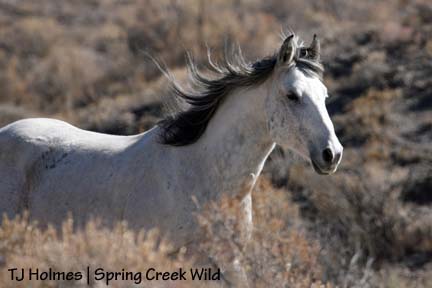
Greeting
He trotted down to the mares and youngsters, the better to protect them.
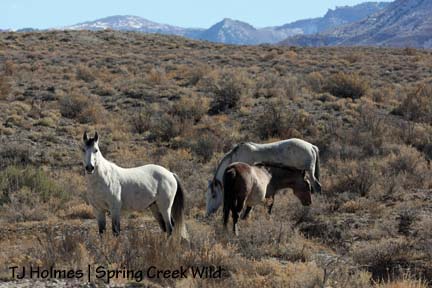
Defending his turf
With Twister and Houdini and a little slice of far background, looking southeastish.
We drove onward to the loop road and took it counter-clockwise. We spotted Bruiser and Cinch between Round Top and Flat Top – closer to FT – napping in the sunshine. It turned out to be a gorgeous day – perfect after the snow earlier in the week. We also spotted the white spot that is Alpha with her compadres up on the roller-coaster ridge. Below them we could see other horses, which I assumed were bachelors until we got closer. The far horses were bachelors, but the horses closest to us were …

Bashful girl
Alegre and Gaia and …
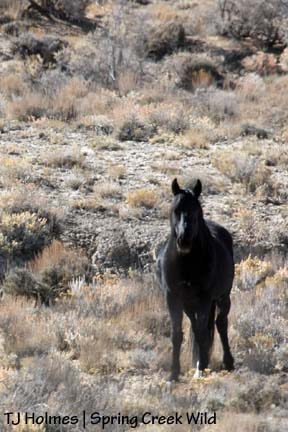
Big Daddy
Bounce.
These were taken through the Jeep’s window; the horses were below the level of the road and just northish of that pond. We drove on until we could see Steeldust’s band through the trees, then parked and got out to walk to them.

Innocents
I took this photo of Storm and Ember – standing right on the road – but then I looked down, and there was Kestrel coming up from a notch in the hill on the other side of the road – right in front of us! And she was followed by Mahogany! We stopped immediately, but they were as surprised as we were and trotted on up to the band, which trotted on down the hill. Roller-coaster ridge earns its name; it’s narrow along most of its length, and you can see right off either side except straight down. We had seen Hollywood lounging in the distance, watching us, hip cocked, and he and his girls were the last to follow. The horses formed into a line on the other side of the ridge heading toward the pond, but we didn’t know at that point if they had already been to water or if they were heading that way anyway.

Roach and Bones
A little farther on, on the southeast side of the ridge that continues after the road drops over the other side, we spotted Poco, Bones and Roach.

Poco
You can see tiny patches of snow behind Poco, remnants from last Tuesday’s storm.
By then, we had seen everybody I expected to see, so we turned around there so we didn’t have to drive over the roughest parts of the loop road and so we could see the horses again on the return trip.

Band at water
This also answered a previous question, when we saw the horses wading into and drinking at the pond. That’s actually Flat Top in the background. Round Top is more southwest from this position. CORRECTION: Bob Ball emailed to say he thought this hill in the background is Round Top, and he’s right. I was thinking of a different pic taken from a different perspective, farther down the road, looking at Flat Top, which is farther from the water hole.

Band at water 2
A zoomed-in look at almost the same image. You can pick out Steeldust, standing in the first image; walking in the second.
We also passed Bounce, Alegre and Gaia a second time, still in about the same place, and Grey/Traveler’s band, who had moved out into the open from the low hills they were on earlier. All the babies were down for naps in the sunshine. The new mares were lower on their hill, but Dale needed to get back. Nice to meet you; hope you visit the ponies again!
The third hunting season ended the day before I got to the basin, and knowing there had been at least two camps at water, I wanted to make sure they had cleaned up after themselves. Californians had been at the trap site, and they did a pretty good job of taking their trash with them. I’m not sure why people think aluminum cans will burn away in the campfire, but I did pick some of those out of the ashes. There were at least two new trails down to Spring Creek – all with hoof prints – but I don’t know if the mares made the trails or if the hunters did and the mares are using them. I headed up the hill to get a look at the girls.

Girl band
They look plenty comfortable where they are.

Grazing
One thing I noticed is that they’re actually eating what grass is there, and by that I mean they seemed to bypass the “shrubs” – the greasewood and four-winged saltbush (names I just learned). I watched the black mare get at the grass (if you can really call it that; it’s very dry and brown and shriveled) at the base of a small greasewood bush, but she didn’t touch the bush. Makes me wonder if they don’t have those plants in Sand Wash Basin? Or never learned to eat them? At that point, I tried to really look at their body conditions, but they still look good. Fuzzy, but I don’t think they’ve lost any weight.
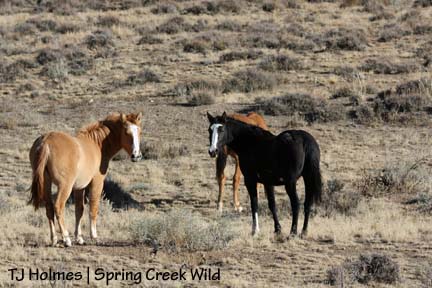
Friendly girls
Here are the apricot dun and black pinto mare, pretty close to each other while the other dun mare grazes ahead of them.
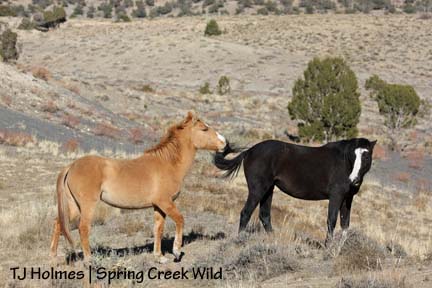
Meanie girl
And here, a few minutes later, black mare gave apricot dun mare a warning sizzle. Sheesh. Black mare definitely has ‘tude!
I was on my way back to the Jeep at that point and figured it was a good time to go ahead and leave them to their own devices.
David Glynn, a frequent visitor to the basin, and his wife, Doris, had pulled in with two horses (Buck and borrowed horse Wally) while I was visiting the girls. I stopped to chat with them, and while we were talking, one truck drove into the basin and one truck drove out. Those were the only vehicles I had seen all day. Traveler’s band had been at the water catchment for a drink then moved out into the open to graze. The folks in the inward-bound truck stopped to watch them, then turned around at the catchment and drove back by for another look. I don’t know what it was about that truck, but Traveler watched it all the way out of the basin.

On guard
He turned his head a couple of times to look at me as I drove by, but mostly he stayed focused on the truck. I took this photo from the road after it curved away from Filly Peak and heads straight to the catchment, and the truck he’s watching was at the far side of that big open area, almost to where it curves out of sight and heads to the entrance.
I went on around to check the camp at Wildcat Spring – which should not have been a camp in my ever-so-humble opinion. I took a bag of trash (mostly cans from the fire pit) away from the camp at the trap site; I took five bags and an old cardboard box away from the Wildcat Spring site. People also had left two elk skins, three legs, the remains of at least three rabbits, two still-full cans of beans, three pairs of socks (?!), more cans in the fire/trash (?) pits and two half-full rolls of toilet paper on a branch near a box topped with a toilet lid (of course I didn’t touch that!), among other things. They had also driven their ATV to and across and alongside the spring AND somehow scooped up mud as a dyke across the water, though not very effectively. Not to mention the previously mentioned (in a previous post) second driveway. Not cool. WAY not cool. Very disappointing.


 Spring Creek Basin Mustangs
TJ,
I was reading your post about the Sand Wash mares not eating the shrubs, specifically, the greasewood and the four-wing saltbush. Both those plants occur in Sand Wash, so I can’t imagine why they wouldn’t be eating them. Maybe there is too much grass yet. There is lots of Nuttall’s saltbush in Sand Wash that gets used pretty hard by all the grazing animals out there. Is there Nuttall’s in Spring Creek?
Funny that the black mare is being so uppity with the apricot dun mare. The dun mare was gathered several miles outside the HMA, having gone through two grazing allotments and fences to get where she was. And she was alone. You could tell she was ready to be around horses again; we pulled up with the contractor’s saddle horses, she appeared instantly on the other side of the fence and trotted up and down the fence. We used a judas horse to lead her through the gate. So, she and the black mare probably didn’t know each other at all prior to their relocation to Spring Creek. Anyway, it looks like they are adjusting well. Love your pictures.
Kathy
Kathy,
Thanks so much for your comments. Wish I could have met you at your gather, but it just turned out to be too much. I don’t know about the Nuttall’s saltbush down here; Bob might know? They could still be finding plenty of grass where they are because not many of our horses had been in that area this year. I just happened to realize while I was watching them last weekend that their grazing patterns seemed more like my domestic horses and not so much like the way the wild horses browse – actually cropping grass low to the ground instead of also picking at the shrubs, if that makes any sense.
Bob did tell us that at least one of the mares had been gathered from off the HMA, but I couldn’t remember which one. She definitely stays close to the other mares, but the black mare is kind of snooty! Ha. Was she with the other dun mare before the gather? Or maybe they made friends in the pens … though the black mare seems more jealous of the dun mare than she even cares about. That “regular” dun mare is pretty easy going. They’re so much fun to watch! They have great personalities.
TJ
TJ,
I will have to check the data sheets to see what day the black mare was gathered and what day the dun mare was gathered. I can’t remember if they came in together, but the HSUS staff that studied them all summer may know. Did you ever get an answer to your question on what the FA stands for? If not, I can enlighten you: the F is for the 6th fertility study, F being the 6th letter of the alphabet, and the A is for the first fertility study of fiscal year 09. So, the next time the BLM uses PZP in 2009, the horses will have an FB brand. We actually didn’t brand the Sand Wash mares because HSUS was confident enough in their photodocumentation data that they would be able to determine which 62 mares got the first dose and give them a second dose. I’m rather happy that we did not brand them as it is not very attractive. The BLM should consider other branding methodology so that it’s a little less obvious, yet still serves it’s purpose of identification.
Have a good weekend of horse watching.
Kathy
Kathy,
I hadn’t gotten such a detailed description of the meaning behind “FA” – thank you! So the sixth fertility study in Sand Wash Basin … or sixth for the Humane Society? Or just the sixth ever for the BLM? And first fertility study of FY 2009 – anywhere within the BLM’s herd management areas? Our mares got “DC” in August 2007, so the fourth fertility study (for the BLM?) and the third that fiscal year? Good information. I think another way to “mark” them would be better, too. I hope the photo documentation would be perfect, but I can see how that information could be lost.
We had a good little meeting with the mares this weekend. The black mare must have known we had been talking about her because she was very obvious in her behavior to keep the dun mare away from the apricot dun mare – really insistent about it! But at one point, the two duns got together and ran for a short distance, kicking up their heels! So much fun to watch them!
TJ