
There’s always one … 🙂
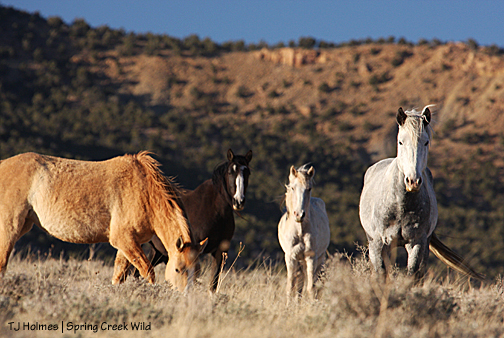
“Photo-horse” – but their ears are all up!
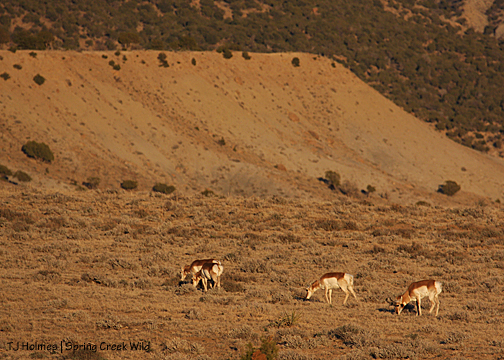
Just to our east, this pronghorn buck (right) and three does.
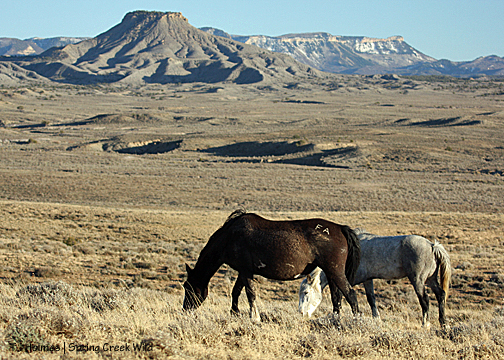
Up on the finger hills with a marvelous view at the end-o-day. The heavily eroded flat-topped “peak” is Brumley Point, in the basin. The far ridges – and yes, that’s still a bit of snow – are not.
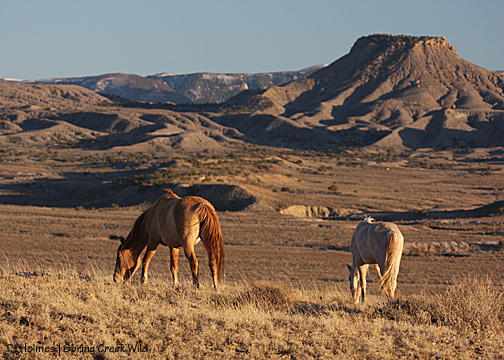
Love that delicious light. They felt no need to pose prettily but carried on with their wild lives. Brumley Point again (don’t you think it was really McKenna that deserved the “point” and Brumley the, well, peak, butte, mesa or hill designation? it reminds me of a high-and-tight cut; don’t ask me why). The low, tree-topped, snaky ridge in the near(er) foreground is what I call the roller-coaster ridge. The horses were already swishing their tails like it was summer. Interesting the little things we associate with certain seasons. I was in a T-shirt still at the end of the day, but it’s not yet summer …
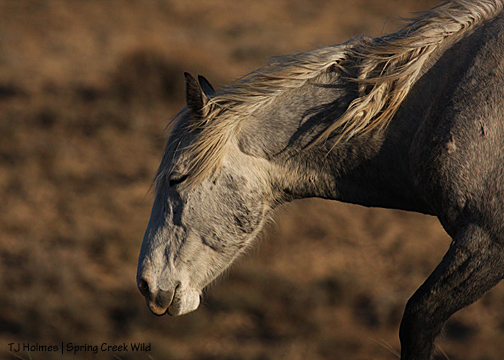
Mr. Kreacher
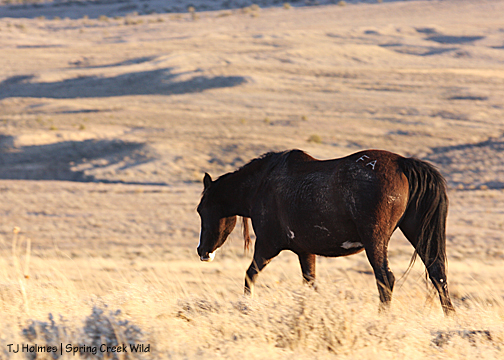
Another PZP-22 success story. No foal last year (like Kootenai), but she looks on track for a spring foal now, eh? And while some of our other girls look a bit scruffy yet, a bit “wintered,” Raven is nearly fat and ready to shine under her spa coating. (The FA brand designates her as part of the October 2008 roundup and PZP-22-receiver from Sand Wash Basin, northwestern Colorado. Kootenai and Mona have the same brand. Our 2007 PZP-22 released mares have a DC brand. Because the horses are so well documented by yours truly, they do not need to be branded to be designated PZP recipients – and we’ll fight hard to ensure that is, in fact, the case.)


 Spring Creek Basin Mustangs
I don’t know how many times I can say “beautiful”!
One thing that isn’t beautiful on any wild horse is an ugly butt brand. I see them in photos of mares in Long Term Holding, and it always disgusts me. I wrote a comment about it a few days ago, and thought I’d share it with you.
“I received a story about an abused Mustang mare this morning (3/31/11), and I want to comment re: butt brands.
This is a gorgeous mare. What person in their right mind would disfigure her? I couldn’t get the Houston SPCA link to work, but, hopefully, this one will: http://www.houstonspca.org/site/News2?page=NewsArticle&id=17937
“I’m sure those enormous, ugly brands make the mares easier to spot, but I wonder what visitors to sanctuaries (especially children) are going to think when they see these beautiful horses so horribly marked. I guess if a mare lives long enough, she could have not only a number, but also quite an alphabet on her rump!
“My point is, if a mare MUST be identified beyond her normal freeze brand, can’t the BLM come up with something smaller and more ATTRACTIVE? Maybe a basic symbol that could be modified when the mare is PZPed? Do these numbers and letters have to be seen from outer space? And what’s with the big Sale Authority “U”. Do these people all need glasses?
“Question: If a member of the general public wanted to buy a SA mare (all other things being equal) do you think they would choose the one who’s butt is marked with huge numbers and letters?
“If the BLM sincerely wants Mustangs to be adopted or sold to good homes, they should do everything possible to make those horses attractive to the public. And a Mustang (of any age or sex) isn’t “unadoptable”. It just hasn’t been adopted. Not everything is based on statistics!”
Agreed. Saying a mustang is “unadoptable” is like saying a child is “unteachable.” I find that “label” repugnant, and I also agree with you from the adoption side. I don’t know whether the mares that stayed in Sand Wash Basin were so branded? I haven’t seen any in pictures, and I keep forgetting to ask. (Those mares have been photographically documented by HSUS as well as many folks now advocating for them.)
You might ask why the mares that came to Spring Creek Basin were branded. In October 2008, my documentation of the Spring Creek Basin mustangs was well-known to BLM … and BLM knew I would be in the basin upon arrival of the mares to photograph/document their release here. I still wonder that …
BLM’s own “SOP” (standard operating procedure) about PZP says the horses do NOT need to be branded if they’re documented by photographs – as Spring Creek Basin mustangs clearly are.
Well, good questions/thoughts but, all are rhetorical, unfortunately. The BLM (in our opinion) doesn’t seem to have a common “SOP” – they do whatever strikes them at the time and no, we don’t believe they think things through about hoping/asking folks to adopt a mustang from a holding facility with such ugly brands. Most of them don’t care as long as *the animal* is gone…
The problem seems to be that although BLM DOES, in fact, HAVE this document (and others), neither the agency in general nor its employees at specific sites always follow it. When we brought it to the attention of our BLM, we were told, “Don’t tell BLM what’s in its memos – it knows.” Um. And yet we’re still waiting for a decision about fertility control, though the memo clearly says:
“It is the policy of the Bureau of Land Management (BLM) to apply fertility control as a component of all gathers unless there is a compelling management reason not to do so.”
There’s EVERY COMPELLING REASON *TO* DO SO … And there’s every compelling reason to do it in Spring Creek Basin, and there’s every compelling reason to LIMIT the “gathers” by doing so.
“All treated mares will be freeze-marked with two 3.5-inch letters on the left hip for treatment tracking purposes. **The only exception to this requirement is when each treated mare can be clearly and specifically identified through photographs.**” (Emphasis mine.)
“12. All mares targeted for treatment will be clearly identifiable through photographs to enable researchers and HMA managers to positively identify the animals during the research project and at the time of removal during subsequent gathers.”
From BLM’s memo/SOP straight to execution of said exception. 🙂
The first two quotes are from BLM’s March 2009 memo “Population-level fertility control field trials” and is listed on the blog roll as “BLM PZP policy.” The quote that starts with the number 12 is from BLM’s “Attachment 1: Standard operating procedures [SOP] for population-level fertility control treatments.” It’s in my original proposal as a reference, and I just added it to the blog roll as “BLM SOP for fertility control.”
So it’s all there, and despite being told BLM knows what’s in these documents, it’s a good reminder – at least to let BLM know WE know.
BLM has had to become marketers of mustangs and burros – and you’re right, it’s not very good at it – because neither marketing nor education is part of the agency’s mission. Groups like the Mustang Heritage Foundation have helped fill a marketing role with the popular Extreme Mustang Makeover series. Groups like the Colorado chapter of the National Mustang Association fill an educational role here. 🙂
And to touch on your last comment: It is extremely hard to get most BLM personnel to even say “the horse” or “the horses” – and forget about them calling the horses “mustangs.” It’s usually “head” or “animals” (as you said) or “the resource.” The last one particularly galls me because BLM is specifically supposed to be protecting “the resources” on the public lands it manages, and yet the horses are usually NOT seen as a “resource” but as a pest. (In some of my conversations, more concern has been displayed about “50-plus-year-old trash” on public lands than the horses …) It’s such an “interesting” widespread “phenomenon” that I have to think it’s something they’re instructed to do.
I am soooo fed up with our government! Not just the BLM … every agency. The “top” may have Laws, Rules, Regulations, and SOPs, but neither the “bottom” nor any of the “in-betweens” seem to be required (or even inclined) to comply. It’s like every level is it’s own fiefdom!
When I read the 2007 Spring Creek EA and Gather Plan, many things didn’t make sense. There also seemed to be some “It’s too hard!” whining, especially about water trapping. Wouldn’t bait trapping be different?
One thing that frosted me was: “No observable effects associated with these impacts would be expected within one month of release EXCEPT a heightened shyness toward human contact, vehicles, HELICOPTERS, etc.” I’ve read reports by a number of adopters who say their horses have NEVER been able to tolerate helicopters, or any low-flying aircraft. They just freak out!
Another thing that jumped out, because of the recent Antelope Gather: “All traps and holding facilities shall be oval or round in design, with no 90º corners.” I saw photos of Sun J traps that were rectangular, with horses “stuck” in the corners. Plus many horses were forced directly from the traps into trailers (no loading chutes or ramps involved), regardless of age or sex, and were sorted off-site.
Sun J got about half of the 2011 contracts, because they were the low bidder. Like all low bidders, they’re pushing things to the limit and beyond, and getting away with it!
GRRRRR!!!
BTW, Twin Peaks will be allowed to stay at high AML BECAUSE of PZP and that wierd 60/40 ratio. At least for now.
Again, agreed … I’ve heard many times – from many different sources (BLM and otherwise) – that there is no cohesion within the agency: Things are sort of “suggested,” but individual offices do what they want and ignore the rest. I can’t tell you how many times I’ve heard the reference about each being its own little fiefdom (and witnessed the reality of such)! But I think it’s important to be on top of this kind of thing, and we’ve consistently pushed that “national BLM” is doing such and such – why isn’t it/why can’t it being/be done here? If no one knows to hold BLM to its own standards, it’s easier to get away with “what it wants to do.”
I’m going to touch on your second point lightly … BLM does helicopter roundups – and calls them humane – because they’re fast and, “by head,” cheaper. But fast is never a good thing when it comes to working with animals, horses OR mustangs, specifically. And overall, by my math, it’s actually more expensive – and it certainly adds up in holding expenses!
Last summer – three years after our last roundup, a helicopter flew low over the basin, and I witnessed four bands hugely disturbed. I never saw one band again that day, I tracked another band, found another almost entirely by accident at the end of the day and witnessed one band running, running, running, running, until they were completely out of my sight (and I had a long view in that case). Horses are adaptable, yes, but this is a traumatizing event. Only BLM (and its supporters) think it’s humane. Obviously, I completely agree with you here.
The corrals used by Cattoor Livestock in 2007 in Spring Creek Basin were absolutely rectangular. We asked that they be bigger to allow the horses more room to get away from each other and were told they needed to be kept small so the horses couldn’t “get a running start at each other.” Truth? More panels to make corrals bigger cost more and take more time to set up.
How big is the Twin Peaks herd? Were they treated with native PZP or PZP-22? Unless they think the AML there is off, or unless they plan to treat the mares with the goal of stopping reproduction (or making it absolutely equal the number of deaths), that seems odd. I don’t want us to go to the low end of our AML, but neither do I want to leave it at the high end – because then any increase in population puts us at risk of a roundup. We haven’t had many conversations here about gender skewing … but I expect BLM to press it – though I don’t agree with it. I have to say that, with other things, at this point in time, I’m not going to fight that particular battle very hard. It’s not necessary with PZP … and if I can convince BLM of that, I surely will. BLM claimed it skewed the genders in 2007, but it released five mares, a filly and four stallions (and another stallion – Grey/Traveler – later). In reality, the gender ratio WAS skewed. I don’t have my numbers in front of me, but it was something like 10 mature mares to 24 or some stallions. (No documentation at that time, and there’s no way BLM could have known that.) The five mares got the PZP-22 … one died that winter, it didn’t work on three of the remaining four mares (and because of the PZP-22 studies in Sand Wash Basin and Cedar Mountains, we know why). It’s been four years between roundups – BLM will look at that as “hey, look, gender skewing worked.” Unfortunately, I can’t say it didn’t … just that I don’t believe it to be necessary with the use of PZP. In the Pryor Mountain EA, it specifically says the population does NOT need to go to the low end with the use of PZP. We’re going to press that idea here, too.
The October helicopter survey “showed there are now about 790 wild horses and 160 wild burros remaining in the HMA, slightly over the upper limit of the appropriate management level of 448-758 horses and 72-116 burros.”
They released an additional 4 stallions, two mares with colts, two additional mares (treated, but it doesn’t say with what), 11 mules and ONE burro. Hope the oldster quickly found some friendly protection!
So few on 800,000 acres, with good forage and water … very sad.
This is the Press Release:
http://www.blm.gov/ca/st/en/info/newsroom/2011/march/NC1138_twinpeaksrelease.html
Evidently there’s already development on the HMA with much more planned, and at least one pipeline in the works to take water from the aquifer to supply Reno. Hard to tell if that 800,000 acres will be good much longer.
One thing my involvement has taught me is that it’s hard to know about something I haven’t personally seen. However, that area seems – in numbers – like it ought to be able to support more horses (about one horse per 1,000 acres?). I’m not sure BLM is going to give up the herd areas it has already zeroed out … but it should stop – or be stopped – from continuing that process. And where they exist, the horses and burros should be the priority – not oil and gas, not cows, not sheep, not extraction. Obviously, we all agree with this … we all outside BLM. Unfortunately, I don’t see that happening. 😦 Sad, indeed. And neither BLM nor other government agencies will give any credence to the fact – FACT – that equines are native. That would go a LONG way, I’m sure, toward giving mustangs and burros priority on the lands they still occupy.